
A running back who averages 12 points per game doesn't score 12 points in every game. Some games he might score 25 points; in others, he might score only 2. This spread in production—this gap between the expectation and the week-to-week reality—is called "variance".
Starting with the 2014 season, Footballguys tasked me with studying variance to figure out ways to incorporate it into our tools so we could make better recommendations. Since then, it has been a bit of a hobby horse of mine.
I've written a lot about variance over the years, but mostly just focusing on one end of the spectrum: consistency (which is a myth). I always intended that one of these days I would write up the whole range of what I'd learned. And of all these days, it turns out today is one of them.
Everything* Worth Knowing About Variance
*(or, at least, everything I can think of)
We'll start with consistency, since that's what most people think of when they think of variance in fantasy football; they want consistent players who score close to the same total every week rather than inconsistent players, who might have a few big games here and there, but cost you more in the long run with their repeated duds.
The piece I linked above explores these problems in detail. Let's quickly recap them.
1. Consistency isn't valuable.
Simulations of fake leagues and studies of real ones confirm that even massively exaggerated consistency (such as a hypothetical player who scores the same total every week) barely moves the needle in wins and losses. Why? Because most fantasy games aren't close; the average margin of victory depends on your exact league settings, but usually runs 20 points per game or more. The handful of extra points per week from a consistent performer usually just translate to losing by 18 instead of 24 (or to winning by 30 instead of 24).
Also, the idea that a consistent player outscores a similarly productive inconsistent player most weeks holds up only in exaggerated hypotheticals. In real leagues, an inconsistent player is just as likely to post a higher score more often. The example I gave in 2024 was Jahmyr Gibbs, the #2 back in points per game (19.37) and the league's most consistent performer. James Conner, despite being less consistent and less productive (9th overall, 16.73 points per game), still outscored Gibbs in 10 out of 15 games that season.
Conner wasn't inconsistent because he had a lot of bad games mixed in with a few huge ones. He was inconsistent because he had a lot of good games mixed in with a few duds—pretty much the opposite of the profile most people will encourage you to picture when thinking of an "inconsistent" player.
2. Consistency isn't consistent.
In the piece linked above, I looked at the Top 20 running backs in 2023 and 2024 using a measure of consistency called "coefficient of variation", or CV. I then compared each player who appeared on both the 2023 and 2024 lists to see how stable their year-to-year consistency was. The correlation in CVs was only 0.08, meaning consistency in 2023 in that sample explained just 0.6% of the variation in consistency in 2024. Knowing how consistent a back was in one year told you essentially nothing about how consistent he was in the other.
3. Inconsistency isn't cumulative.
If having an inconsistent player were bad, you'd assume having five of them would be worse. But grouping inconsistent players together actually increases their consistency; with enough boom/bust players, you find some players booming every week to cover the ones who inevitably bust. Variance at the player level does not directly translate to variance at the team level—and variance at the team level is what we care about.
So, for all intents and purposes, player-level consistency doesn't matter. Are there any other facts worth knowing about variance? You bet!
4. Different teams want different amounts of variance.
In aggregate, variance is neither a positive nor a negative. But we don't manage the aggregate; we manage a single team.
If you're in a league where the average team scores 150 points per game, and you're the best team in the league with an average score of 180 points per game, you would love for your team to have very little variance. When you're good, it's best to be consistently good.
On the other hand, if you're the worst team in the league with an average score of 120 points per game, you would want your team to have a lot of variance. If you have to be bad, at least be inconsistently bad.
5. You CAN influence your team's variance.
This might seem to contradict point #3 above. You can't create an inconsistent team just by loading up on enough inconsistent players. That doesn't mean you can't create an inconsistent team, though; you can still get there using the magic of covariance. You just need players whose production tends to influence each other.
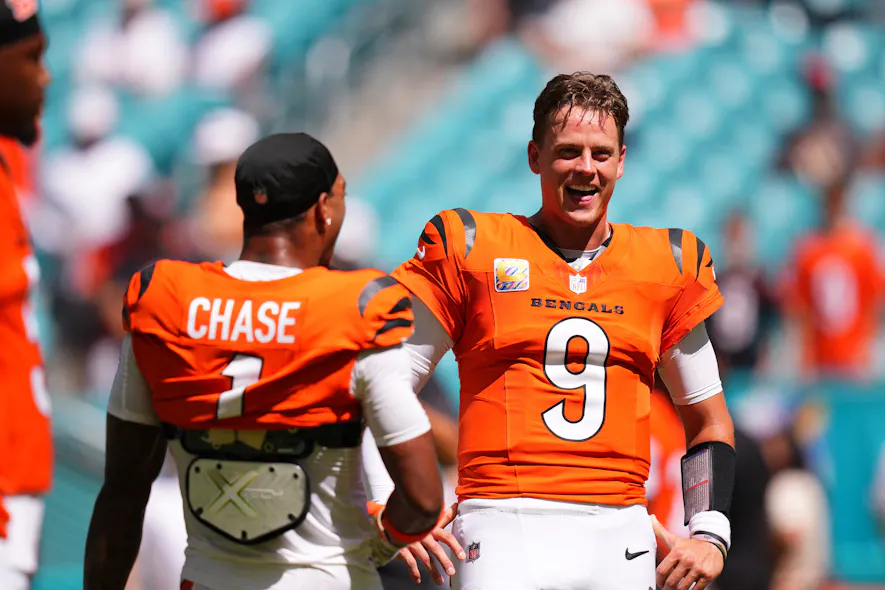
For instance, if you start Jordan Love and Ja'Marr Chase, a big game from one will have no bearing on whether the other has a big game or not. But if you were to start Joe Burrow and Ja'Marr Chase, instead, things change. If Chase goes off for 200 yards and 3 touchdowns, it's very likely that Joe Burrow had a great game, too (you'd expect 200 passing yards and 3 touchdowns at a minimum). If Burrow finishes with 120 passing yards and no scores, Chase likely didn't have a very good week.
Starting a quarterback and wide receiver from the same team increases your team's variance. Starting a wide receiver and a running back from the same team, on the other hand, slightly decreases it.
6. Your opponent's players matter, too!

I said that variance is good if you're a bad team and bad if you're a good one, but it's more accurate to say that it's good if you're an underdog and bad if you're a favorite. If you're the third-best team in the league, you usually won't want a lot of variance, but it'll come in quite handy the weeks you face the #1 team.
And the variance that matters isn't just in your score, but in their score as well. Underdogs want to increase the odds that a big game for their team coincides with a bad game for their opponent. Favorites would prefer otherwise.
You can influence this with cross-lineup variance. If your opponent is starting Joe Burrow and you are starting Ja'Marr Chase, your scores will tend to move in the same direction. That's great if you're favored to win, but terrible if you're not. Often a very smart play when you're a heavy underdog is starting the defense that is facing the opponent's starting QB, even if it's not projected for a lot of points.
The average outcome of the game is already going to be a loss for you; your path to victory generally requires their team to underperform and yours to overperform. So start from the assumption that their team will underperform (because if not, you're probably losing either way) and ask, "If that's the case, what players are most likely to have overperformed?"
(Note that Footballguys' roster-management tools build all of this logic in, which will alter their recommendations if you are a sufficiently large underdog or favorite and display all sources of serial correlation that will impact a given matchup.)
7. Variance is predictable.
This may seem to contradict point #2 above (consistency isn't consistent), but there are in fact several variables that correlate with higher levels of week-to-week inconsistency. Players who average more yards per touch tend to vary more than players who average fewer. Players who get a higher percentage of their production from touchdowns are slightly more volatile. Younger, inexperienced players tend to see higher weekly fluctuations, as do those in uncertain roles (such as committee running backs rather than workhorses).
8. ...make that *sort of* predictable.
The above effects are all real, but the effect size is fairly small. When I was projecting variance by hand before we automated it in the tools, I'd put the most volatile players down for about 30% more expected variance than average. Even knowing as much as we can, the vast majority of weekly fluctuations are still just randomness.
9. "Variance" operates on two different timescales.
So far we've been talking about weekly variance, but there's also variance in season-long production. (Some would argue about the appropriateness of using statistical modeling for one-off events, but from my perspective, variance was always nothing more than "deviation from the projected total", so it made sense to treat both types the same.)
From a weekly perspective, variance is typically referred to as "consistency". At the season-long level, it's more commonly discussed as "upside".
10. Season-long variance is two-tailed.
Variance covers deviations from expectations in both directions. When fantasy players chase upside, they like to imagine "one-tailed" distributions: the bottom and middle of the range of possibilities are very tightly clustered, but there's a juicy long tail of possibility where everything breaks right for the player, and he becomes a league-winner. In my experience, these kinds of distributions don't really exist; the range of possibilities tends to be fairly symmetric, and "upside" is offset by commensurate "downside".
11. Also, "upside" should be defined.
Kurt Warner was a former grocery store bag boy who was thrust into the starting lineup after a preseason injury to the starter; he went on to win league MVP. Cooper Kupp was a former third-round pick who had yet to make a Pro Bowl through four seasons. He led the league in targets, receptions, receiving yards, receiving touchdowns, and receiving first downs and was named Offensive Player of the Year.
Warner proved that any unproven second- or third-string quarterback's "upside", as far as we know, is breaking records and winning MVPs. Kupp proved that any fifth-round fantasy pick is capable of putting up one of the greatest seasons we've ever seen. If this is what we mean by upside, then upside as a concept is meaningless.
When I projected upside, I defined my target as "the 90th percentile in a player's range of possible outcomes". That made it easy to check my work after the season: if 90% of players underperformed my projections and 10% exceeded them, my projections were well-calibrated.
Unless someone has made their benchmark clear, treat claims that this player or that one has high upside as meaningless.
12. Season-long variance is an unalloyed good.
Unlike weekly variance, which some teams want and others would rather avoid, season-long variance is purely positive. Fantasy leagues are structured so that finishing at the top of the distribution is disproportionately valuable; alternating 1st- and 12th-place finishes is better than alternating 6th- and 7th-place finishes. This is especially true in dynasty, where 12th place is rewarded with the top pick in the next rookie draft.
Also, you can leverage covariance to alter your season-long variance profile just as easily as your weekly one.
13. After all of this, variance is still massively subordinate to production.
If one player scores meaningfully more points than another, it essentially doesn't matter who is higher variance and who is lower. Scoring points is the most important thing in fantasy, and the players who do that the most are the most valuable.
Variance, in its various forms, operates at the margins. It matters. But not much.
Follow @AdamHarstad Follow @Footballguys