

Jadan Baugh Fits This Iteration of NFL Offenses
The NFL is forever locked in a punch-counterpunch dynamic between offense and defense. For years, the Spread Offense Era limited the ground game with RPOs, screens, and vertical passing that suggested: "Running Backs Didn't Matter."
There still may be truth to the underlying message that running backs rarely deserve high NFL Draft capital. It's one of the most punishing positions in the sport, and the lifespan at the position is often short. The role also supports having multiple runners who do different things well.
Then there are backs like Jadan Baugh. Florida's starting running back, Baugh has the burgeoning skills to develop into an every-down back who can pound a defense into submission between the tackles, reach the perimeter with quickness and footwork, and do damage in the open field and in the passing game.
Jadan Baugh has good but not great speed. His acceleration appears compelling enough that he can hold off defenders in the secondary.
If this is the case when he reaches the NFL, Jadan Baugh could become a feature back and a top-end starter. If not, Baugh still has the skills to become a lead back or a productive fantasy starter in a 50/50 backfield.
With the league rolling with heavy offensive sets to counter years of opposing defenses playing light and small to deal with the spread game. Now, defenses are paying the bill that has come due, and Jadan Baugh can charge interest.
The Rookie Scouting Portfolio
If you know about the RSP and my process, skip to Jadan Baugh's Depth of Talent assessment or his film in the final two sections of this article. Otherwise, read on, because you'll gain a better understanding of a resource that has been pleasantly shocking readers since 2006...
The RSP -- The Rookie Scouting Portfolio -- is preparing for its 22st season of publication. If you're not familiar, you can go here to buy the 2027 publication at a pre-sale discount beginning this Friday, November 27. In fact, you can go right now and do it before I announce it elsewhere.
You can also use the link to learn about the pre-draft publication available every April 1, the post-draft publication included with the purchase, and my dynasty rankings and projections package, which is a separate service.
The pre-sale ordering period at a discount usually lasts a month. Most returning subscribers -- and you should know that most new subscribers become long-time subscribers -- wait until I end the discount period because they already believe what I offer for the money is a big discount.
This scouting report of Jadan Baugh will give you a small taste of what you get with the RSP. We'll begin with the game tracking.
I try to make the RSP's process as transparent as possible. It's a process that multiple scouts and analytics professionals working directly for NFL GMs have praised. One in particular, who has an extensive background in both arenas, told me back in 2011 that the process was "light years ahead" of the NFL's system for evaluating film.
We're not talking about my skill as a scout, but the method for defining, tracking, and scoring prospects, and the continuous improvement philosophy baked into the process.
Here's Jadan Baugh's Game Charting that I've done thus far. This is the first section of an extensive checklist of defined and weighted criteria that I use to grade a player.
One thing that stands out with the Rookie Scouting Portfolio's tracking of running backs is the emphasis on studying power and contact balance in a more accurate context. Yards After Contact (YAC) is prone to misleading data.
I realized this when studying Nick Chubb and Saquon Barkley. Both are powerful backs, but determining who had more power and contact balance based on YAC made zero sense.
While Barkley may have earned more YAC than Chubb in college, imagine this scenario. Barkley gets slapped on the thigh on his way to a 75-yard gain. Chubb runs through a defensive end's wrap of his knee in the backfield, and then Chubb bounces off a linebacker's head-on collision to carry two more defenders forward for 6 yards.
Barkley got a lot more yards, but yardage is the wrong number to track. If Jadan Baugh ran through Maxx Crosby's head-on hit at the two-yard line for a touchdown while Saquon Barkley ran through a feather-duster slap from a cornerback on a sweep for 38 yards, who cares about 2 vs. 38 when judging power?
It's like YAC apologists telling you McDonald's has better-quality meat than the French Laundry because it sells more units. The better number is broken tackles separated by the defender's position and the tackle technique attempted.
Jadan Baugh running through a defensive lineman's hit is a more impressive display of power than Barkley running through a cornerback's slap to the knee or ankle (a reach) without fully getting a two-handed grasp (wrap). The RSP uses the same concept for eluding defenders for the same reason -- making the defender miss is the signal, but how many yards a runner got for making a defender miss is noise.

You can see that Jadan Baugh has legitimate power just by the fact that he has earned success bouncing off hits against all three levels of defenders. This is uncommon. Most NFL running backs only bounce off hits from defensive backs and certain hits from linebackers, and Jadan Baugh is accomplishing above and beyond that expectation.
Jadan Baugh is also bouncing off a lot of reaches. This is the expectation for a good power runner, because reaches are the easiest tackle type to defeat because they are incomplete tackles due to poor form, or because the defender can't earn a good enough angle on the runner to wrap up.
Wraps are the toughest tackle to break. Most running backs don't break many wraps -- even the most powerful runners because the form is good. This is why you see Jadan Baugh's numbers as a tackle-breaker are much better with reaches and hits than wraps.
Breaking a wrap or reach and moving a pile are strong indications of power. Bouncing off hits are a strong indicator of contact balance.
Here's the rest of the checklist. I'm not going to do much explaining with the rest of these pictures. You'll see categories with criteria and weight scores. You'll also see whether Jadan Baugh performed these criteria.
If he didn't, he either didn't show he could do it, or he didn't perform it in a satisfactory fashion. I'll provide this context in Jadan Baugh's written scouting report and in other sections of the RSP.

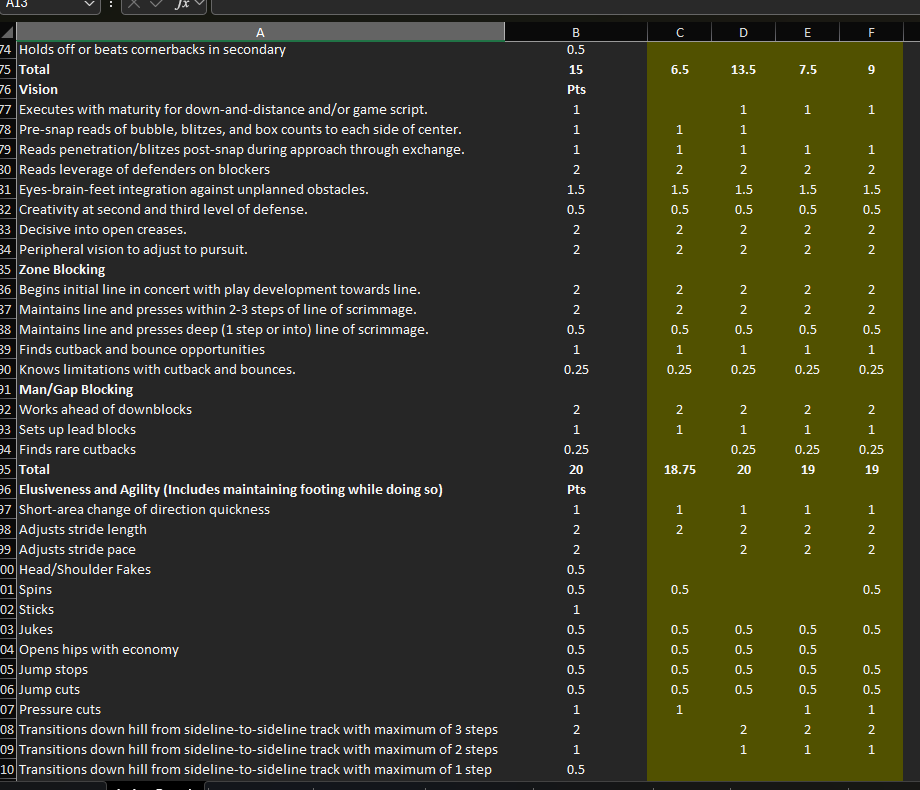
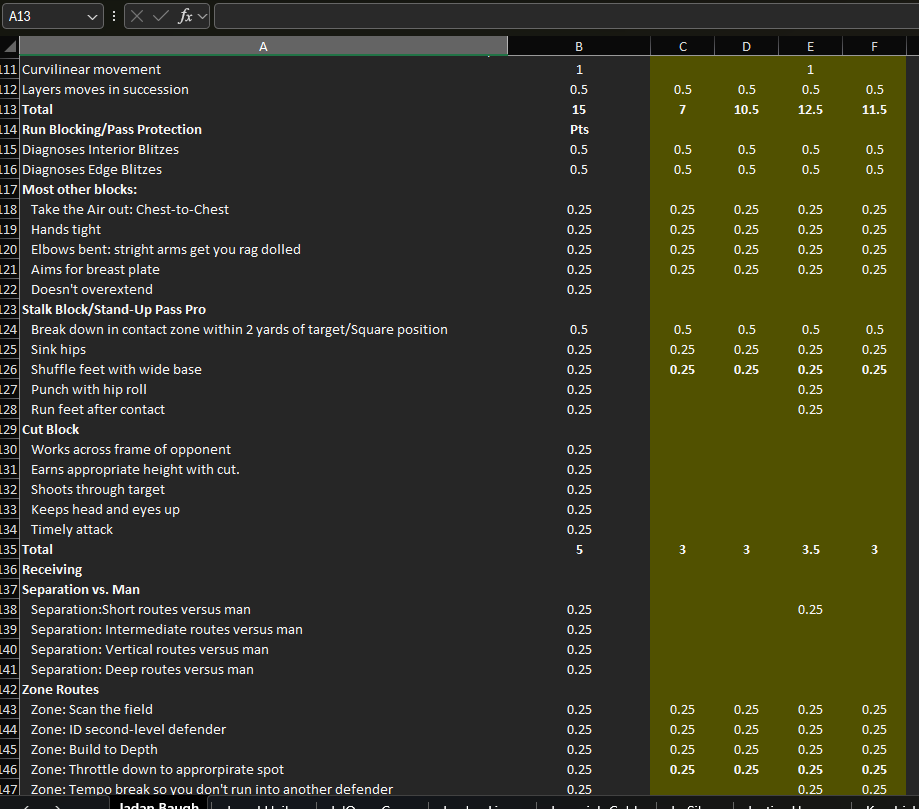


As you can see, this is an extensive list of what's expected from Jadan Baugh as a running back. This checklist of criteria is a list of basic running back skills that formulate my Breadth of Talent Score.
I take all the games and create one score based on what they've done in all of the games. All my grades are on a 100-point scale, and I provide a key that explains the ranges and what they mean for a player's current skill set and potential development. Breadth of Talent tells the reader how many basic skills a prospect displays that a team might seek from a running back.
Jadan Baugh's Breadth of Talent Score is 90.125 out of 100. This is an excellent score and indicates that Baugh has enough basic skills to contribute to a team and likely in a variety of running back roles if called upon.