
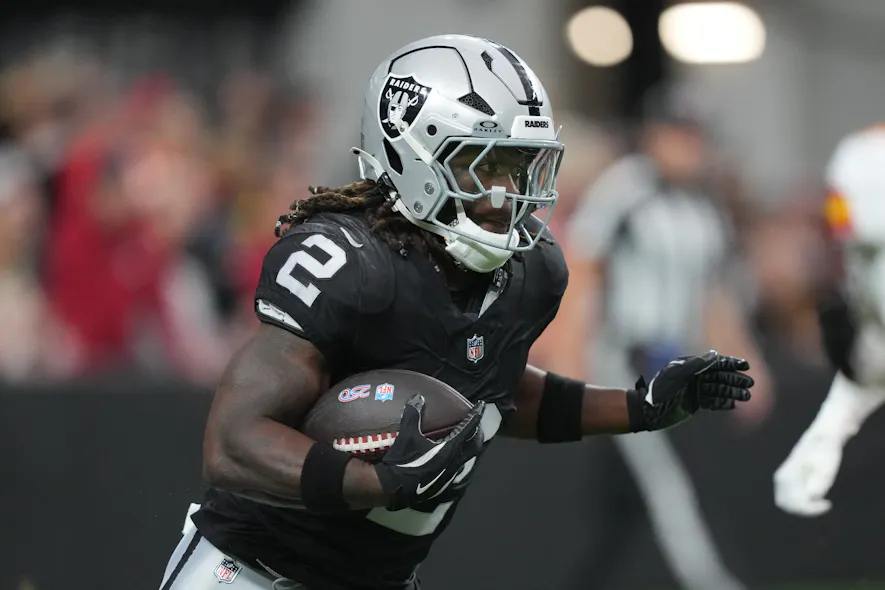
RELATED: See all of our 2026 Player Spotlights here
From "Disappointing" RB1 Last Year to League Winner This Year
Every season, fantasy managers obsess over the "sophomore leap," which is that distinct archetype of a highly-touted second-year running back you can't wait to plug into your RB1 slot on draft day. This year, that player is Ashton Jeanty, and he is primed for a top-three overall finish in 2026.
DON'T MISS OUT: Sign up for our free, daily newsletter here.
If you drafted Jeanty as a rookie, the disappointment depended entirely on your league's scoring. He went off the board at an ADP of RB6 and finished as the PPR RB11, so in points-per-reception formats he basically finished a half tier below expectation. That's not a bust; that's a fair-value rookie season.
Standard leagues were a different story. Same RB6 ADP, but he limped in at RB15, a steep miss for a top-six pick. The gap tells you exactly what happened: his 55 receptions did a lot of heavy lifting to prop up his PPR line, masking a ground game that the broken Raiders offense never let breathe.
The context matters here. The Raiders' offense was an absolute trainwreck last season, averaging a league-worst 14.2 points per game. Even the Cleveland Browns managed to score two more points per game than Las Vegas. The fact that Jeanty salvaged a top-seven PPR finish inside that total structural gridlock tells you everything you need to know about his floor. In a more efficient 2026 offense, his ceiling is massive.
Bijan Robinson offers a useful historical blueprint for exactly what we're looking at. Robinson increased his fantasy production by a whopping 35% in PPR from Year 1 to Year 2. The two backs posted remarkably similar rushing totals as rookies, putting an identical sophomore jump well within Jeanty's reach.
Bijan Robinson's Fantasy Production from Year One to Year Two
| Season | PPR Points | PPR Per Game |
|---|---|---|
| 2023 (Rookie) | 252.3 | 14.8 |
| 2024 (Year 2) | 339.7 | 20.0 |
| Improvement | +34.6% | +34.6% |
Bijan Robinson's 14.8 rookie PPG sits right alongside Jeanty's 14.4, making an identical leap a clean comp.
The Klint Kubiak & Rick Dennison Volume Engine
To fix this stagnation, Las Vegas cleared out the short-term fixes and built a coaching staff centered on long-term stability. The Raiders landed Klint Kubiak the moment he stepped off the field as a Super Bowl champion, fresh off engineering Seattle's title-winning offense, a unit that finished third in the NFL in scoring at 28.4 points per game in 2025. That's the same Kubiak who took Sam Darnold, a former bust, and turned him into a Pro Bowler and a champion. The front office prioritized a play-caller with deep roots in the Shanahan-Kubiak wide-zone system, then paired him with veteran offensive line coach Rick Dennison to anchor the installation. Now working together on their fourth different NFL franchise, this duo provides immediate, structural continuity to a young unit that desperately needs an identity.
That identity will be built on raw ground volume. In 2025, the Raiders' rushing attack hit absolute rock bottom, finishing dead last in rushing yards and rushing touchdowns, and second-to-last in rushing attempts. Kubiak and Dennison were specifically hired to correct that passive approach and establish a physical run game.
When these two coach an offense together, establishing the run isn't a goal; it's a mathematical certainty.
Team Rushing Volume: Kubiak & Dennison History
Historical data across their shared coaching stops shows a heavy, unyielding commitment to team rushing attempts:
| Team & Season | Rushing Attempts Per Game |
|---|---|
| Minnesota (2019) | 29.8 |
| Minnesota (2020) | 29.3 |
| Minnesota (2021) | 26.4 |
| New Orleans (2024) | 26.1 |
| Seattle (2025) | 29.8 |
| Overall Average | 28.2 |
Jeanty averaged just 15.6 rushing attempts per game last season. Given the new staff's historical team baseline of 28.3 carries, projecting a realistic bump of three to four additional carries per game for Jeanty is completely reasonable. That added volume transforms his weekly projection before we even talk about efficiency.
A True Three-Down Workhorse
Raw carries are only half the battle; Jeanty's elite pass-catching traits are what unlock overall RB1 upside. He caught 55 passes as a rookie, showing he doesn't need to leave the field. Throughout his career, Kubiak has consistently spoon-fed his running backs targets to generate easy, on-schedule yardage.
| Season | Team | RB Receptions |
|---|---|---|
| 2021 | Minnesota Vikings | 94 |
| 2024 | New Orleans Saints | 97 |
| 2025 | Seattle Seahawks | 53 |
| Average | 81.3 |
Kubiak's system averages 81.3 backfield receptions per year since 2021. If those usage patterns hold true in Las Vegas, Jeanty should easily challenge the 60-reception mark in 2026.
The coaching staff isn't hiding their intentions either. They've already publicly floated Christian McCaffrey's offensive snap share as the benchmark role Jeanty could earn. McCaffrey played 83% of his team's offensive snaps in 2025. If Jeanty reaches that elite tier of utilization, his fantasy ceiling becomes astronomical.
The quarterback dynamics reinforce this perfectly. Fernando Mendoza is the franchise's future, but he'll spend his rookie season on the sidelines as long as Kirk Cousins plays reasonably well. That's a gift for a pass-catching back, because Cousins has been one of the league's most committed short-area throwers for years, not just recently.
Kirk Cousins Short-Yardage Passing Depth (2021-2025)
| Year | Overall Pass Attempts | 0-9 Yards | Behind LOS | % Short |
|---|---|---|---|---|
| 2021 | 445 | 238 | 89 | 73.5% |
| 2022 | 621 | 306 | 95 | 64.6% |
| 2023 | 293 | 146 | 46 | 65.5% |
| 2024 | 412 | 184 | 72 | 62.1% |
| 2025 | 249 | 110 | 53 | 65.5% |
| Average | 66.3% |
Roughly two-thirds of Cousins' attempts have traveled nine yards or fewer over the last five seasons. Checkdowns are built straight into the progression of a Kubiak offense as efficient outlets, and Cousins has spent much of his career feeding them. We saw this exact dynamic elevate Bijan Robinson, who averaged a hefty 4.5 receptions per game during Weeks 12 to 18 last season with Cousins at quarterback.
Combine that passing volume with the installation of a wide-zone scheme. The system stretches defenses horizontally and forces defenders into terrible angles. Jeanty's vision and horizontal agility leave him well-positioned to exploit cutback lanes, identical to how Ken Walker III and Christian McCaffrey have dominated in similar structures.
Defensive Gravity and Red-Zone Dominance
The biggest threat to a high-volume running back is facing stacked boxes. Fortunately, Jeanty shares the field with Brock Bowers. Bowers is an elite vertical chess piece who forces defensive coordinators to account for him before they can commit extra defenders to the box. This structural spacing allows the coaches to get Jeanty into the open field with momentum.
Once he's there, he creates for himself. Jeanty finished among the top five in the NFL with 61 forced missed tackles last season. He's doubled down on that contact balance this offseason, incorporating boxing into his training regimen to further sharpen his reaction time.
When the Raiders get inside the 20, Jeanty completely hogs the football. Even inside last year's broken offense, he logged 44 red-zone touches, accounting for nearly 90% of the team's entire running back total. The next closest back on the roster had exactly five red zone touches.
Where things get exciting is combining Jeanty's workhorse role with Kubiak's tendency to give running backs more work in the red zone than the average NFL offense.