
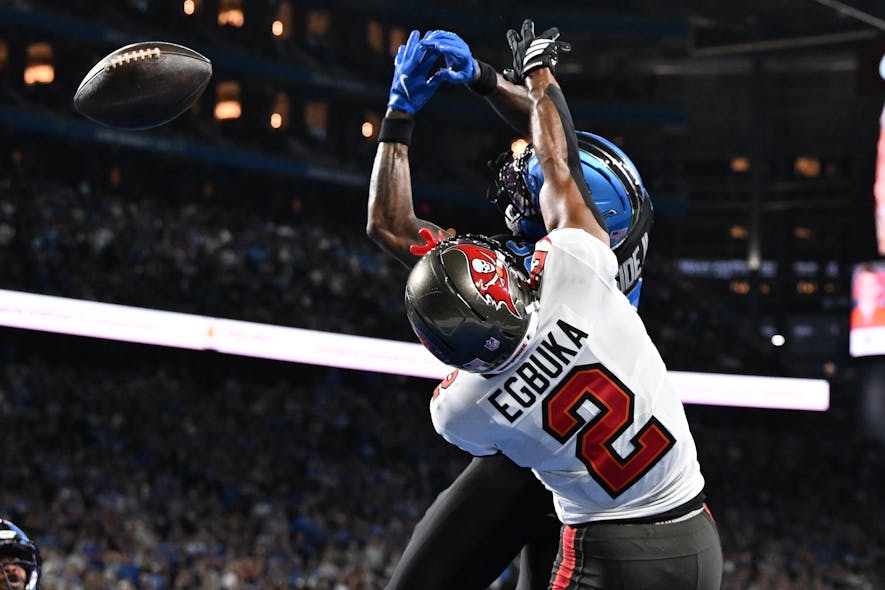
Emeka Egbuka Has Dropped the Ball for Fantasy GMs
Fantasy football's WR15 in PPR formats this year, Emeka Egbuka was WR6 after the first seven weeks. Since then, the rookie has been WR36, barely startable in some formats.
Drops have been a part of the problem; Egbuka has eight, according to the game charters I accessed. For additional context, Emeka Egbuka has 23 catches for 279 yards and a score from Weeks 8-14 and 5 drops during that span.
We've seen a precipitous decline for Emeka Egbuka, who, I was told, was the best rookie receiver in this class, and everyone should have seen it coming. For the past seven weeks, Jayden Higgins and Tetairoa McMillan might have something to say about that.
Chimere Dike has emerged from the shadows and is nipping at Egbuka's heels during this same span. For the past four weeks, Dike and Luther Burden III were top-36 fantasy receivers. Emeka Egbuka? WR50.
If you use drops to judge a receiver, Emeka Egbuka is on his way to earning a pejorative label with his game. It might not be a fair assessment. This week, we take a deeper look into Egbuka, his drops, and the broader context of his fantasy decline since Week 7.
Pre-NFL Draft Assessment of Emeka Egbuka
I gave Emeka Egbuka an immediate starter grade in the pre-draft version of the 2025 Rookie Scouting Portfolio -- now through December 22nd, you can pre-order the 2026 RSP at an insane discount of $19.95 -- earning a score of 85.6.
I compared Emeka Egbuka stylistically to an aspiring Puka Nacua. It's not a shocker that Egbuka wound up in a system that has roots with the Rams' offense, and Egbuka earned Nacua's role in that system.
When charting five of Egbuka's college games, he caught 38 balls and 3 drops -- 1 was a pinpoint-accurate pass, while the other 2 had catchable accuracy against defender contact.
When grading Emeka Egbuka's receiving techniques and concepts to the defined standards I have in the RSP, here's what I thought of his work:
The Elevator Pitch: Egbuka has starter skills, but his game is limited to specific roles within an offense. He’s a flanker or future slot receiver whose best work is in open space.
Match Emeka Egbuka with linear routes that work across the field at a variety of depths, and he can deliver a lot of production because of his value as a runner after the catch. Ask Egbuka to spend most of his time working timing routes against tight man-to-man coverage, win consistently at the boundary, and earn contested catches, and there’s potential for disappointment.
This is the difference between Egbuka’s game belonging on the continuum of Puka Nacua’s and having Nacua’s skills and talents. Egbuka's game is in the same city, but not the same neighborhood.
Emeka Egbuka opts for the wrong attack of targets and allows the ball into his frame when there’s no need to do so. He’s often unprepared to use the correct attack for targets that aren’t pinpoint accurate, but reasonably catchable.
This behavior impacts his effectiveness with targets against tight coverage and contested plays requiring athletic adjustments. These targets occur most often against man coverage, timing routes, and plays at the boundary.
Emeka Egbuka’s timing routes lack sharp detail at the break point. It leads him to drift out of breaks and gives good cover corners the angle to break up targets.
Egbuka will thrive as an outlet receiver who catches short passes in space and wins intermediate and deep targets on slower-developing routes across the middle of the field. Yes, he’ll have some victories with timing routes and contested plays on vertical routes, but it’s likely you’ll see his share of struggles there, too.
With continued work, Emeka Egbuka might find himself in the Nacua’s neighborhood of skills. Right now? That’s a projection.
Here's what I specifically wrote about his tracking and catching of the ball:
Pass Tracking: He tracks the ball effectively over his shoulder as well as behind his back shoulder while still breaking downhill. He leaves his feet unnecessarily for targets at his chest, where he’s using underhand attack.
Hands/Catch Radius: Emeka Egbuka can catch the ball at thigh level, working away from the ball with underhand position. He can extend fully with underhand position to earn the ball. He highpoints effectively.
He has lapses with attack position, using underhand position with targets arriving at chest and shoulder height. He’s not prepared to use the correct attack when targets arrive behind his anticipated break path, and he has dropped balls because of it. Even as a senior, he opts for underhand attack and allows the ball into his frame when he has every reason to attack at the earliest point and gain a step as a runner.
Overall, Emeka Egbuka looked like a starter prospect, but there would be a learning curve on the job. Sometimes that curve is steep early in the season, sometimes it gets much steeper as the season progresses.