
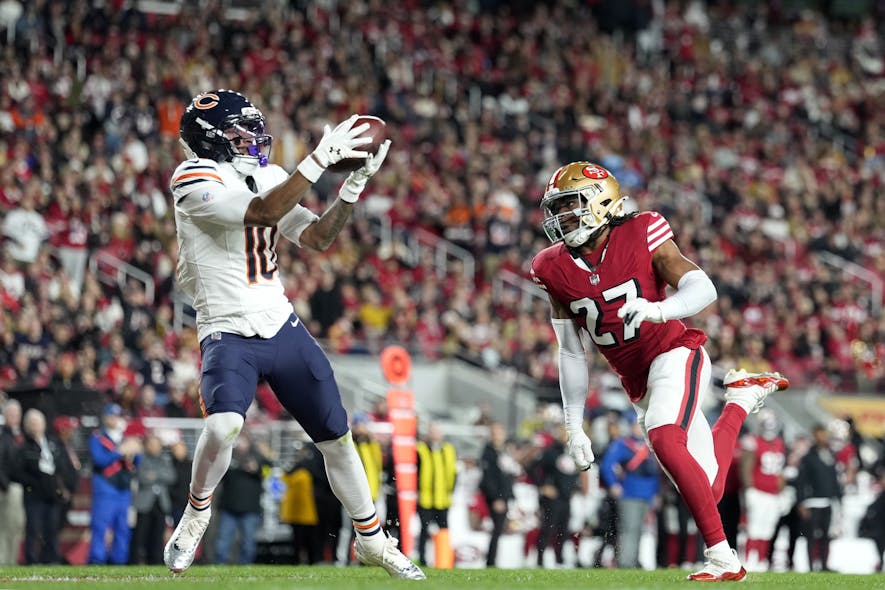
I was much higher on Luther Burden III than the consensus this summer, and my reasons were similar to why I was higher than the consensus about Ladd McConkey in 2024. The results didn't pan out this year, and I'll discuss the real reasons why, but I'm doubling down on Burden in 2026.
This week, I'm taking sections from last summer's article on Burden, updating some of these points, and building on them with Burden's tape from the 49ers game. The end result of what I've seen from Burden leads to a bullish prediction:
Burden will not only prove that he was the best rookie receiver of the 2025 class, but he will also become the Chicago Bears' passing production leader in 2026.
While I was wrong about projecting immediate fantasy success for Burden, the rationale was correct. My thoughts on rookie receiver fits are rooted in a 21-year-old process that has aged well in recent years.
A.J. Brown, Justin Jefferson, Ja'Marr Chase, Jaylen Waddle, and Chris Olave were all players I had higher than the consensus. I specifically labeled Brown, Jefferson, Chase, and Olave as players with the best team fit among their peers and most likely to deliver strong production immediately. Even Jayden Reed and Jordan Addison were higher on my board than most.
And as we saw with Michael Wilson and Alec Pierce this year, some RSP favorites needed more time or a better opportunity.
Luther Burden III is a talent on par with the top-15 receivers in the NFL, but his skills and fit were misunderstood. Many did the same with Brown and Jefferson, labeling them bad fits. They got sucked into the same myths about receivers that we're seeing about Burden.
Just as I didn't overreact to Chase's drops during training camp, I wasn't going to overreact to Luther Burden III going to baseball games with his teammates and throwing out the first pitch while nursing hamstring and oblique injuries.
Between this report and a character-assassination piece on Caleb Williams—a feature that should be used in Journalism 101 classes around the country to teach incoming students how not to source interview subjects—the analysis of Chicago's players was absurd.
Luther Burden III Fits Ben Johnson's Lead WR Archetype
The analysis myths surrounding Luther Burden III this summer were rampant. Although Burden didn't earn the production I expected, the public bought into incorrect reasons why Burden wouldn't succeed early:
- There were too many mouths to feed.
- Caleb Williams was unproven, and he couldn't support multiple options.
- Burden was a gadget player based on college usage and efficiencies.
Long-term, the process is more important than the results. Buying into these myths would have prevented you from buying into Colston Loveland and Williams, as well as remaining closed off to Burden when it mattered most.
I recommended Luther Burden III over multiple starters in fantasy championships this week when answering start-sit questions. Burden was an impactful play in this year's most important week.
This was something I also expected last spring:
What If the Hammy Fails Him?
If Luther Burden III can't stay healthy enough for a reliable role to begin the year, Moore will earn 3-5 of the 7 targets per game that I'm projecting to Burden. This will at least be the case until Burden proves mentally and physically ready for a larger role.
If Luther Burden III proves as much, that fantasy WR20 projection may not hit for the entire season, but it will hit for the weeks with the most gravity for the fantasy season.
Burden has been WR20 since Week 9.
Getting the process right matters. It's why I recommended you buy into McConkey in 2024, despite him being knocked for his limited college production and his lack of history as a primary option in Georgia's offense.
Data collection can miss vital context about a player's skills translating to the pros and his potential fit with a new scheme. It's vital to project a player's techniques, knowledge of positional concepts, and athletic ability to the NFL.
This is what I did with all of the receivers listed above, including Luther Burden III. Let's examine the bulleted list of myths as they relate to Burden. We're going to work backward.
Myth No. 1: Luther Burden III Was A Gadget Player...Busted
There was NFL Draft and fantasy analysis from winter and spring that compared Burden's production profile to Wan'Dale Robinson and Mecole Hardman. Luther Burden III earned a lot of quick-hitting targets at or behind the line of scrimmage at Missouri, so it tracked that an incomplete analysis would arrive at these comparisons.
(As an aside, Robinson had a career-year and deserves credit that he can offer more the gadget production, but it only came his way due to Malik Nabers' injury.)
Burden's college production made it difficult for data analysts to develop a clear profile of Luther Burden III's skills beyond this narrow scope of use. What people failed to see was that this issue was more about the limits of their analysis and shouldn't have been conflated with the limits of Luther Burden III's game.
Most of you are old enough to remember that A.J. Brown was a slot receiver at Ole Miss and Justin Jefferson manned the slot at LSU. Analysts undervalued both players based on their roles, failing to adequately document the skills that extend beyond the results.
Tracking production, breakout seasons, route success, and draft capital are all valuable layers of studying a player. If you're not analyzing release processes, route stems and breaks, uncovering against defenders, and comparing man-to-man routes vs. zone routes, there's a significant risk of missing the underlying foundation for projecting a player's success.
With a large enough sample, data analysis can gloss over this missing context and, sometimes, get more right than wrong, proclaiming success. Analysts hope these processes are baked into the results. When they are, they don't have to understand the tools of wide receiver play that make or break the player's game.
This approach is good enough to allow you to color within the lines of safe decision-making because a large enough sample can encompass enough "good play" to bake the process into the results. When you follow safe decision-making, you're less likely to be a big loser in fantasy football.
If you stay within the lines too much and don't consider compelling scenarios to step outside, you're also less likely to be a big winner. There are areas of the draft where it's safer to avoid the consensus because everyone is thinking alike. In competitive endeavors, you win by fitting in.
Luther Burden III's data screamed dink-and-dunk and/or gadget archetypes like Robinson, Mecole Hardman, and Tavon Austin. If you took that data as gospel, you might as well have seen smoke on Instagram while scanning your phone during previews in a movie theater and screamed FIRE!!!!
None of these three gadgets arrived in the league with complete games when it came to routes or their work at the point of the catch.
Luther Burden III was a far more complete route runner than characterized, and his speed, as predicted, translated to the vertical game. Burden demonstrated position-specific techniques and concepts on film that some data analysts couldn't quantify due to sample size, but these skills led to route success beyond the gadget game.
- He repeatedly beat cornerbacks aligned at the line of scrimmage on vertical routes.
- He stacked (cuts off their paths to control the route) defenders early or late in routes.
- He used effective changes in pacing and takes angles to enforce a defender's position to set up breaks.
- He used his head and eyes at the top of routes to bait defenders playing over the top.
- His breaks were tight and sharp, with the snap to create angles of separation that defenders couldn't cut off.
- He could drop his weight into breaks against tight coverage, and it led to effective separation.
Receivers like Luther Burden III don't perform these techniques by accident and occasionally get right once. These weren't false positives based on the study of results. These are true positives based on the study of the process.
Luther Burden III's route skills, speed, ability to adjust with his quarterback, and pass-tracking made him a legitimate intermediate and vertical threat.