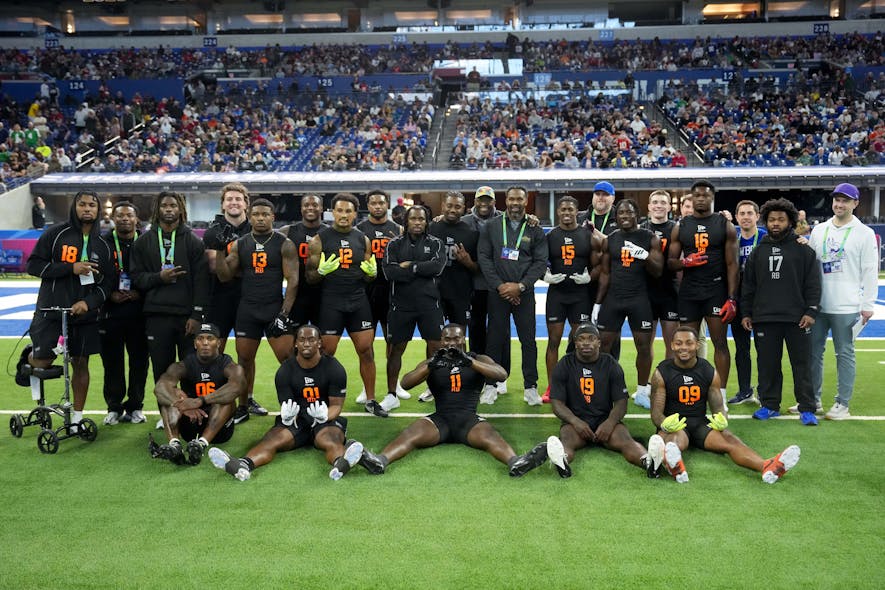
We're in a new era of the NFL Draft. Incoming rookies used to show up to the NFL Combine in Indianapolis ready to prove themselves among their peers. Today, prospects pick and choose which drills will make them look best. Many weigh in at the combine and do strength and explosion drills, and then strategically wait until their pro day to lose a few pounds and run their speed and agility drills.
The two combine drills that have the strongest correlation to running back production are the three-cone drill and the shuttle. This year, among 21 invites, we received a total of five results from those two drills. The broad jump has the third-strongest correlation to production among combine drills. Just 11 running backs participated. The 40-yard dash, while having almost no predictive expectations for NFL production, garners the interest of fans and media more than any other drill. Less than half of the invited running backs participated in that drill. For those nerds (me) who were waiting for athletic testing from these incoming running backs, it seemed like their time came and went in the blink of an eye on Saturday.
Running backs are starting to realize that a bad combine performance can do more harm than good.
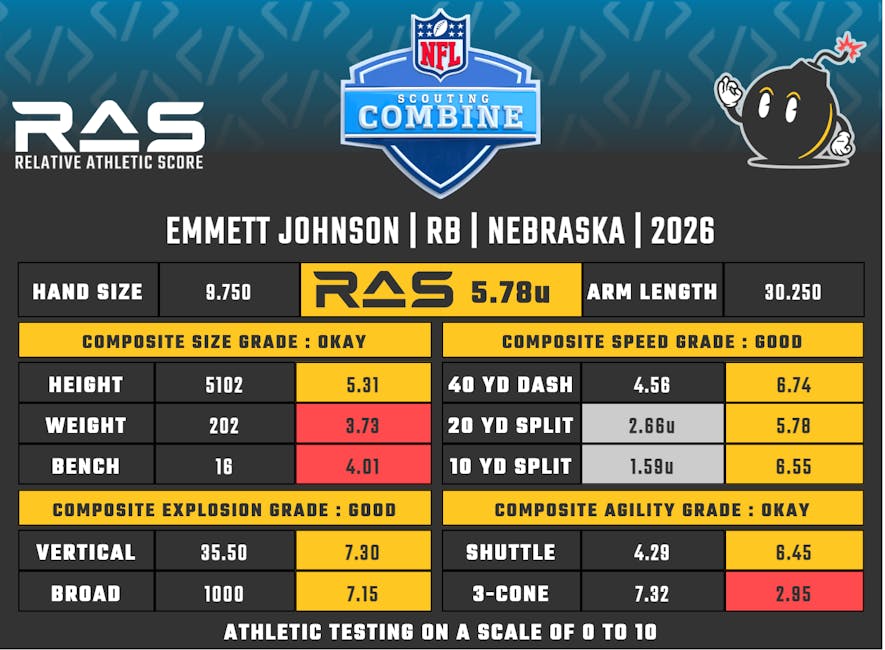
Let's look at Emmett Johnson. Of the nine running backs who did enough at the combine to qualify for Relative Athletic Score, he ranked the worst, with a score of 5.78. To put that into perspective, that means his testing puts him inside the 57.8th percentile of all incoming running backs since 1987. He didn't test poorly. He just didn't hide. He was the only running back to run the three-cone drill. And of the four to do the shuttle, he turned in the best time. Despite not being a muscular back, he showed up on Sunday to bench press, putting up fewer reps than any other running back. While many people will see his yellow chart and knock him for being "unathletic," it's hard not to see his willingness to participate as endearing, possibly a signal of his competitiveness.
Now, let's look at Mike Washington Jr. He logged a 10.00 Relative Athletic Score, the best a prospect could possibly get. Of 2,115 running backs in the Relative Athletic Score database, Washington sits atop them all. He showed up in Indianapolis a whopping 223 pounds. He clocked elite marks in the broad jump and vertical jump. He ran a 40-yard dash in 4.33 seconds, best among all running backs. And then he put his sweatpants on and called it a weekend.
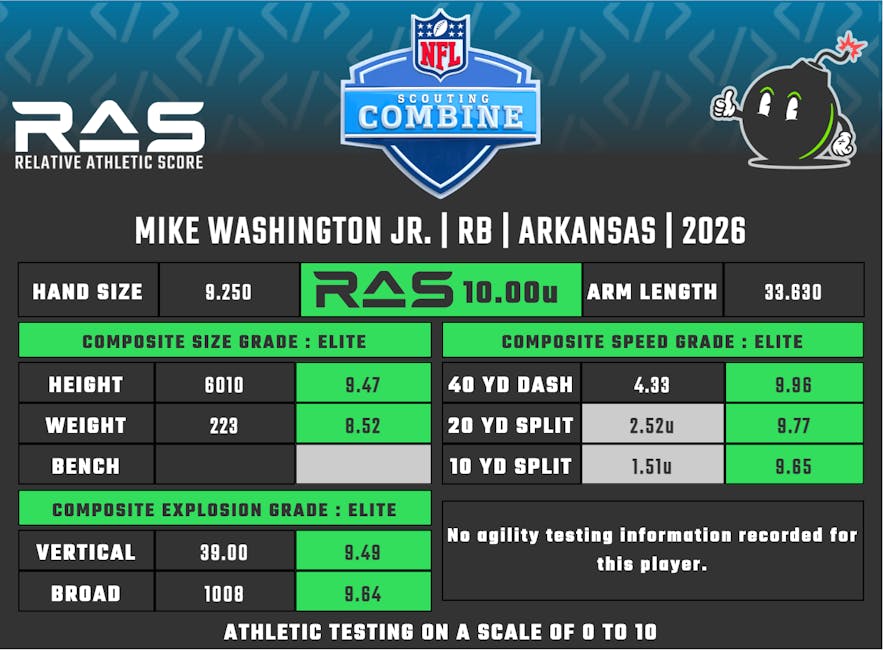
He could have showcased his abilities in the three-cone, shuttle, and bench press drills. But what's the point? Washington could have only negatively impacted his draft stock from those drills. Washington is a muscular back with elite burst and straight-line speed. The questions on his profile concern his lateral agility, and he likely knew that those scores would affect his overall athleticism grade. So he made a business decision.
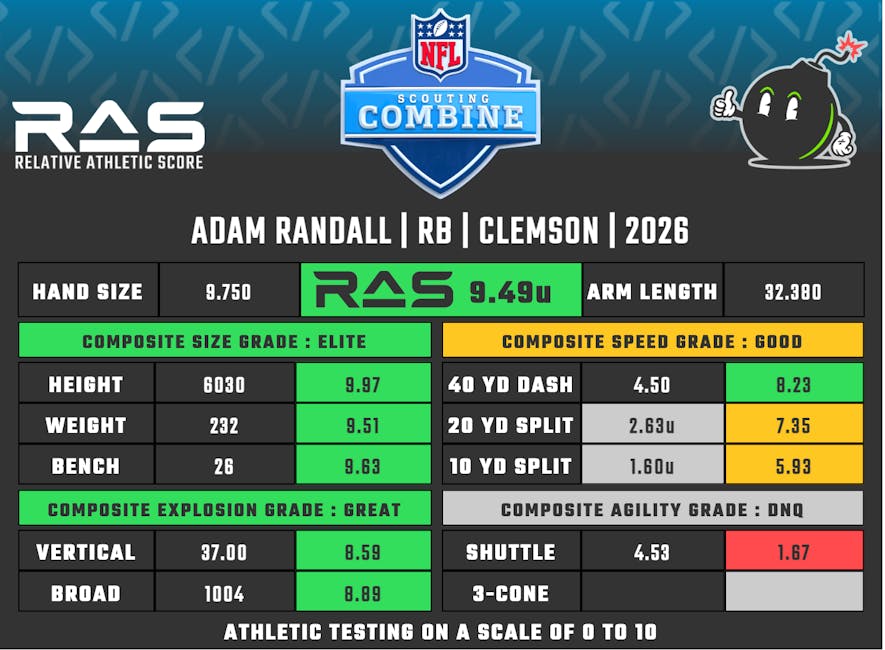
Adam Randall was another running back who knew what he had to do. Big, muscular, fast, and explosive, he chose to weigh in, jump, and run the 40 on Saturday. After a poor shuttle performance, Randall opted not to run the three-cone. Knowing he had uncanny strength, however, he improved his Relative Athletic Score with a position-best 26 reps on the bench press.
You get the points. Athletes are strategically picking the drills they know will most improve their draft stock and avoiding those that may hurt it.
And then there were running backs who just didn't test at all.
Nicholas Singleton broke his foot at a Senior Bowl practice, so he's excused. Le'Veon Moss is managing an ankle injury and said he wants to wait until Texas A&M's pro day, where he can be fully healthy. Desmond Reid is also getting healthy. But what about Kaytron Allen? Jonah Coleman? These are perceived top guys in the draft who just decided not to test. What happened to the competitive vigor that used to headline this weekend?
Because of how prospect testing has changed, looking through combine "winners" and "losers" has become a much more nuanced exercise. Luckily, this year's class was small enough that we could just look at every player individually.