
Quick links to all positions: DLs | LBs | DBs | DTs & CBs
For a long time, defensive linemen were the trickiest position in IDP drafts. The reason was good ol' positional scarcity. With 3-4 edge rushers classified as linebackers by many fantasy providers, the talent pool on the defensive line was easily the shallowest of any defensive position. In 12-team IDP leagues that start a pair of D-linemen, there just weren't enough reliable weekly starters to go around.
DON'T MISS OUT: Sign up for our free, daily newsletter here.
Thankfully, times have changed.
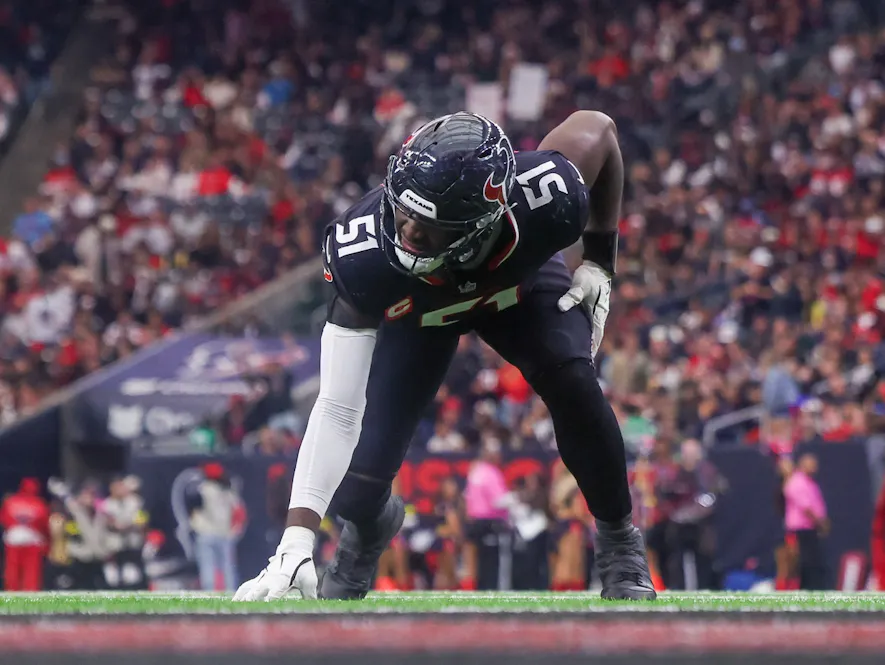
With the advent of "True Position," most IDP providers now classify players like Pittsburgh Steelers edge rusher T.J. Watt as a defensive lineman, just like 4-3 ends like Will Anderson Jr of the Houston Texans. It's as it should be—the players may line up differently, but their role is the same—murder the quarterback.
Preferably on the other team.
Now, there are more options available to fantasy managers on draft day. More options means more potentially successful strategies—more ways to build the proverbial mousetrap.
Of course, just because there are more avenues when it comes to IDP Draft Strategy on the defensive line doesn't mean there isn't still a best road to take. A path to victory in 2026.
And here's the roadmap.
Defensive Linemen Draft Strategy
There's a major caveat with draft strategy on the defensive line—know your scoring.
In tackle-heavy IDP formats, defensive linemen lose value relative to linebackers. In The Huddle IDP Expert League in 2025 (a fairly standard setup), Los Angeles Rams edge rusher Myles Garrett was fifth in fantasy points among defenders. But he was just one of two defensive linemen who cracked the top 25.
Conversely, in The King's Classic Butkus Division (where the IDP scoring is—robust), Garrett wasn't just the highest-scoring IDP. He was the No. 1 player overall. Four of the top-10 IDPs were defensive linemen. There will be defensive players selected in Round 1 there.
With that said, there's a draft strategy on the defensive line that can be effective whether managers are playing in a "starter kit" IDP league or with a bunch of hardcore degenerates like in Butkus. And it's fairly simple.
Step 1 is acquiring an anchor for the defensive line—grabbing an elite, high-end option I can rely on week in and week out. Preferably a top-five guy. It's going to take a fairly significant investment—one of your first few defensive selections. But it's worth it to have a lineman managers can just plug in on a weekly basis and watch them destroy everything.
Step 2 can be a little trickier, because scoring and draft flow can muddy the waters. But more often than not, it's worth to be relatively aggressive when drafting a second weekly starter.
If managers can get a second starter ranked in the top 15 or so at a reasonable cost, that's great. A second starter in the top 10 is awesome sauce. The more consistency fantasy teams have on the defensive line, the lower the odds of a week where the position nets you like three points--and gets you beat.
What's that reasonable cost? It's impossible to definitively pin down. There are too many variables. Lineup requirements. Scoring. The flow of an individual draft. But there's a cutoff point where IDP managers should want to have both weekly starters rostered.
With that said, the added depth on the defensive line brought about by True Position affords some flexibility. If the value on draft day is on offense or at linebacker, there's another tier of defensive linemen who have a legitimate chance to finish inside the top 24. That's a group best targeted for the No.1 reserve, but no plan survives contact with the enemy.
The more draft capital invested in starters, the more patient IDP managers can theoretically be drafting those reserves, although having one you can start without doing a shot of Fireball is a good idea. But don't get too hung up on depth--in a fairly standard IDP setup with two DL starters, carrying more than four really isn't needed.
The Importance of Tiers
IDP rankings are great, but they can also be misleading. The drop from one player to the next isn't linear. There could be essentially no difference in value between No. 12 and No. 13, but a much wider gap between No. 20 and No. 21.
That's where tiers come in--grouping similarly ranked players together. Instead of targeting an individual, IDP managers target a group. Have your DL1 by the end of Tier X. Your DL2 by the end of Tier Y, and so on and so forth.
Guess what's coming next?
Tier 1: There Can Be Only One
| Rank | Player | Team | 2025 Finish |
|---|---|---|---|
| 1 | Myles Garrett | LAR | DL1 |
So, um, Garrett had himself a year in 2025, bringing home his second Defensive Player of the Year award in three years. Garrett tied a career-high with 60 total tackles, led the league in tackles for loss for the second straight year, and broke the single-season sack record with 23—on a defensive line in Cleveland where he was doubled constantly. Now that he's on a Rams line that features Byron Young, Braden Fiske and Kobie Turner, Garrett could be the first player in NFL history to amass 20 sacks in back-to-back seasons.
Tier 2: Solid DL1
| Rank | Player | Team | 2025 Finish |
|---|---|---|---|
| 2 | Will Anderson Jr | HOU | DL7 |
| 3 | Aidan Hutchinson | DET | DL3 |
| 4 | Maxx Crosby | LV | DL5 |
| 5 | Danielle Hunter | HOU | DL6 |
| 6 | Nik Bonitto | DEN | DL10 |
| 7 | T.J. Watt | PIT | DL13 |
| 8 | Byron Young | LAR | DL4 |
Tier 2 is larger this year than last year, if only because Garrett is a tier unto himself in 2026. But as you can see, it also appears to be a relatively "safe" group of IDP options—the only player in the tier who finished outside the top 12 last season in The Godfather's Default IDP Scoring was Watt, and he had his lung punctured by a trainer late last season.
If there's a defensive lineman who unseats Garrett as the top option at the position, he's going to come from this tier. So long as IDP managers have their No. 1 starter on the line by the end of this tier, they should enter the 2026 campaign rollin'.