
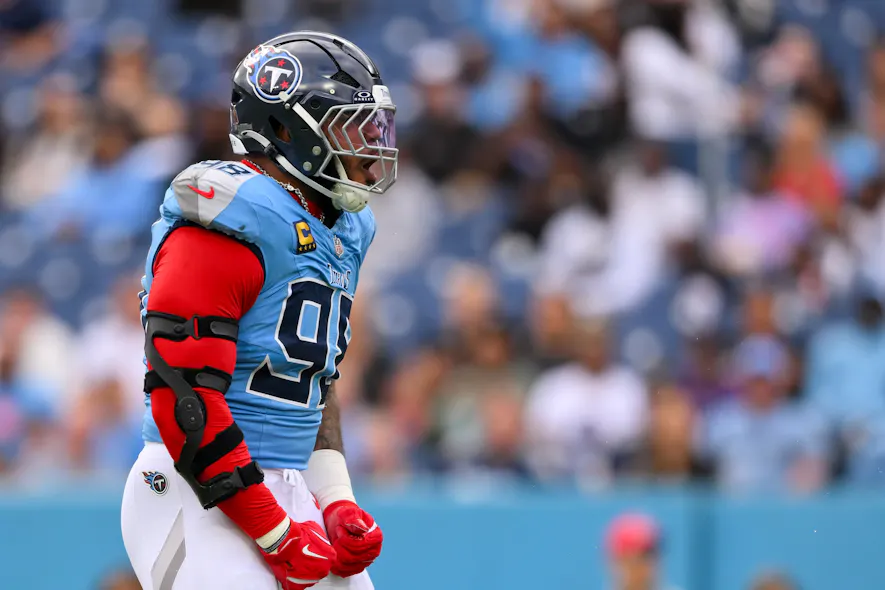
Quick links to all positions: DLs | LBs | DBs | DTs & CBs
In the majority of IDP leagues, defensive linemen aren't separated into defensive ends (or edge-rushers) and defensive tackles. Defensive backs are not broken down into safeties and cornerbacks. As a rule, that makes most defensive tackles cornerbacks of little value in that format.
DON'T MISS OUT: Sign up for our free, daily newsletter here.
However, in hardcore IDP leagues like Deathmatch and the King's Classic Butkus Division (Or the Fantasy Football Oasis IDP Brouhaha, which is for charity and open to all—just saying.), defensive linemen are split into edge-rushers (DE) and interior linemen (DT). Defensive backs are broken down into cornerbacks and safeties. At least one starter is required at cornerback and defensive tackle each and every week.
Both positions are wildly high-variance--especially cornerbacks. But any position IDP managers have to start players at is an opportunity to get an edge--an advantage that could mean the difference between victory and defeat. Between dropping the hammer or getting a beatdown.
The latter is no fun.
No one likes to be a punching bag, so in an effort to avoid being Marvis Frazier in the season to come, as we conclude the 2026 IDP Position Primer series here at Footballguys, we'll do so by examining the defensive tackles and cornerbacks—the optimal draft strategies for both positions and the top options available this year.
Gotta be thorough, after all.
Defensive Tackle Draft Strategy
For many years, there was a prevailing draft strategy where drafting defensive tackles was concerned--"AD or Bust."
For a stretch, Aaron Donald of the Rams wasn't just the top defensive tackle. He was the No. 1 option at the position by a sizable margin. IDP managers had two choices--pay retail for the future Hall of Famer or wait for a secondary option.
Now, however, things are more complicated—even with Donald reportedly considering a return to the NFL after the Rams traded for edge-rusher Myles Garrett. There's no clear-cut top option at the position, and the player we think will lead all big uglies in fantasy points rarely does. Last year, the first tackle drafted in the Butkus Division (DeForest Buckner of the Colts) missed a significant chunk of the season and finished outside the top-12 tackles. The highest-scoring defensive tackle (Tennessee's Jeffery Simmons) came off the board five full rounds later.
Neither is especially weird, whether it's the top option failing to match his draft price or an unexpected tackle claiming the top spot. It's equally unlikely that Simmons will repeat as the top DT in 2026--the last time a player notched back-to-back DT1 finishes was the aforementioned Aaron Donald in 2019 and 2020.
He was a game-wrecker.
There also hasn't been a big gap in scoring between "elite" defensive tackles and low-end weekly starters in recent years--at least in many scoring systems. Over the past three seasons, the gap between the "best" weekly starter (DT1) and "worst" weekly starter (DT12) in The Godfather's Default IDP Scoring hasn't been more than three fantasy points per game.
Given those realities, a measure of patience at defensive tackle isn't the worst idea ever. This isn't to say that being the last manager to draft a starter, especially if your league starts multiple tackles. But in leagues that start just one, IDP drafters don't have to reach for an elite option at the position to be fine on the interior. The "edge" in points per game may not be worth the cost even if you do hit on a tackle, and with "True Position" becoming the norm in IDP and 3-4 ends being classified as tackles, the position is deeper than ever.
The Importance of Tiers
IDP rankings are great, but they can also be misleading. The drop from one player to the next isn't linear. There could be essentially no difference between No. 12 and No. 13, but a much wider difference between No. 20 and No. 21.
That's where tiers come in--grouping similarly ranked players together. Instead of targeting an individual, IDP managers target a group. Have your DT1 by the end of Tier X. Have your DT2 (if necessary) by the end of Tier Y, and so on and so forth.
Defensive Tackle Tiers
Tier 1: The Elite Options
| Rank | Player | Team | 2025 Finish |
|---|---|---|---|
| 1 | Jeffery Simmons | TEN | DT1 |
| 2 | Kobie Turner | LAR | DT8 |
| 3 | Derrick Brown | CAR | DT4 |
| 4 | DeForest Buckner | IND | DT24 |
| 5 | Quinnen Williams | NYJ | DT17 |
This quintet of consistent veterans does offer an appealing fantasy floor at a position where variance is more the rule than the exception—provided they stay healthy. Buckner was unable to do so a year ago, but he was fourth in fantasy points per game while he was out there. However, these names carry price tags to match in many drafts. The best value may be Kobie Turner of the Rams, who has posted three solid seasons to open his career but has yet to have a true statistical "breakout" season.
Tier 2: The Rest of the DT1
| Rank | Player | Team | 2025 Finish |
|---|---|---|---|
| 6 | Leonard Williams | SEA | DT7 |
| 7 | Zach Allen | DEN | DT18 |
| 8 | Zach Sieler | MIA | DT13 |
| 9 | Cameron Heyward | PIT | DT5 |
| 10 | Dexter Lawrence II | CIN | DT77 |
| 11 | Jalen Carter | PHI | DT40 |
Is there more risk involved in Tier 2? Yes—with the exception of Philadelphia's Jalen Carter, most of this bunch is aging veterans, some of whom are coming off injury-marred seasons. But there's also elite upside—a Tier 2 tackle finishing in the top spot wouldn't be a huge upset. The tackles in this tier will also be available multiple rounds after the first few tackles are drafted, whether it's because of age or a down season in 2025.
Recency bias can lead to value.
Tier 3: Do You Feel Lucky?
Continue reading this content with a ELITE subscription.
An ELITE subscription is required to access content for IDP (individual defensive players) leagues. If this league is not a IDP (individual defensive players) league, you can edit your leagues here.