
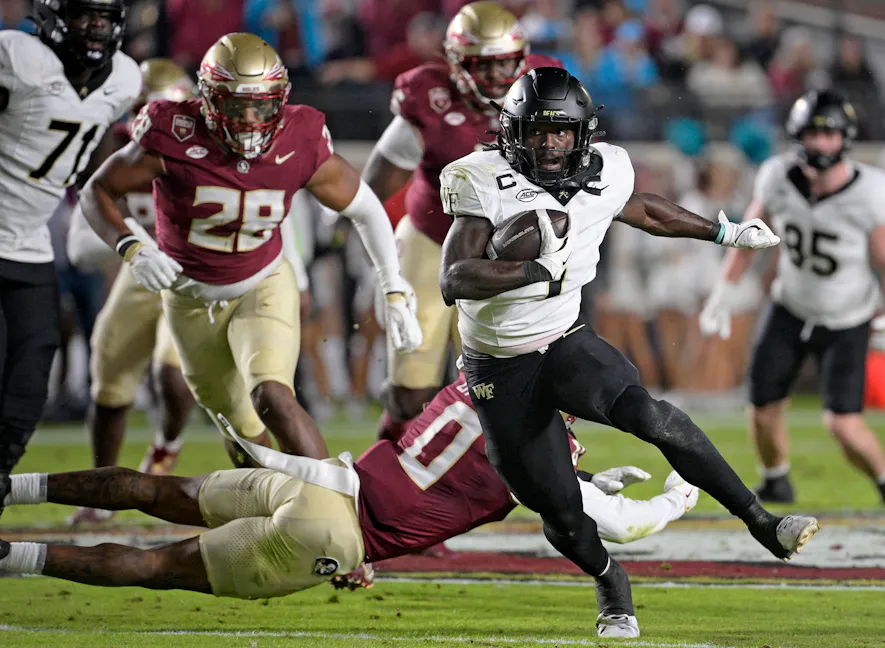
Demond Claiborne: There's A Lot That's Shady About This Late Pick
#Vikings RB Aaron Jones Sr. says rookie Demond Claiborne’s speed reminds him of Jahmyr Gibbs:
— VikingzFanPage (@vikingzfanpage) June 10, 2026
“Honestly, it looks a little like Jahmyr Gibbs in terms of that speed and burst.” pic.twitter.com/rhZPJCcRU2
The general public will view the statement with healthy skepticism. On the surface, it appears logical that they see this buzz as shady.
DON'T MISS OUT: Sign up for our free, daily newsletter here.
Demond Claiborne is a sixth-round pick in the 2026 NFL Draft; he weighs 188 pounds, and his breakaway/explosive run metrics were never impressive. At the same time, everything I've heard the general public say along these lines is superficial.
Running Back is one of the least understood positions in football, but most of the public believes it's one of the most straightforward. Even veteran scouts and personnel executives often reduce the demands of the position to athletic explosion and intuition.
There are corners of enlightened thinking. Former Vikings GM Rick Spielman told Kevin Clark in an interview that the closer a player is to the middle of the field, the more they must process information with speed, accuracy, and confidence.
Successful processing requires reading and reacting at the speed of instinct. It looks intuitive, and eventually, it becomes intuitive, but it's learned behavior.
Running backs like Demond Claiborne weren't born to be play the position. That's romanticized sports journalism nonsense.
There's no official curriculum for learning the position, but there's a process. Successful running backs ingrain the best practices of the position.
They imitate past stars. They filter what works for them and cast aside what doesn't. Then, they refine their knowledge and application through the trial and error of game reps and film study.
As they learn the nuances of blocking schemes and defenses, the best running backs develop diagnostic and game-management maturity. Confident and accurate processing of information is why running back has the widest range of successful body types and athletic skills of any position in the NFL.
While there is a preferred wheelhouse of physical dimensions for prototypical running backs, we've seen successful runners weigh anywhere in the range of 172 pounds to 206 pounds and measure as short as 5'6" to as tall as 6'4". Whether they're Devin Singletary or Derrick Henry, they reached this level because of the speed of what they see and the precision of how they process it into action.
This range of body types for one position spans the ranges of four on the defensive side of the ball: cornerbacks, safeties, linebackers, and defensive ends. They also possess a high variance of speed, agility, flexibility, and strength.
Demond Claiborne wouldn't be the first to succeed as an NFL running back at his weight, draft capital, and subpar explosive run metrics.
Most of these backs selected no earlier than the fifth round -- if drafted at all -- delivered impactful seasons as NFL starters and fantasy cogs. Most of them played during the past 15 years and were all shapes, sizes, and varying ranges of explosion: Kyren Williams, Isiah Pacheco, Kyle Monangai, James Robinson, LeGarrette Blount, Arian Foster, Terrell Davis, Priest Holmes, Willie Parker, Kenneth Gainwell, Rico Dowdle, Aaron Jones Sr., Chris Carson, Austin Ekeler, Raheem Mostert, Danny Woodhead, Chris Ivory, Peyton Hillis, Jerome Harrison, Ahmad Bradshaw, Michael Turner, and Fred Jackson.
The shadiest thing I see attached to running back evaluation is explosive run metrics. A follower on my X feed asked a great question about Demond Claiborne concerning this topic: Why didn't Claiborne's speed translate to good breakaway/explosive run metrics in any year of his college career?
Demond Claiborne's explosive run metric was in the mid-60th percentile during his career -- not a strong figure. The problem with the over-expectation run metrics is they try to estimate trench play.
The intent is to get a contextually rich data point that shows how a runner interacts with his blocks and opponents without an accurate assessment of how the player works it the trenches.
I've always avoided these metrics. Instead, I've found it more valuable to create defined metrics that break down concepts, techniques, and execution.
If the defense wins, but the player performs these skills, you often see that the blocking failed them. If the defense lost but the player didn't perform these skills, you often see that the blocking was successful.
This helps you separate players who performed poorly in the box score against defenses that overmatched their teammates, yet still earned strong grades from players who delivered great box-score stats but displayed flawed processes.
This doesn't just apply to Demond Claiborne. It goes as far back to valuing runners like Ahmad Bradshaw, Matt Forte, and Joseph Addai in poor box-score efforts while finding significant flaws with Darren McFadden, Anthony McFarland Jr, Bishop Sankey, and Tevin Coleman in games where they delivered massive outputs. All four were explosive.
A recent back who possessed a promising grade but had limited success between the tackles in the box score in college was James Cook III. In fact, Cook's explosive run metrics were as bad or worse than Demond Claiborne's.
When studying Cook, it was clear that he processed the game fast and understood the concepts, techniques, and execution necessary for success -- even if his process didn't yield results.
I'd rather leave yards over expectation metrics alone. Instead, I focus on raw materials for athletic ability and advanced conceptual skills with reading blocks, using correct footwork, pad level, pacing variation, manipulation skills, and game management.
In these areas, Demond Claiborne is shady. Not suspect, but Shady-like -- LeSean "Shady" McCoy in the way he processes information and executes solutions.
There's something a little Shady about the way Demond Clairborne runs...#NFLDraft pic.twitter.com/mZTfPZiv1X
— Matt Waldman (@MattWaldman) February 3, 2026
McCoy was one of a number of backs I listed on Demond Claiborne's Stylistic Comparison Spectrum in the 2026 Rookie Scouting Portfolio. Another was fellow explosive run metric failure, James Cook III.
The Elevator Pitch for Demond Claiborne
While Demond Claiborne has some Shady McCoy to his game, it has nothing to do with them having similar playing weights. We’ll get to that soon enough. It’s Claiborne’s pace changes, peripheral vision, and ability to flip his hips to create sudden and sharp escape angles.
Shady often looked like he was walking a tightrope, a matador facing off a bull, or Oberon performing acrobatics against the Mountain. Demond Claiborne possesses that similar sense of control and bravado at the razor’s edge.
His changes of direction are notably quick because he’s skilled at playing with pacing. He presses slow and deep before entering the crease with breathtaking suddenness.
There’s a legitimate feel for the flow of the defense. Whether that comes from studying box counts pre-snap, his peripheral vision, or advanced processing that comes from extensive experience, Claiborne has it.
As daring as Demond Claiborne's runs can look, he’s also a wise decision-maker who takes what the defense gives him and doesn’t take risks in the red zone and other short-yardage situations. This may not show up early in Claiborne’s game in the NFL, because he may have to recalibrate his gauge when it comes to the speed and quickness of box defenders.
Demond Claiborne pairs head and shoulder fakes with footwork better than most backs I’ve watched in recent years. Watching Claiborne move with the football is like listening to a musician who can tell a lyrical story with impressive technique versus a musician who shreds with technical patterns but hasn’t learned to make it as musical.
While Demond Claiborne may need to recalibrate his gauge for defensive pursuit as a mover, he has excellent speed and acceleration, so don’t expect a massive struggle. Claiborne turns the corner against all three levels of the defense, including cornerbacks. He’ll hold off most defenders in the open field with a clean lane – or clean enough to weave his open-field magic.
Claiborne’s power is good for his size, but that power is ordinary by RB standards. He’ll run through reaches, bounce off glancing shots, and win some direction collision as the aggressor into contact. He can drag or push defenders when wrapped high.
At his current weight, Demond Claiborne doesn’t pull through wraps, and his contact balance is limited. If there’s an area that could limit Claiborne’s ceiling as a professional, it’s the 188-pound frame.
There will be legitimate questions about how much of a workload Claiborne can handle each week. Will the league prove too punishing?
Jahvid Best was a great young running back, but concussions forced him to retire after three years in the league. Best, a dynamic speedster, was 5’9”, 190 pounds.
There are questions about Bucky Irving’s workload moving forward. The 5’10”, 195-pound runner couldn’t get healthy last year after suffering an injury that usually doesn’t take so long to heal.
Clinton Portis weighed 190-195 pounds out of Miami when he had a fantastic rookie year for Denver but according to Cecil Lammey, he was even lighter by season’s end. It inspired him to add significant muscle. Portis played most of his career between 215-225 pounds.
At the same time, James Cook III and Charlie Garner are 190 pounds. Garner was a change-of-pace for most of his career, but he had four seasons as a starter or co-starter for the 49ers and Raiders where he averaged 1,718 yards from scrimmage and 7.5 touchdowns during that space, only missing 3 games – 1 game a year for 3 of those 4 years.
Cook has averaged 1,582 yards from scrimmage and 12.67 scores for the past 3 seasons, and he has missed 1 game out of 51 on the schedule.
Jamaal Charles played between 195-200 pounds, and he had five seasons out of six where the yardage was better than Garner’s three-year stint and touchdown totals on par with some of Cook’s best efforts.
Demond Claiborne fits alongside Portis, Garner, and Charles as dynamic movers who held up under strong workloads in college. Charles had 582 touches in 3 seasons at Texas. Garner had 330 career touches in 2 seasons at Tennessee. Portis had 461 touches in 3 seasons at Miami.
Cook was the only back from this group with less than 300 career touches (297 in 4 years). Demond Claiborne? In 4 years at Wake Forest, he has 613 touches.
Claiborne is a skilled pass-catcher, a decent blocker with flashes of high-end skills, and he’s a promising route runner. Claiborne’s 188 pounds may not be the question mark we believe it to be.
Demond Claiborne may not get the chance to prove it right away as a lead back, but he’s going to open eyes as a playmaker early in his career and see enough touches that fans and teammates want more.
Note: If the scouting report details don't matter to you, skip ahead to Demond Claiborne's Film and Final Thoughts.