
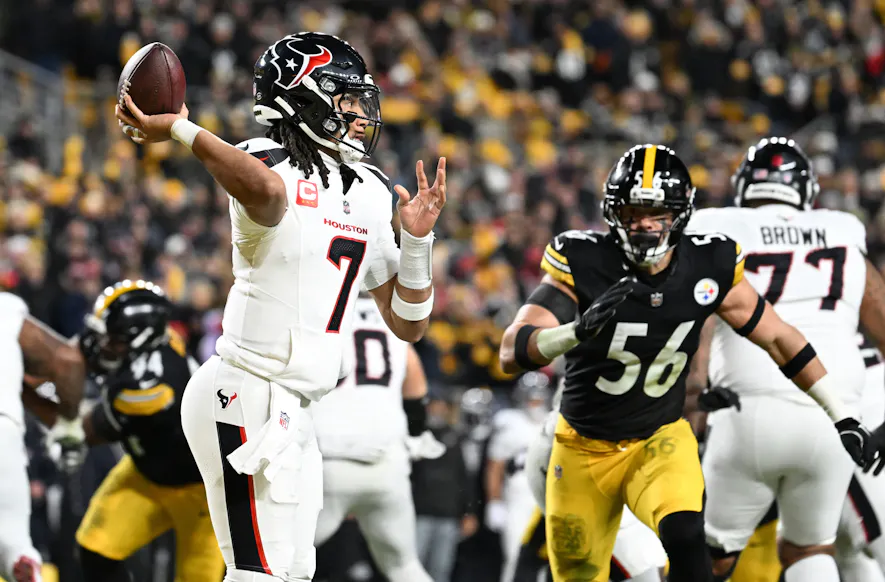
CJ Stroud: The Kyle Pitts Sr. of Fantasy Quarterbacks?
Both players had strong rookie years, delivering frontline fantasy starter production with the promise of more to come. Both delivered underwhelming production relative to public expectations in subsequent seasons.
The version of Kyle Pitts Sr. the fantasy public thought they'd see finally emerged in Year Five, generating career highs with targets, receptions, and touchdowns as the TE2 in PPR formats. Pitts signed a lucrative contract extension this offseason and believes his career is just beginning.
DON'T MISS OUT: Pre-Order the 2026 Footballguys Draft Guide before they are all gone.
Can we expect CJ Stroud's career to follow a similar arc?
CJ Stroud's Developmental Arc Parallels Kyle Pitts
Pitts' NFL career began in 2021 with proven veteran Matt Ryan. From 2021-2024, Pitts worked with Ryan, Marcus Mariota, Desmond Ridder, Taylor Heinicke, Kirk Cousins, and Michael Penix Jr.
Two of these options had less than 30 games of experience. Two were career backups. The only long-term starter was Cousins. An Achilles tear the year before limited Cousins' throwing velocity and range of accuracy in Year One with the Falcons.
There were also three combinations of head coach/offensive coordinators during this span. The impact on Pitts' development curve?
Not good, Bob.
CJ Stroud's career has some parallels. Stroud began his pro career in 2023 with offensive coordinator Bobby Slowik. It's notable this was Slowik's first season with the Texans, so the entire offense was learning a new system with a rookie quarterback.
CJ Stroud got two seasons with Slowik before Nick Caley took over in 2025. Changing coordinators twice early in a quarterback's career is a challenge for a young passer. Changing coordinators three times in four years is a problem for an offensive unit.
The Texans' offensive line also lacked cohesion. From 2022-2025, here's the list of changes we've seen to the starting unit. I'm using 2022 as context for CJ Stroud beginning his career with an unstable line.
- Left Tackle: Laremy Tunsil (2022-25)
- Left Guard: Kenyon Green (2022 and 2024), Tytus Howard (2023), and Laken Tomlinson (2025)
- Center: Scott Quessenberry (2022), Michael Deiter (2023), Jarrett Patterson (2024), Jake Andrews (2025)
- Right Guard: A.J. Cann (2022), Shaq Mason (2023-24), and Ed Ingram (2025)
- Right Tackle: Tytus Howard (2022 and 2024-25) and George Fant (2024)
CJ Stroud and his offensive line have never worked with the same center from one year to the next. Centers read the defense, make line calls, and must have great rapport with guards in the passing game to execute double teams or gloss over assignment mistakes.
C.J. Stroud has lacked stability with scheme and his offensive linemen. These are the foundations of developing a good passing game. It's like being a tight end without a stable scheme and quarterback.
CJ Stroud and the Texans OL: Finding the Root Problem
Fantasy football analysis can forget that players contribute to a player's production. We may label their stats as individual statistics, but it's misleading. They are not islands unto themselves.
Offensive skill positions (QB, RB, WR, and TE) need their teammates to generate production. Without accounting for the team element, we lack the context to deliver quality analysis.
This is why some analysts use data, including EPA and/or DVOA data. It's why I also study film.
It doesn't take much film study to see that CJ Stroud has dealt with a lot of pressure. And let's make something clear right here, right now: CJ Stroud is a pocket passer.
The Georgia-Ohio State playoff game fueled a narrative that CJ Stroud could run and use his legs as a weapon in an offense. If Stroud's poor performance on a pre-draft processing test was the most overblown pre-draft narrative of an early-round pick, then the idea that this college playoff game was proof of CJ Stroud's dual -threat skills wasn't far behind.
CJ Stroud can move to buy time, but he offers little threat as a runner. This is a distinction of massive importance, because pocket quarterbacks have fewer physical tools to handle pressure.
I'm not talking about the blitz. This gets lumped in with pressure, but there's a difference. Defenders reaching the pocket and threatening the quarterback when the defense isn't blitzing is pressure.
Most quarterbacks anticipate blitzes far more effectively than pressure. You'll see this with C.J. Stroud's three years of passing data versus the blitz compared to his data versus pressure.
Here's C.J. Stroud's work against the blitz since he's been in the league. I'm also showing other pocket passers from 2025 and, in some cases, 2024, based on their health or a team change. I statistically qualified the quarterbacks as pocket passers on this list if they rushed for less than 300 yards in the season(s) listed.
C.J. Stroud and His Pocket Peers vs. the Blitz
| Player | Year | Comp | Att | Yds | Com% | Avg | TD | INT | Sack | Fumble |
|---|---|---|---|---|---|---|---|---|---|---|
| CJ Stroud | 2025 | 118 | 187 | 1353 | 63.1 | 7.2 | 4 | 4 | 13 | 1 |
| CJ Stroud | 2024 | 117 | 188 | 1258 | 62.2 | 6.7 | 7 | 5 | 28 | 1 |
| CJ Stroud | 2023 | 109 | 172 | 1435 | 63.4 | 8.3 | 11 | 3 | 19 | 3 |
| Brock Purdy | 2024 | 115 | 170 | 1532 | 67.6 | 9 | 10 | 6 | 17 | 1 |
| Dak Prescott | 2025 | 135 | 192 | 1655 | 70.3 | 8.6 | 7 | 2 | 11 | 4 |
| Sam Darnold | 2025 | 128 | 215 | 1785 | 59.5 | 8.3 | 13 | 8 | 11 | 4 |
| Dak Prescott | 2023 | 125 | 182 | 1499 | 68.7 | 8.2 | 13 | 4 | 12 | 0 |
| Jared Goff | 2025 | 136 | 210 | 1701 | 64.8 | 8.1 | 13 | 2 | 16 | 2 |
| Jacoby Brissett | 2025 | 72 | 108 | 865 | 66.7 | 8 | 2 | 1 | 15 | 3 |
| Jordan Love | 2025 | 108 | 177 | 1421 | 61 | 8 | 14 | 3 | 9 | 1 |
| Dak Prescott | 2024 | 38 | 63 | 502 | 60.3 | 8 | 5 | 1 | 4 | 1 |
| Matthew Stafford | 2025 | 150 | 245 | 1944 | 61.2 | 7.9 | 30 | 3 | 15 | 4 |
| Daniel Jones | 2025 | 90 | 153 | 1188 | 58.8 | 7.8 | 7 | 1 | 8 | 2 |
| Aaron Rodgers | 2025 | 72 | 118 | 672 | 61 | 5.7 | 5 | 0 | 10 | 2 |
| Daniel Jones | 2024 | 65 | 115 | 643 | 56.5 | 5.6 | 4 | 2 | 10 | 1 |
As you can see, C.J. Stroud's production against the blitz, especially in 2025, is solid to good relative to his peers. I sorted the table of his peers by Yards Per Attempt, then by Completion Percentage.
Whether it's pressure or the blitz, a healthy yards-per-attempt rate (given a decent sample size) is a good indication that the quarterback is spotting good solutions early and accurately. The best fantasy producers of these lists had the strongest Yards Per Attempt data, and CJ Stroud's 8.3 yards per attempt in 2025 is among the best of his peer group.
Touchdowns are also a good sign, but you can see there's a broad range of success in this small sample. Matthew Stafford threw the ball more against the blitz than any of the pocket passers and had more than twice the number of TDs (30) than the second-best performers (three tied with 13) on the list.
I shared multiple seasons for Dak Prescott and Daniel Jones because of injury and the difference in their OL's performances from one year to the next. The Cowboys revamped their line heading into 2025. Jones went to the Colts, who had a better OL.
CJ Stroud's OL is much better on paper heading into 2026. Pay attention to Prescott's and Jones' blitz and pressure data. I'll have more to say about this soon.
C.J. Stroud and His Pocket Peers vs. Pressure
| Player | Year | Comp | Att | Yds | Com% | Avg | TD | INT | Sack | Fumble |
|---|---|---|---|---|---|---|---|---|---|---|
| C.J. Stroud | 2025 | 60 | 129 | 787 | 46.5 | 6.1 | 4 | 5 | 25 | 2 |
| C.J. Stroud | 2024 | 71 | 154 | 1021 | 46.1 | 6.6 | 2 | 3 | 57 | 5 |
| C.J. Stroud | 2023 | 67 | 137 | 813 | 48.9 | 5.9 | 3 | 0 | 36 | 6 |
| Dak Prescott | 2025 | 83 | 146 | 1248 | 56.8 | 8.5 | 4 | 3 | 31 | 2 |
| Dak Prescott | 2023 | 84 | 139 | 1114 | 60.4 | 8 | 7 | 3 | 40 | 2 |
| Daniel Jones | 2025 | 52 | 88 | 703 | 59.1 | 8 | 4 | 0 | 20 | 7 |
| Jared Goff | 2025 | 85 | 155 | 1192 | 54.8 | 7.7 | 2 | 2 | 36 | 4 |
| Matthew Stafford | 2025 | 83 | 164 | 1210 | 50.6 | 7.4 | 4 | 1 | 26 | 5 |
| Brock Purdy | 2024 | 58 | 108 | 753 | 53.7 | 7 | 5 | 4 | 31 | 5 |
| Jacoby Brissett | 2025 | 70 | 136 | 880 | 51.5 | 6.5 | 4 | 1 | 42 | 4 |
| Sam Darnold | 2025 | 69 | 136 | 872 | 60.7 | 6.4 | 11 | 5 | 30 | 6 |
| Aaron Rodgers | 2025 | 41 | 98 | 589 | 41.8 | 6 | 4 | 2 | 31 | 5 |
| Dak Prescott | 2024 | 31 | 61 | 361 | 50.8 | 5.9 | 3 | 2 | 21 | 4 |
| Jordan Love | 2025 | 57 | 144 | 717 | 39.6 | 5 | 1 | 4 | 20 | 4 |
| Daniel Jones | 2024 | 40 | 94 | 451 | 42.6 | 4.8 | 3 | 2 | 29 | 3 |
As you can see, unadulterated pressure is one of the toughest conditions for a quarterback to resolve. Completion percentage is significantly lower across the board, TD-to-INT ratios are narrower, and there are a lot more sacks and fumbles.
CJ Stroud's figures were rough every year. There are two potential conclusions here. One, CJ Stroud self-destructs when pressure arrives without sending an extra defender. This was Kenny Pickett's problem as a collegian, and it wasn't much better during his early years as a pro.
Jordan Love's splits between blitz and pressure are a good indicator that Love has a good grasp of working against blitzes, but unadulterated pressure leads to self-destruction. This was also the case with Love at Utah State.
We don't know for sure if this is CJ Stroud's issue, because his offensive line and schemes have been so disjointed during his NFL career. This wasn't a problem for him at Ohio State.
In contrast, Green Bay has a good enough OL and scheme continuity. The Packers also have a run game to limit these scenarios but when a defense can paint Love in this corner, Love's game goes haywire -- even with a good OL.
I'm more inclined to believe CJ Stroud's root issue is a lack of scheme and OL continuity. If the Texans' OL displays a dramatic improvement on the field that the personnel upgrades present on paper, we'll see a significant increase in CJ Stroud's yards per attempt, completion percentage, and TDs, and this theory will have validity.
This improvement against pressure we're seeking from CJ Stroud is something we saw between 2024-25 with Dak Prescott and Daniel Jones. Prescott got an OL upgrade, and Jones landed with a team that had a better OL. You can see dramatic improvements in yards per attempt, completion percentage, and TD-to-INT rates.