
We are proud to be among the first, if not the first, to publish full projections for the upcoming season, going live just days after the Super Bowl. Publishing detailed projections in early February comes with trade-offs, not the least of which is a near-total lack of clarity on how free agency, cap transactions, and the NFL draft will reshape rosters.
We've been updating our projections in near real time, including during the recent onslaught of free-agent transactions. This version will remain largely stable until we can layer in the April NFL draft, but stable projections don't mean settled debates.
We have a staff of sharp analysts with sharp takes of their own, so I thought it would be worthwhile to solicit their views on the key coin-toss situations that will shape each team's outlook in the coming months. These are important questions where reasonable, informed people can credibly land in very different places. I asked my colleagues to weigh in with one assumption: they were answering strictly through the lens of a standard 0.5-PPR redraft league.
New York Giants Coin-Toss Questions:
- Where do you expect the Giants' offense to finish on a points-per-game basis?
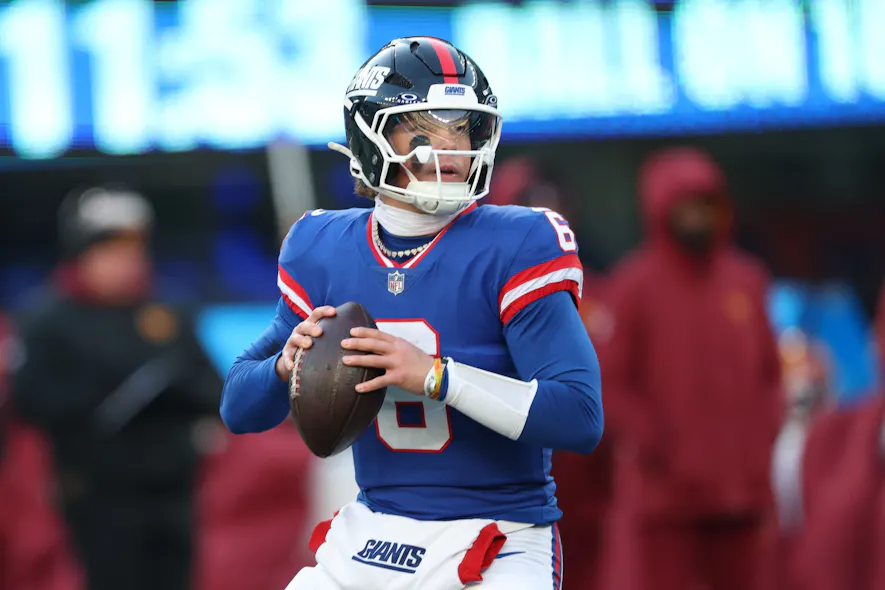
- Do you expect Jaxson Dart to repeat as a QB1?
- Will Cam Skattebo remain the Giants' clear-cut No. 1 option?
- Do you expect Isaiah Likely to overtake Theo Johnson as the starter?
- How does the receiver pecking order shake out behind Malik Nabers?
Q: John Harbaugh has taken command of the franchise and tapped Matt Nagy to run the offense. Where do you expect the Giants' offense to finish on a points-per-game basis (a range is fine)?
Maurile Tremblay: I'd estimate 20-22 points per game, which would be average to below average. There's tension between John Harbaugh's run-first identity and offensive coordinator Matt Nagy's background. During Harbaugh's 18-year tenure in Baltimore, the Ravens led the NFL with a 50.6% run rate. In Nagy's previous play-calling stint, his Chicago offenses ran the ball only 41.7% of the time and produced inconsistent scoring. I suspect Harbaugh's philosophy will prevail, and the Giants will prioritize the ground game. Greg Roman is on staff as a senior offensive assistant. The free-agent targets reflect trench-building. The passing game and overall scoring will be somewhat capped, even though Dart's skill set seems like a good fit for Nagy's RPO/shotgun concepts.
Jeff Haseley: I see the Giants in the 24-26 points-per-game range. The floor is high with Jaxson Dart quarterbacking an offense that includes notable names coming back from injury, namely Malik Nabers and Cam Skattebo. Combine that with a Matt Nagy offense under John Harbaugh's tutelage, and the Giants are an offensive threat in the making.
Meng Song: What's the more likely scenario: Patrick Mahomes II is no longer good based on the last few seasons, or he carried the Chiefs' offense in spite of questionable offensive line play and play-calling? If the last couple of seasons in Kansas City are any indication, I don't have high expectations for New York with Matt Nagy calling plays. Even just league average would be a success with their No. 1 quarterback, running back, and wide receiver all returning from major injuries and the offensive line questionable at best.
Andy Hicks: Until we see what the Giants do during the draft, I would err on the side of caution — perhaps in the 18-24 range. I would expect the team to concentrate on the defense or offensive line during the draft, but a Jeremiyah Love selection with the fifth overall pick would be a statement pick and point the team in an upward direction.
VERDICT: I project the Giants as league average (22-24 points per game).
With so many changes happening within the organization, let's acknowledge that our best estimates are just as likely to be way off the mark as bullseyes. That said, I think the Giants are in a strange position. So many of the constituent parts offer high-end upside if all goes well; however, we equally have to question the durability and consistency of those pieces, because what we’ve seen has been limited outside of Malik Nabers. I’m not sure the "Matt Nagy stinks" narrative makes all that much sense, since Andy Reid called plays in Kansas City. But it is fair to wonder if Nagy really is a plus play-caller, since his time in Chicago also left much to be desired.
Q: Jaxson Dart was a Top-5 fantasy quarterback from Weeks 4 through 18. Do you expect him to repeat as a QB1 (Top 12) this year?
Maurile Tremblay: Dart's top-5 fantasy production was largely driven by his 487 rushing yards in 11 starts. The scheme he's entering actually supports a repeat in that regard. Nagy's offense will emphasize RPOs, designed quarterback runs, and shotgun formations — Dart was in shotgun 79.9% of the time as a rookie — and Harbaugh's track record with Lamar Jackson shows he's comfortable building around a mobile quarterback. The risk is that Dart may not have the passing efficiency or volume to support top-five numbers over a full season. I'd say Dart is a reasonable bet to finish as a back-end QB1, somewhere in the QB8 to QB12 range. The transition to a Harbaugh-style ground-and-pound identity probably shaves a few points per game off his fantasy ceiling.
Jeff Haseley: Absolutely. If past experience is a predictor of future success, Dart is on his way to a strong season with plenty of weapons. There may be some growing pains at first while the team and the offense are introduced to the new ways of Matt Nagy and John Harbaugh, but all indications point to a positive season on offense.
Meng Song: If he stays healthy, yes, but that's a concern for the "Isiah Pacheco of quarterbacks." Dart added tons of fantasy production with his legs, but he's already said, "This is football... we're not playing soccer out here." I think his current best-ball ADP of QB11 is about right, considering the ceiling while also accounting for the injury risk.
Andy Hicks: No. Until he reins in his recklessness, he's going to keep getting punished by opposing defenses and missing games. His fantasy stats primarily came from nine rushing touchdowns. The new coaching group will want him to run, but much more smartly, and they also expect more rushing touchdowns to go to the running back group. As a passer, he isn't going to be a fantasy starter on the back of that alone, although the return of Malik Nabers will help.
VERDICT: A Top-12 baseline with WIDE variance.
I project Dart at QB11, largely using the same methodology Maurile articulates. However, I also agree with the optimistic and pessimistic takes from my other peers. We always talk about players and how they will rank if they stay healthy, but do we properly factor in the risk of injury? Probably not. It is April, so I am assuming Dart stays healthy, as I do for most players not coming back from significant surgeries. But we cannot forget that what made him a fantasy star last year—his aggressiveness—also put him in harm's way repeatedly. I have little doubt that his rushing upside, an enticing supporting cast, and proven veteran coaches would see Dart finish as a top-12 fantasy option if he plays 16 or 17 games. But the odds he plays that many games are also likely lower than at least two-thirds of the league's other Week 1 starters. The ideal approach is to pair Dart with a lower-volatility, proven QB2 in the mid-rounds, a strategy that insulates you from Dart's very real downside projection.