
Every fantasy football draft strategy has a name. Zero Running Back. Hero Running Back. Late-Round Quarterback. Bully Tight End. The options can feel overwhelming. But all of those strategies share a common ancestor: Value-Based Drafting, or VBD.
In today's episode of The Footballguys Fantasy Football Show, I said, "Every strategy that you have learned about since is based on Value-Based Drafting. This is really what catapulted fantasy football analysis into what it is today."
VBD was developed by Footballguys founder Joe Bryant more than twenty years ago. The idea is deceptively simple, but it runs counter to how most casual players instinctively approach their drafts.
Joey and I dove deep in a new episode of The Footballguys Fantasy Football Show. You can listen here, or find a summary below.
What Value-Based Drafting Actually Means
At its core, VBD requires two things: projections for every fantasy-relevant player, and a way to assign value to those players based on your league's specific settings.
In Joe's initial article about VBD, he simply stated, "The value of a player is determined not by the number of points he scores. His value is determined by how much he outscores his peers at a particular position."
An example using last season's numbers: Trey McBride finished as the top-scoring tight end, outscoring the average TE1 (TE2-TE12) by nearly four points per game. Josh Allen, the QB1, outscored the QB2 by less than one point per game. Christian McCaffrey and Puka Nacua were within two points of the RB2 and WR2.
The implication is significant: drafting McBride gave your team a massive weekly edge that no quarterback or skill position player could match at a comparable draft cost.
You are trying to lock in advantages at every single position that you can with every single pick that you make.
Brock Bowers: The Poster Boy for VBD in 2026
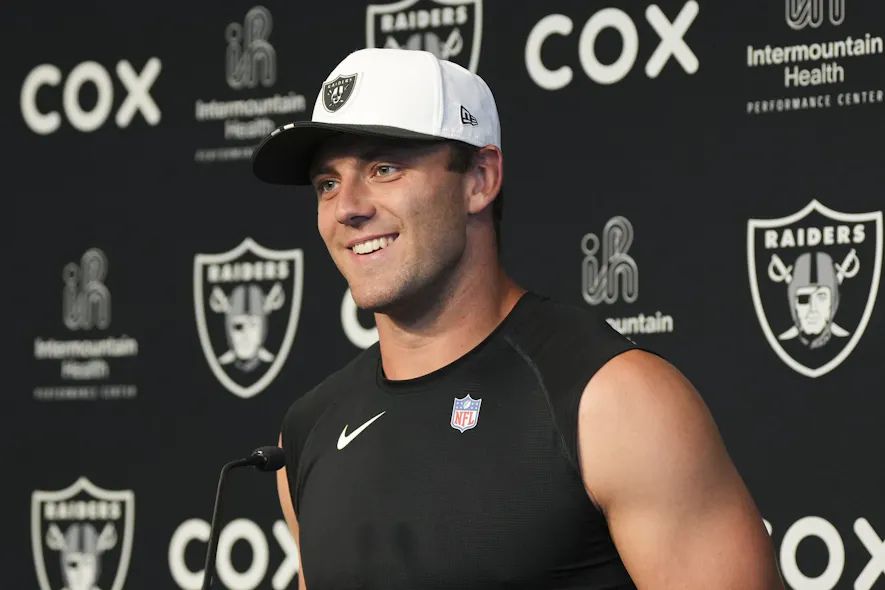
Heading into 2026, we point to Brock Bowers as the clearest example of VBD in action.
We have Bowers ranked as the TE1, despite Trey McBride finishing as the actual TE1 in scoring last season. Joey explained the reasoning on our show: Klint Kubiak is now the architect of the Raiders offense, and his track record of elevating primary pass catchers is well established. He helped fuel Brandon Aiyuk's breakout in San Francisco, aided Justin Jefferson's leap in year two, and last season made Jackson Smith-Njigba look like a star.
"Brock Bowers is definitely the alpha in this offense," Joey said. "And we've seen what Kubiak does with his alpha receiver."
I added that Bowers showed up despite playing most of 2025 on a hobbled leg with a PCL injury, and immediately posted a three-touchdown game upon returning. Meanwhile, the Raiders' wide receiver room consists of Jalen Nailor, Tre Tucker, and Jack Bech, a very underwhelming corps. Bowers will function as the team's de facto number one receiver.
We have Bowers projected to outscore our TE2, Trey McBride, by more than two points per game and our TE12, Dallas Goedert, by eight points per game. Those projections push him up to be the eighth most valuable player in PPR formats. For context, current ADP on DraftKings is 18th overall.
"If you look just at blanket projections across all positions, there are ten running backs and wide receivers projected to outscore Brock Bowers," I said on the show. "We have twenty-seven quarterbacks projected to outscore him. But it's the positional scarcity that makes him worth reaching for."
The practical application: draft Bowers in round two, skip the expensive quarterbacks in the next few rounds, and pick up Brock Purdy in round ten. You lose one to two points per game at quarterback. You gain a multi-point weekly edge at tight end. Over the course of the rest of the draft-day selections, the micro-advantages you secure at each position add up.