
As the dynasty calendar flips toward the 2026 offseason, one position stands out for its volatility and opportunity: running back. Contracts are short, workloads shift quickly, and a single change in environment can turn a stagnant asset into a league winner overnight.
On the latest episode of the Footballguys Dynasty Football Show, the conversation centered on the upcoming class of running backs set to hit free agency, along with players on expiring rookie deals whose situations could dramatically change. Rather than projecting final outcomes, the focus was on probability, team incentives, and how dynasty managers should be thinking about these backs now—before the market adjusts.
The "Big Four" on Expiring Rookie Deals
The discussion began with a tier of high-profile running backs finishing their rookie contracts, each carrying very different levels of uncertainty and upside.
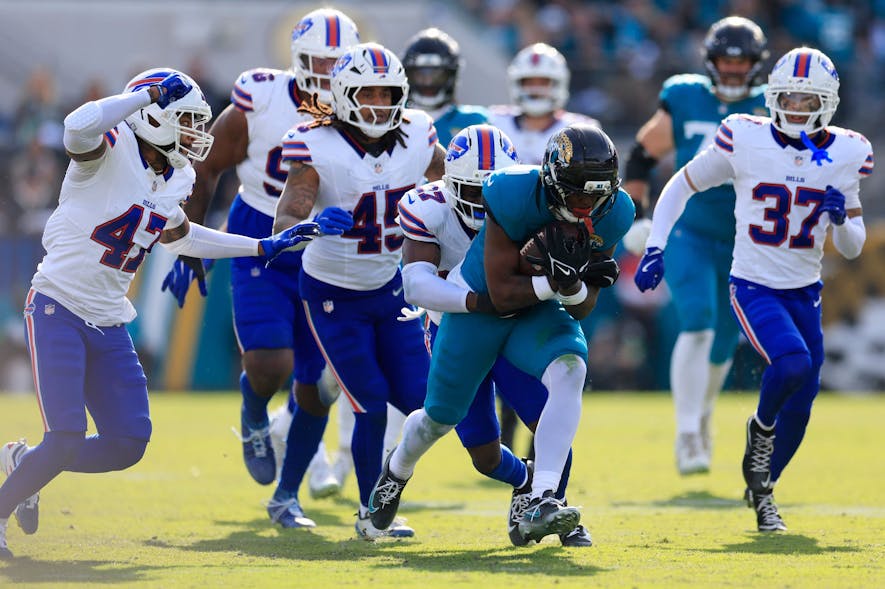
Travis Etienne Jr. feels like the simplest case. Despite periodic frustration from fantasy managers, Etienne's long-standing relationship with Trevor Lawrence—dating back to Clemson—still matters. He's been a reliable pass catcher, a steady presence in the offense, and someone Lawrence clearly trusts. While he hasn't fully lived up to first-round expectations, Jacksonville has shown little urgency to move on, making it more likely that Etienne remains a Jaguar in 2026.
If that happens, it caps the short-term upside for younger backs like Tank Bigsby's replacements, Bhayshul Tuten and LeQuint Allen Jr., but it doesn't eliminate their dynasty value. Running back remains the most fragile position in football, and "handcuffs" with real talent tend to find opportunity eventually. Betting on athleticism and draft capital remains a viable long-term strategy.
Breece Hall, meanwhile, sits at the opposite end of the spectrum. Few doubt his talent—or his fantasy ceiling—but his future hinges on how the Jets handle a likely franchise reset. The expectation is that New York will use the franchise tag, especially given the lack of foundational offensive talent elsewhere on the roster. That said, Hall's name has already surfaced in trade rumors, and there's a growing sense that his best fantasy years may still be ahead of him—just possibly not with the Jets.
From a dynasty perspective, Hall represents both frustration and hope. He's never played in a stable or efficient offense, yet still flashes elite traits. A change of scenery could immediately vault him back into the top tier of fantasy running backs.
Ken Walker III is another big-named back to watch. Few backfields generate as much weekly frustration as Seattle's, but it's also one of the most interesting long-term situations to monitor.
Walker and Zach Charbonnet finished with identical fantasy production, despite getting there in very different ways. Walker brings explosiveness and big-play ability, while Charbonnet provides physicality, efficiency, and goal-line reliability. The problem—and the opportunity—is that both are good enough to be featured backs, yet unlikely to coexist long-term on second contracts.
Seattle has cap flexibility, but with other financial priorities looming, it's increasingly plausible that Walker hits the open market while Charbonnet remains. For dynasty managers, the actionable takeaway isn't predicting which one stays—it's recognizing that both profiles are worth acquiring. The worst-case scenario keeps them in RB2 territory; the best-case scenario creates two starting backs in separate offenses.
Rachaad White's inclusion alongside Etienne, Hall, and Walker initially feels jarring—until you zoom out.
Just two years ago, White was a top-five fantasy running back. Since then, his role has fluctuated due to injuries, competition, and usage shifts in Tampa Bay. That volatility has created a persistent narrative that White is "inefficient," but the data tells a more nuanced story. As his workload has decreased, his efficiency has improved, climbing steadily into the upper tier of rushing EPA metrics.
White still checks key boxes: size, pass-catching ability, and proven three-down usage. While he may no longer project as a locked-in workhorse, he profiles extremely well as the lead back in a committee—or even as a featured option in the right offense. The dynasty market, however, continues to lag behind that reality, making him an intriguing buy in multi-player deals where his value is minimized as a throw-in.
Veterans Coming Off Achilles Injuries
Another tier worth monitoring includes veterans returning from early-season Achilles injuries, notably Najee Harris and Austin Ekeler.
Austin Ekeler, approaching his age-31 season, faces a steep uphill battle to regain fantasy relevance. While his impact on the game—and fantasy football itself—can't be overstated, the combination of age, mileage, and injury makes it difficult to project a meaningful role going forward.
Najee Harris is a more complicated case. Despite constant criticism, he's consistently produced at the NFL level and now enters free agency at an age where teams may still see value—especially if medicals check out. Harris could land anywhere from a lead-back role to a high-end rotational spot, depending on market dynamics and coaching preferences. His dynasty value currently reflects pessimism rather than probability, which creates potential buying opportunities.