
Quick Links: Quarterbacks | Wide Receivers | Tight Ends
An Overview of the Running Back Position
For years, running backs were the kings of fantasy football. How fantasy managers fared in a season depended on how strong the backfield was. The first round was annually ruled by running backs, with nine or 10 of the first 12 picks hailing from that position. Managers picking in the first half of Round 1 were taking a back—period.
But the NFL has evolved, and fantasy football has evolved with it. More and more teams are employing backfield committees and three-wide sets. In early ADP data here at Footballguys, Round 1 is now split right down the middle—six running backs and six wide receivers.
There are other reasons for that shift as well. Most fantasy leagues now feature PPR scoring, and wide receivers get a boost in that format. As a position, running backs have a higher bust rate than wide receivers—and no one wants their first pick on draft day to be a bust. Running backs are more prone to injury due simply to the nature of the position—and the only thing worse than a bust is a busted bust.
Now, that's writing.
Scarcity is an issue with running backs as well. There wasn't a single back last year who averaged 20 carries a game. Only four backs had 300 carries. Only 10 backs had even 300 touches. There just aren't as many true "workhorse" backs as there used to be—and those backs have become more valuable as a result.
Throw together volatility and scarcity, and running back is arguably the most difficult position in fantasy to address on draft day. But the position is still also vitally important to winning a championship.
What, no one said it would be easy.
At least there are multiple ways to screw up.
We have that going for us.
RB Draft Strategies
Door No. 1: Robust RB
This is the oldest running back draft strategy, and the one with the worst nickname. It sounds like the house salad dressing at Rocky's Bistro, a run-down Italian restaurant with good food and a D+ from the health department.
This is old-school fantasy drafting—the strategy that was once the consensus. Attacking the running back position early. Drafting running backs with two of your first three picks. Or even with the first two picks. Good old "RB/RB." Geezerball.
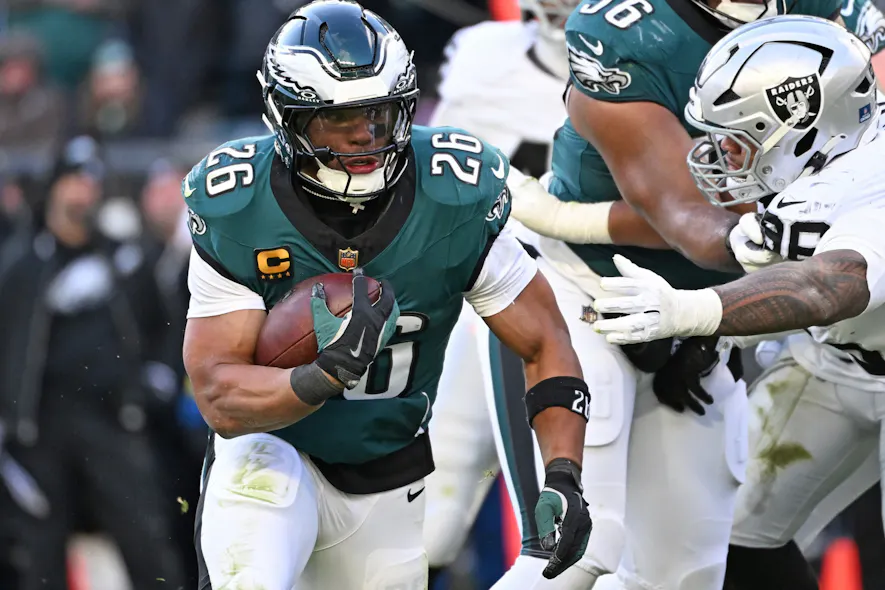
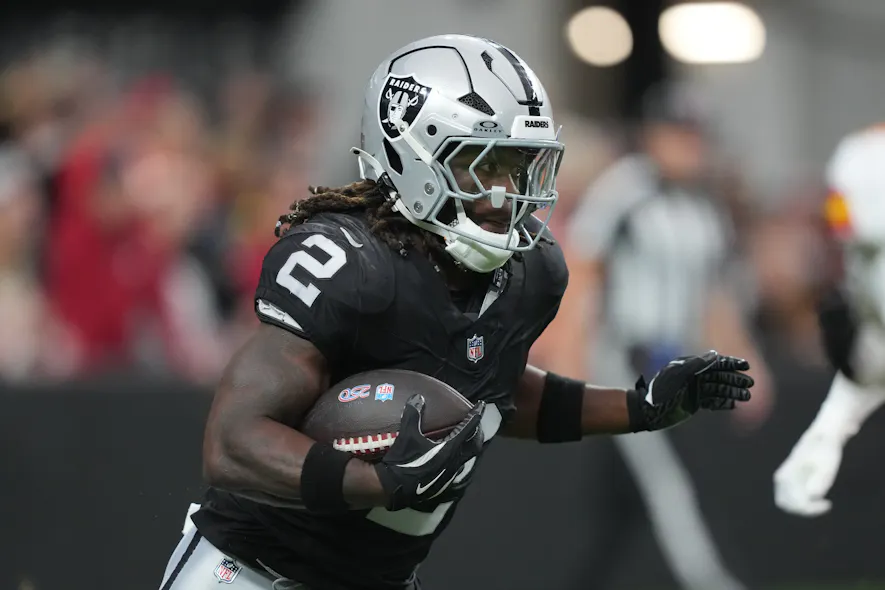
The positives with this are productivity and (hopefully) consistency. Rostering two backs like Ashton Jeanty of the Raiders and Philadelphia's Saquon Barkley means locking in two of those 300-plus touch backs—and touches mean points. The bust rate at running back is also closer to wide receiver in the first few rounds.
The negative will become evident once you hit the middle of Round 3 and don't have a wide receiver yet. Take an elite tight end, and suddenly it's the fourth round and you still have no wideouts. Want that elite quarterback? Well, managers who wait until Round 5 to draft a wide receiver are living on the edge.
Those running backs had better hit, or the season is going to be…ungood.
However, drafting a pair of running backs early can also help fantasy drafters avoid a region of drafts that is so terrifying it is only spoken of in hushed whispers.
"The RB Dead Zone."
The RB Dead Zone
The "RB Dead Zone" is a nebulous parallel dimension—a black-and-white hellscape filled with innumerable horrifying scenarios that are all narrated by Rod Serling.
Wait, that's The Twilight Zone.
The "RB Dead Zone" is the portion of the draft where the difference between bust rates at running back and wide receiver reaches its zenith. The bust rates at the two positions are similar in the first few rounds. And once it's past Round 10, every pick is essentially a dart-throw.
But there's a multiple-round section of drafts where running backs have a significantly higher bust rate than wideouts. Can you find a value at running back in the Dead Zone? Sure. But the odds don't favor it.
Once upon a time, the belief was that the "RB Dead Zone" began in Round 4 or ended in Round 8 or Round 9. But every fantasy draft is unique, and as more managers get aggressive at wide receiver, the border of that black-and-white hellscape can be pushed back.
Put it this way—if you're drafting Pittsburgh's Jaylen Warren or Denver's RJ Harvey, then you have entered the "RB Dead Zone."
You have been warned.