
Doing mock drafts can have varying levels of utility for fantasy managers. Some are extremely helpful when committed managers take them seriously and stick them out through the conclusion of the mock. Other mocks are a waste of time as managers time out, leave after three rounds, or try out their wacky builds to see what it looks like when they take six straight running backs to start the draft.
A mock salary cap draft is no exception. A bot replacing a no-show or a manager spending in an unrealistic manner can ruin the exercise. I wanted to give Footballguys readers the best type of mock: 12 committed salary cap veterans drafting as though it were a real league. We aren't playing it out, but I think we captured that authenticity. The room was sharp, experienced, and nobody timed out or let the platform take over. We played it straight to the final pick, and the result was valuable lessons for how to approach a salary cap draft this year.
Here was the setup, meant to replicate the most common settings in salary cap draft home leagues:
- $200 salary cap
- 16-man rosters
- Starting lineup consisting of 1 QB, 2 RB, 3 WR, 1 TE, 1 Flex, 1 K, and 1 Defense
- Full PPR scoring with 4-point passing touchdowns
You can view the entire salary cap draft and all the rosters right here on the Sleeper platform.
Here's what we learned.
The Nomination Order Is the Whole Game
If this lesson ever needed reinforcing, this mock did it for us. Remember one important thing that sometimes gets lost in this format: There will be some odd-looking prices to an outsider who wasn't in the draft. I call this the Raw Dollar Fallacy. Looking at a mock salary cap draft after the fact and pointing out specific "deals" or players someone "overpaid" for is a futile exercise. It lacks context, and while I understand that $35 is a great price for Amon-Ra St. Brown in a vacuum, if that particular league requires only one starting wide receiver and Ja'Marr Chase went for $32, then St. Brown for $35 is very decidedly not a good price. That's an extreme example, but the point is illustrative.
In this mock, I saw a price on Tee Higgins that I haven't seen very often. He went for $31, and while I think that's too high, I don't blame Team 11 for doing it because when Higgins was nominated, he was clearly the best wide receiver on the board, and it wasn't close. That's an inflated price, but sometimes we have to pay more than we want to, and that's ok—the goal is to land the player.
Team 5 manager Chad landed Trevor Lawrence for $7. It may not seem like a bad price, but this is where context and nomination order are everything. Lawrence was the 2nd quarterback nominated, which led to some buyer's remorse. Chad told me afterward, "Lawrence was the 2nd quarterback to be nominated. I should have waited to see what the QB market was going to be. I would much rather have [Drake] Maye ($8), [Jayden] Daniels ($7), or [Caleb] Williams ($4)." We can't necessarily call this a mistake because it was only a mistake in hindsight. This group of drafters was tough and seasoned, so quarterback prices will likely be higher in many home leagues this summer. Chad had buyer's remorse, but there wasn't much he could have done differently except make a mental note for his next salary cap draft.
Just remember that nomination order is everything. A salary cap draft doesn't unfold in a linear fashion like a serpentine draft. Craft your nominations to stay ahead of the room and drive toward your goals. It's one of the most critical aspects of a salary cap draft.
Things Are Top-Heavy This Year
This topic is self-explanatory but also a core principle we will pay attention to this summer as we prepare. This mock should put everyone on notice about how people see the top of the fantasy rankings this year.
In the past, it has been a bit unusual to see anyone crack $60 in typical $200 salary cap formats. Further, if it happened, the remaining elite players on the board usually were stuck in the low $50s and upper $40s. That's been a pretty consistent story for the past few years.
This year is different.
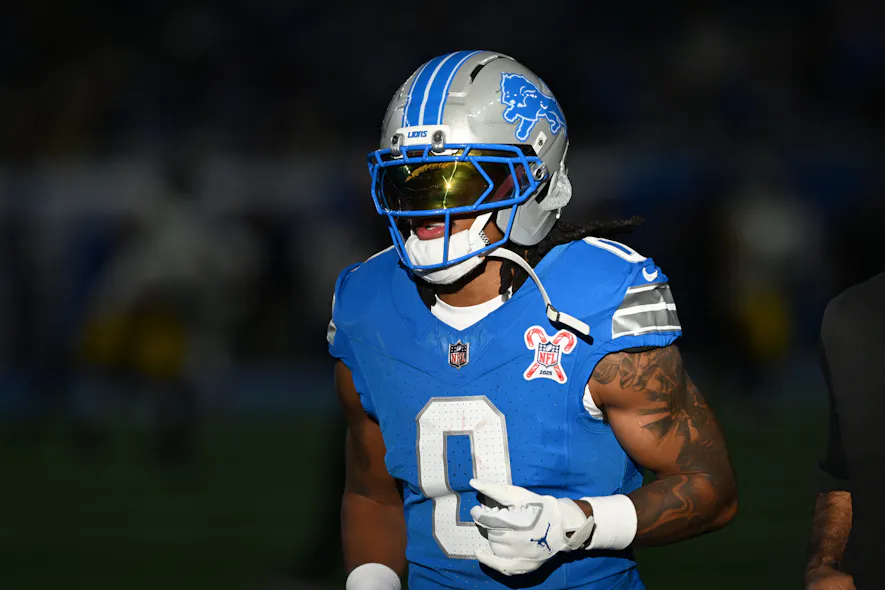
Jahmyr Gibbs went for $70 to Footballguys staffer Ryan Wiesse, who told me, "I went in planning to pay up for one elite running back, and when Bijan Robinson sold for $70, I made that my cap for Gibbs." Strategy aside (which we'll discuss later), remember that the top of the draft is more expensive than it has been in recent years. A $70 player is almost unheard of, and this mock had 2. That doesn't mean it's wrong. Footballguys has both players valued around $70, but it's something we need to be ready for.
Team 12 manager 'Naliface' was caught off guard (as was I) by the high prices, remarking, "I went into the auction planning to build around an elite RB, but I under-budgeted for that tier...I just need to be more willing to shift money around and stay aggressive when it's time to secure that cornerstone player." It's a good lesson, and one that's sometimes personality-based. I'm naturally a cautious, by-the-book drafter, and paying $70 for a player isn't easy for me. But as Naliface pointed out, if we want elite talent, we're going to have to be more comfortable shifting money to the top of our builds.
On top of that, outside of the two elite runners, 8 other players cracked $45. That's a somewhat surprisingly high number, and we have to be ready for that type of spending when planning our approach.
The natural by-product of this development is that prices will fall off a cliff somewhere, but we won't know where until we get into each salary cap draft room. This mock saw tight ends and quarterbacks lose value in the face of the heavy spending, but even more interesting was the massive, flat tier of running backs and wide receivers who didn't go over $30 but still went for at least $16.
Twenty players were tightly bunched between $20 and $29, and if we wanted to be extreme about our approach to value in that range, we would tell ourselves not to pay attention to the name on the back of the jersey, and instead take the cheapest players from this flat group that will undoubtedly produce some strong fantasy starters.
Any Approach Can Work
Look out for my 2026 Salary Cap Draft Plan in early August for specific conversations about players and salary cap allocations that fit our targets. For now, the takeaway from this mock is that any approach can work—it all comes down to how we execute it.
I tend to believe that spending on a few elite players and then filling much of the roster with low-dollar values is the most difficult way to approach a salary cap draft. Hitting on several cheap (less than $10) players isn't easy, so this approach often requires more aggressive waiver wire work to cover the holes. I generally advise that in a 10-team league, we should lean heavier on elite producers and worry less about our bench, but as leagues grow in size, the difficulty of playing 'stars and scrubs' rises again.
Team 6 manager Steve spent $121 on Bijan Robinson ($70) and Jaxon Smith-Njigba ($51 was too cheap for Smith-Njigba; the room was sleeping a bit here), and didn't spend more than $8 on another player the rest of the draft. Steve said afterward, "Spending $121 on two guys forces you to bargain hunt, and I know I can average like $6 per guy for the remaining 14 spots. It's a trade-off for sure." Steve has his top wide receiver but will then need to find two more starters between Quentin Johnston ($8), Jordyn Tyson ($7), Ricky Pearsall ($6), and Wan'Dale Robinson ($7). That seems entirely possible, but this is an extreme example of a top-heavy roster.
On the other hand, Team 10 manager Matt took a more balanced approach. He had 5 players between $20 and $45, with 3 over $30. He has arguably less star power than Steve, but his starting lineup goes deeper. Which lineup will score better depends entirely on how Steve does in nailing the cheaper parts of his roster. Matt told me afterwards that he liked his balanced approach, but that his flyer on Malik Nabers for $20 made his team more of a question mark than he wanted. Ultimately, though, it was about accepting the risk to try to win a title. "The combination of Jefferson, Nabers and Flowers down the stretch was too tough to pass on for that price," he said. If Nabers is anything close to himself by the end of the year, Matt will have landed a steal.
The beauty of a salary cap draft is that we get to choose how to build our teams, and if the room isn't doing what we want, we can always adjust on the fly.