
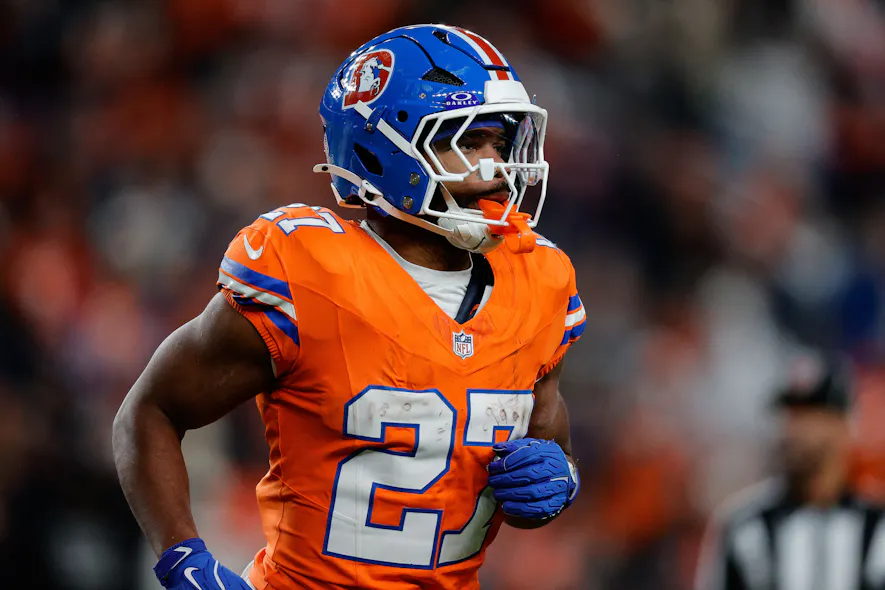
RELATED: See all of our 2026 Player Spotlights here
J.K. Dobbins signed a two-year contract extension for a hefty pay raise, something that doesn't often happen to 27-year-old running backs coming off season-ending injuries. The Denver Broncos could have let Dobbins, who was on an expiring one-year deal, walk in free agency. Instead, they gave him a contract worth up to $20 million.
DON'T MISS OUT: Sign up for our free, daily newsletter here.
Despite being the Broncos' most effective rusher and the most efficient running back Sean Payton has coached since NFL Next Gen Stats began tracking such metrics, fantasy managers are not drafting Dobbins first among Denver tailbacks. That honor's going to RJ Harvey an average of two rounds earlier. Many drafters appear set to avoid the Denver backfield altogether, fearing a dreaded "running back by committee" situation.
Both reactions leave easy money on the table. Asking "Who's the best back?" misses the point entirely. Ask the only question that actually matters for fantasy: "Which back pays off his ADP?"
That's Dobbins.
Denver RBs at a Glance
Denver brings back rare backfield continuity, returning four running backs and fullback Adam Prentice from last year's squad. The only addition is fourth-round rookie Jonah Coleman.
- Dobbins (27): Dobbins looked every bit like Denver's lead back through Week 10 last season before a hip-drop tackle resulted in a season-ending Lisfranc injury. Devastating bad luck is nothing new for Dobbins, who previously suffered a torn ACL in 2021 and a torn Achilles in 2023. However, his 2024 rebound in Los Angeles (14.8 PPR PPG, RB24) and his 2025 Denver tape proved he still has high-end juice when healthy.
- Harvey (25): Drafted 60th overall in 2025, Harvey spent the first half of his rookie year strictly in a change-of-pace role before Dobbins went down. Forced into the starter's seat in Week 11, he handled a heavy workload but struggled to produce efficiently on the ground.
- Jonah Coleman (22): Selected in the fourth round (108th overall) out of Washington, Coleman saw his draft stock fall after a late-season PCL strain sidelined him for Combine testing. He brings a physical, compact running style that mirrors Dobbins' game.
- The Depth (Tyler Badie, Jaleel McLaughlin, Adam Prentice): Badie served as the primary pass-down back in 2025, while McLaughlin faded into healthy-scratch territory after backing up Javonte Williams in previous years. Prentice remains Sean Payton's trusted fullback, but none of the three carry meaningful standalone fantasy value.
2025 Denver Running Back Stats
| Player | Gms | Rsh | RshYd | Yds/Rsh | RshTD | Rec | RecYd | RecTD |
|---|---|---|---|---|---|---|---|---|
| RJ Harvey | 17 | 146 | 540 | 3.70 | 7 | 47 | 356 | 5 |
| J.K. Dobbins | 10 | 153 | 772 | 5.05 | 4 | 11 | 37 | 0 |
| Jaleel McLaughlin | 8 | 37 | 187 | 5.05 | 1 | 4 | 27 | 0 |
| Tyler Badie | 16 | 8 | 23 | 2.88 | 0 | 19 | 141 | 0 |
| Adam Prentice | 16 | 10 | 44 | 4.40 | 0 | 6 | 53 | 0 |
2025 Season Review
While Denver's backfield is often labeled a "running back by committee," season-long stats obscure how clearly defined these roles actually were. Splitting 2025 into two distinct halves reveals the true pattern.
Weeks 1–10: Dobbins Dominates the Ground
In the first ten weeks, Dobbins logged three times as many carries as Harvey and outgained the rookie 772 yards to 214 while playing nearly 150 more snaps. Harvey's fantasy value was saved by the passing game, where he caught 25 passes for 175 yards and 4 touchdowns (accounting for two-thirds of his PPR production). Neither back was used heavily on third or fourth down; Harvey had 11 combined rushes and targets on late downs compared to Dobbins's 9 out of a team total of 29.
Weeks 11–18: Harvey Struggles in the Lead Role
Once forced into the starter's workload, Harvey's rushing efficiency cratered. He averaged just 3.40 yards per carry—nearly a full yard less per attempt than when Dobbins was healthy. McLaughlin actually out-gained him on a per-carry basis (5.19 YPC) in relief. While Harvey saw an increase in third-down work (accounting for 18 of 34 RB opportunities), his overall share of the backfield work was actually lower than what he and Dobbins combined for in the first half of the year.
The Metric Gap
Early-down work in Denver remains heavily run-first, averaging roughly four rushes per target regardless of who is in the backfield. That environment directly favors Dobbins. According to NFL Next Gen Stats, Dobbins ranked 4th among 48 qualifying running backs in rushing yards over expected (RYOE) per attempt, trailing only Rhamondre Stevenson, James Cook III, and Derrick Henry. Harvey ranked 46th. Dobbins also finished near the top of the league in 10-plus-yard runs per game, yards after contact, and rushing success rate.
NFL Next Gen Metrics for Dobbins and Harvey
| Metric | J.K. Dobbins | Rank | RJ Harvey | Rank |
|---|---|---|---|---|
| RYOE per game | 16.1 | 3rd | -5.3 | 45th |
| RYOE per attempt | 1.1 | 4th | -0.6 | 46th |
| Runs of 10+ yds per game | 2.1 | 6th | 0.5 | 47th |
| YACO per game | 53.8 | 10th | 26.5 | 43rd |
| YACO per attempt | 3.5 | 13th | 3.1 | 36th |
| Success rate | 44.4% | 13th | 39.7% | 33rd |
Dobbins' success in Denver was no fluke. Prior to his injury, he posted the highest RYOE per game among qualifying backs to play for Payton since Next Gen Stats began tracking the metric in 2018. In 2024 with the Chargers, Dobbins ranked 11th (8.8 RYOE per game), and he finished fourth during his rookie season in Baltimore (13.1 RYOE per game). Meanwhile, Harvey's rushing metrics mirrored Javonte Williams' line under Payton in 2023 (-5.2, 39th) and 2024 (-5.2, 37th).
A healthy Dobbins is undeniably the team's most effective early-down rusher. Harvey is the better receiving option, which carries significant weight in PPR formats. Harvey averaged 7.6 yards per reception (17th among qualifying running backs) and 1.4 yards per route run (seventh). He also finished third in receiving Expected Points Added (EPA) behind only Christian McCaffrey and Bijan Robinson.
However, portraying Harvey as a true "three-down weapon" is aspirational marketing more than an accurate description of his current role. While Harvey flashed dynamic receiving ability when targeted, Denver rarely deployed him on obvious passing downs. Pass protection is the primary culprit here. Harvey entered the league with subpar pass-blocking skills, which Pro Football Focus ranked dead last among qualifying Power 5 backs for the 2024 season.
Whether Dobbins was available or not, Denver operated with a single featured running back on nearly every play, occasionally complemented by the fullback. Take away the names on the jersey, and the structural pattern becomes obvious: regardless of whether Dobbins or Harvey served as the lead, they handled almost two-thirds of all running back touches that week. As the historical data shows, this has been standard operating procedure for a Sean Payton-called offense.
Sean Payton's Backfield Usage
The industry often tags Sean Payton with the "committee" label, but historical data tells a different story. When Payton has an effective lead option, his offense concentrates workload in a predictable way.
To see this pattern, look at game-by-game roles rather than season-long totals. In any given week, define the Game-RB1 as the back who leads the team in touches, the Game-RB2 as the second option, and so forth. Across a 12-year sample, Payton's distribution of touches among those single-game roles has remained remarkably stable.
Distribution of Regular Season Touches Under Sean Payton, 2014-2025
| Time Frame | Game-RB1 | Game-RB2 | Game-RB3+ |
|---|---|---|---|
| Denver 2025 (Weeks 1-10) | 64.8% | 27.9% | 7.3% |
| Denver 2025 (Weeks 11-18) | 65.0% | 22.5% | 12.4% |
| Denver 2024 | 54.4% | 28.9% | 16.7% |
| Denver 2023 | 57.5% | 27.4% | 15.1% |
| New Orleans 2019-21 (Kamara era) | 71.2% | 25.0% | 3.8% |
| New Orleans 2017-18 (Ingram & Kamara overlap) | 58.0% | 35.5% | 6.5% |
| New Orleans 2014-16 (Ingram era) | 62.9% | 24.6% | 12.5% |
In 2025, Denver's touch distribution returned to classic Payton form. Whether Dobbins or Harvey served as the primary back in a given week, the weekly lead back handled nearly two-thirds of the total backfield touches (64.8% in Weeks 1–10; 65.0% in Weeks 11–18). That level of workload concentration was Payton's highest since Alvin Kamara operated as a true workhorse in New Orleans from 2019 to 2021.
The fragmented, committee-style backfields Denver fielded in 2023 and 2024 were the exception, not the rule. Driven by circumstance rather than scheme, those split backfields stemmed directly from Javonte Williams' October 2022 multi-ligament knee reconstruction. Williams returned in 2023 but lacked his pre-injury explosiveness. Continued inefficiency through 2024 culminated in an effective benching during a crucial late-season matchup against Kansas City before his departure in free agency.
Once Payton had healthy, efficient options in 2025, he reverted to his historical baseline: one primary driver getting ~65% of the work, a secondary option capping out around 25%, and minimal scraps for the rest.
New OC, Same Sean Payton Offense
Sean Payton will not call offensive plays this year, handing those duties to first-time play-caller Davis Webb. Hired as quarterbacks coach in 2023 and promoted to pass game coordinator in 2025 before taking over as OC, Webb is a fast riser. But fantasy managers expecting a schematic shift can breathe easy. "It's the same offense for the most part," Webb noted before OTAs. "This is a Sean Payton-coached football team with a Sean Payton offensive philosophy."
Payton handed over the headset primarily to streamline game-day operation. Early indications suggest Denver will use more pre-snap motion, target the middle of the field more aggressively, and get calls into Bo Nix faster. "Quicker" in this context isn't about running a high-tempo offense; it's about giving Nix maximum time at the line of scrimmage to process the defense and make pre-snap adjustments.
Make no mistake: Payton maintains significant control over the offensive architecture. After guiding Denver to a 14-win season, Payton signed a contract extension through 2030, locking in long-term structural stability. The play-caller on the headset may be new, but the system, execution, and running back usage guidelines remain classically Payton.