
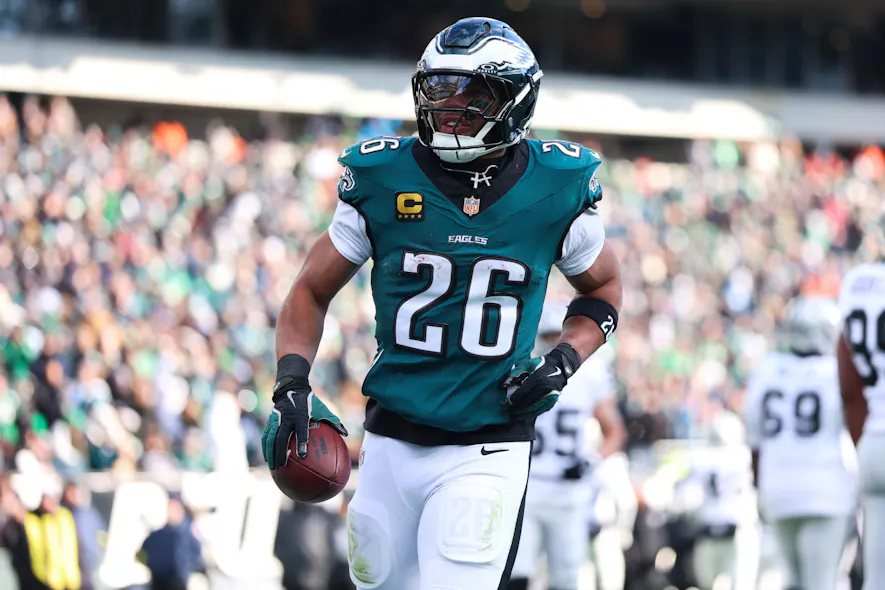
RELATED: See all of our 2026 Player Spotlights here
The Price of Uncertainty
Having had live projections running since February, it's fair to say some of my initial expectations get reshaped once we roll up our sleeves and do deep dives into players and their situations. My outlook for Barkley has taken a notable turn.
DON'T MISS OUT: Pre-Order the 2026 Footballguys Draft Guide before they are all gone.
My early projections had him as RB6, which would've made him a table-pounding buy at the end of the first round, given his consensus ADP of RB8. But now that I've dug deeper, I find myself seeing a few too many uncertainties to comfortably target him at ADP.
- Sean Mannion's unproven resume as the new play-caller
- The structural friction of asking veteran players to dramatically change their approach to the game
- Questions surrounding the durability of the offensive line and the loss of legendary coach Jeff Stoutland
- The ripple effects of A.J. Brown's departure
- Barkley's uneven history of returning value relative to his draft-day cost
Let's be clear: he still projects as a top-12 option in any scoring format, but that says more about how quickly the truly reliable options at the position dry up. At a certain point in the second round, you start having to make calculated bets on which risk factors you're most comfortable dealing with.
The Yin & Yang of Barkley's Eagles Career
Rostering Saquon Barkley has been a blessing and a curse, depending on the season. In 2024, those who embraced his move to the Eagles landed one of the league's best fantasy players en route to a historic season; he helped many managers win their leagues. In 2025, coming off that monstrous season and returning with the same supporting cast, he was drafted in the first half of the first round in every league, and he ended up being a massive disappointment, finishing as RB15 (0.5 PPR scoring), with a 36% year-over-year decline in fantasy points.
While RB15 is still a viable starter, we all know that when your first-round stud delivers third-round value, you're playing catch-up with the rest of your roster. This year, fantasy managers are splitting the bet, drafting him 14th overall as the RB8. That projection is entirely in his range of outcomes, but it assumes a lot of unknowns fall the right way.
How The Eagles Landed Sean Mannion
Head coach Nick Sirianni has enjoyed the most successful five-year run in Eagles history. Lest you think I'm being hyperbolic, consider: 59 regular-season wins, 10 playoff wins, three NFC East titles, two Super Bowl appearances, and a Super Bowl victory.
But the Eagles' offensive productivity has been less consistent.
- 2021 (OC Shane Steichen): 14th in yards, 12th in points
- 2022 (OC Shane Steichen): 3rd in yards, 3rd in points
- 2023 (OC Brian Johnson): 8th in yards, 7th in points
- 2024 (OC Kellen Moore): 2nd in yards, 2nd in points
- 2025 (OC Kevin Patullo): 24th in yards, 19th in points
We won't relitigate all the changes over the years, other than to acknowledge that last year was entirely unacceptable. Especially considering the team made a change from Brian Johnson to Kellen Moore after a season where the Eagles ranked 7th offensively. To finish in the bottom half of the league, with a roster that dominated the Kansas City Chiefs in the Super Bowl just months before, was inexcusable.
Out goes Kevin Patullo and in comes Sean Mannion. For many Eagles fans, the hire was surprising. Considering that two of Sirianni's OCs parlayed their success in Philly into head coaching jobs, most expected the Eagles to have the pick of the litter this hiring cycle. Yet, those opinions probably didn't account for two things: 1) coaches are nervous about being the scapegoat if the Eagles don't turn things around immediately and 2) an astounding 21 teams replaced their offensive coordinators this cycle.
We'll never know for sure where Mannion ranked against the competition, but ultimately he's the guy tasked with righting the talented ship. Anyone who tells you they know how Mannion will do is kidding you and themselves.
He's one of the least experienced hires in modern NFL history:
- Age: 34
- 2015–2023: 9 seasons as a backup quarterback (Rams, Vikings, Seahawks)
- 2024: Offensive Assistant, Green Bay Packers
- 2025: Quarterbacks Coach, Green Bay Packers
That's it. That's the resume.
So how did he get the job? To be fair, many successful offensive coaches are former quarterbacks, particularly backups. But the most encouraging piece of Mannion's puzzle is the play-callers he learned under as a player and assistant coach: Sean McVay, Kevin Stefanski, Klint Kubiak, and Matt LaFleur. You couldn't ask for a better quartet of young, proven offensive minds to build your playbook. That wealth of experience undoubtedly played a huge role in the Eagles' decision to bet their franchise on him. Pedigree and approach aside, we still can't ignore the fact that NFL history is littered with failed play-callers who come and go with a whimper.
The Blueprint: Dissecting Mannion's Scheme
While we can't know the results of Mannion's system and play-calling, we do know what he intends to implement, and how it should differ from what's come before:
- The Architecture: This is straight out of the McVay/Shanahan playbook. The goal is to stop relying on individual playmaking and let the playbook do the heavy lifting by manipulating defenders before the ball is snapped.
- The Main Rushing Concept: Mannion wants to run a heavy outside-zone attack. The entire offensive line moves laterally at the snap, forcing the defensive front to chase them sideways until the front structure breaks and cracks open a lane.
- The Changeup: When defenses try to cheat and over-pursue horizontally, the offense will respond with "Duo" concepts and counter plays; straight-downhill, gap-scheme designs that punish defenders for flowing too fast.
- The Alignment: They are moving away from the shotgun and living under center. This lets the tailbacks build momentum moving forward rather than starting flat-footed, giving them a massive head start.
- Tight Formations: Receivers aren't just standing out by the numbers anymore. They are cracking down tight near the tackles to handle edge-blocking duties, giving the running back a much shorter path to get outside.
- The Fakeout: Every single run play is packaged to look identical to their play-action and bootleg passing concepts for the first few steps. By the time defenders realize it's a pass, they'll be out of position.