
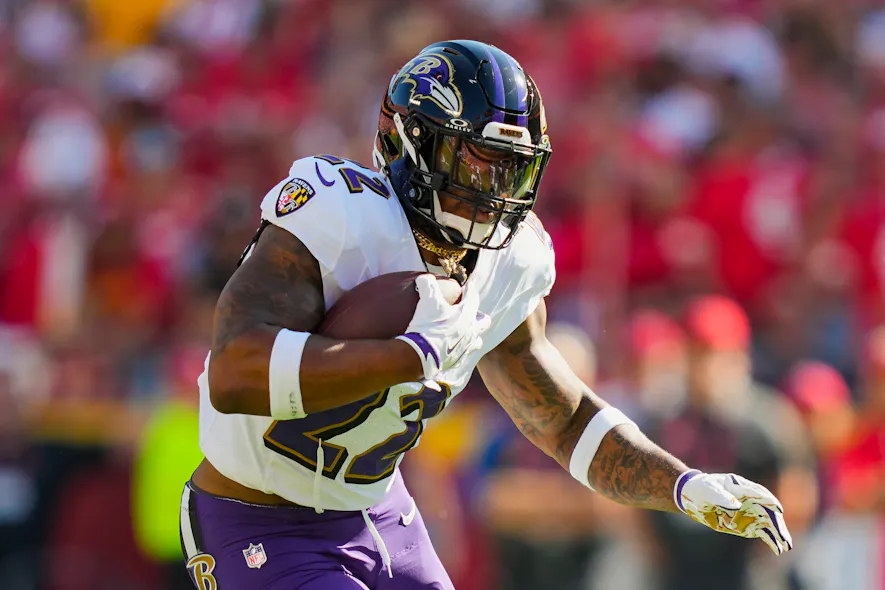
RELATED: See all of our 2026 Player Spotlights here
Stop me if you've heard these before...
- He's too old.
- He's endured too many touches.
- He doesn't catch the ball.
Derrick Henry isn't just fighting his own decline. He is fighting the entire history of the running back position, and the market has priced that fight almost perfectly.
Last season, at age 31, Henry carried the ball 307 times for 1,595 yards and 16 touchdowns, finishing as the RB7 in both total points and points per game. It was his second consecutive 1,500-yard season and his fourth consecutive top-8 fantasy finish. Remarkably, this sustained excellence came in a Baltimore offense that lost Lamar Jackson for four games and spent much of the first half sputtering.
DON'T MISS OUT: Pre-Order the 2026 Footballguys Draft Guide before they are all gone.
The market's response? A consensus ADP of RB12, coming off the board in the middle of the second round. My projections (0.5 PPR scoring) slot him right next door at RB11. That price is no accident; it is the actuarial table talking. The ultimate question we must answer is whether Henry is the lone outlier in NFL history for whom those tables simply do not apply.
The Aging Curve Is the Whole Argument
Forget vague, hand-wringing declarations that "he’s 32 years old." Let's look at what the best senior running back seasons in NFL history actually look like.
All-Time Top 10 Fantasy Seasons: 30-Year-Old Running Backs (0.5 PPR)
| Rank | Player | Year | Age | Gms | Rush | RuYds | RuTD | Recs | RecYds | RecTD | FPTs |
|---|---|---|---|---|---|---|---|---|---|---|---|
| 1 | Priest Holmes | 2003 | 30 | 16 | 320 | 1,420 | 27 | 74 | 690 | - | 410.0 |
| 2 | Tiki Barber | 2005 | 30 | 16 | 357 | 1,860 | 9 | 54 | 530 | 2 | 332.0 |
| 3 | Derrick Henry | 2024 | 30 | 17 | 325 | 1,921 | 16 | 19 | 193 | 2 | 328.9 |
| 4 | Charlie Garner | 2002 | 30 | 16 | 182 | 962 | 7 | 91 | 941 | 4 | 301.8 |
| 5 | Walter Payton | 1984 | 30 | 16 | 381 | 1,684 | 11 | 45 | 368 | - | 293.7 |
| 6 | Thomas Jones | 2008 | 30 | 16 | 290 | 1,312 | 13 | 36 | 207 | 2 | 259.9 |
| 7 | Corey Dillon | 2004 | 30 | 15 | 345 | 1,635 | 12 | 15 | 103 | 1 | 259.3 |
| 8 | Adrian Peterson | 2015 | 30 | 16 | 327 | 1,485 | 11 | 30 | 222 | - | 251.7 |
| 9 | Lamar Smith | 2000 | 30 | 15 | 309 | 1,139 | 14 | 31 | 201 | 2 | 245.5 |
| 10 | Emmitt Smith | 1999 | 30 | 15 | 329 | 1,397 | 11 | 27 | 119 | 2 | 243.1 |
| Average | 15.8 | 316.5 | 1,481.5 | 13.1 | 42.2 | 357.4 | 1.5 | 292.6 |
All-Time Top 10 Fantasy Seasons: 31-Year-Old Running Backs (0.5 PPR)
| Rank | Player | Year | Age | Gms | Rush | RuYds | RuTD | Recs | RecYds | RecTD | FPTs |
|---|---|---|---|---|---|---|---|---|---|---|---|
| 1 | Curtis Martin | 2004 | 31 | 16 | 371 | 1,697 | 12 | 41 | 245 | 2 | 298.7 |
| 2 | Walter Payton | 1985 | 31 | 16 | 324 | 1,551 | 9 | 49 | 483 | 2 | 293.9 |
| 3 | Derrick Henry | 2025 | 31 | 17 | 307 | 1,595 | 16 | 15 | 150 | 0 | 278.0 |
| 4 | Tiki Barber | 2006 | 31 | 16 | 327 | 1,662 | 5 | 58 | 465 | 0 | 271.7 |
| 5 | Ricky Watters | 2000 | 31 | 16 | 278 | 1,242 | 7 | 63 | 613 | 2 | 271.0 |
| 6 | Tony Dorsett | 1985 | 31 | 16 | 305 | 1,307 | 7 | 46 | 449 | 3 | 258.6 |
| 7 | Raheem Mostert | 2023 | 31 | 15 | 209 | 1,012 | 18 | 25 | 175 | 3 | 257.2 |
| 8 | Floyd Little | 1973 | 31 | 14 | 256 | 979 | 12 | 41 | 423 | 1 | 238.7 |
| 9 | Thomas Jones | 2009 | 31 | 16 | 332 | 1,402 | 14 | 10 | 58 | 0 | 235.0 |
| 10 | Lenny Moore | 1964 | 31 | 14 | 157 | 584 | 16 | 21 | 472 | 3 | 230.1 |
| Average | 15.6 | 286.6 | 1,303.1 | 11.6 | 36.9 | 353.3 | 1.6 | 263.3 |
All-Time Top 10 Fantasy Seasons: 32+ Year-Old Running Backs (0.5 PPR)
| Rank | Player | Year | Age | Gms | Rush | RuYds | RuTD | Recs | RecYds | RecTD | FPTs |
|---|---|---|---|---|---|---|---|---|---|---|---|
| 1 | John Riggins | 1983 | 34 | 15 | 375 | 1,347 | 24 | 5 | 29 | 0 | 284.1 |
| 2 | Walter Payton | 1986 | 32 | 16 | 321 | 1,333 | 8 | 37 | 382 | 3 | 256.0 |
| 3 | Ricky Williams | 2009 | 32 | 16 | 241 | 1,121 | 11 | 35 | 264 | 2 | 234.0 |
| 4 | Ottis Anderson | 1989 | 32 | 16 | 325 | 1,023 | 14 | 28 | 268 | 0 | 227.1 |
| 5 | John Riggins | 1984 | 35 | 14 | 327 | 1,239 | 14 | 7 | 43 | 0 | 215.7 |
| 6 | DeAngelo Williams | 2015 | 32 | 16 | 200 | 907 | 11 | 40 | 367 | 0 | 213.4 |
| 7 | Fred Jackson | 2013 | 32 | 16 | 207 | 896 | 9 | 46 | 375 | 1 | 210.1 |
| 8 | Mike Anderson | 2005 | 32 | 15 | 239 | 1,014 | 12 | 18 | 212 | 1 | 209.6 |
| 9 | Marcus Allen | 1993 | 33 | 16 | 206 | 764 | 12 | 34 | 238 | 3 | 207.2 |
| 10 | John Henry Johnson | 1962 | 33 | 14 | 251 | 1,141 | 7 | 32 | 226 | 2 | 206.7 |
| Average | 15.4 | 269.2 | 1,078.5 | 12.2 | 28.2 | 240.4 | 1.2 | 226.4 |
The table below benchmarks the average fantasy output of the top 10 historical seasons at each age threshold against Henry's actual production:
| Age | Avg FPTs, Top 10 Seasons Ever | Henry's Actual Season |
|---|---|---|
| 30 | 292.6 | 328.9 (3rd-best age-30 season ever) |
| 31 | 263.3 | 278.0 (3rd-best age-31 season ever) |
| 32+ | 226.4 | ??? |
Look closely at that historical baseline. Even among the elite survivors who avoided an immediate performance cliff, the running back position naturally sheds roughly 30 fantasy points per year through the early 30s. Keep in mind, this sample completely excludes the dozens of backs who fell off the radar entirely.
Henry isn't just resisting this curve; he is lapping it. His age-30 campaign trailed only Priest Holmes and Tiki Barber on the all-time list, while his age-31 season sat behind only Curtis Martin and Walter Payton. That is two consecutive years of posting top-three historical finishes against the absolute stiffest competition the record books can offer.
Now for the punchline: If Henry regresses directly to 226.4 fantasy points—the historical average of those top ten age-32-plus seasons—he will land right around the RB12-14 range. By drafting him at RB12, the market is pricing Henry to match the exact mathematical average of the greatest "old running back" cohort to ever play the game. Breaking even requires a historical baseline. Turning a significant profit requires him to author one of the three finest age-32-plus seasons in modern football history. Fortunately, we don't need our second-round picks to provide a massive surplus; we just need them to deliver on expectation.