
Welcome to Regression Alert, your weekly guide to using regression to predict the future with uncanny accuracy.
For those who are new to the feature, here's the deal: every week, I break down a topic related to regression to the mean. Some weeks, I'll explain what it is, how it works, why you hear so much about it, and how you can harness its power for yourself. In other weeks, I'll give practical examples of regression at work.
In weeks where I'm giving practical examples, I will select a metric to focus on. I'll rank all players in the league according to that metric and separate the top players into Group A and the bottom players into Group B. I will verify that the players in Group A have outscored the players in Group B to that point in the season. And then I will predict that, by the magic of regression, Group B will outscore Group A going forward.
Crucially, I don't get to pick my samples (other than choosing which metric to focus on). If I'm looking at receivers and Jaxon Smith-Njigba is one of the top performers in my sample, then Jaxon Smith-Njigba goes into Group A, and may the fantasy gods have mercy on my predictions.
And then, because predictions are meaningless without accountability, I track and report my results. Here's last year's season-ending recap, which covered the outcome of every prediction made in our nine-year history, giving our top-line record (51-17, a 75% hit rate) and lessons learned along the way.
What Use is Yards per Carry?
Yards per carry is one of the most beloved statistics for judging running backs. Jamaal Charles has never averaged below 5 yards per carry in a season where he's had at least 20 carries*; therefore, Jamaal Charles is a star. Trent Richardson had 1300 yards from scrimmage and 12 touchdowns as a rookie, ranking as a top-10 fantasy back, but his 3.6 yards per carry was an early warning sign that he would eventually be regarded as a colossal bust.
*(Technically, Charles averaged 4.97 yards per carry in 2013, but what's a few hundredths of a yard among friends?)
I've written more about Trent Richardson before, back in 2014, when another young rookie had just had a high-volume, low-ypc season that had everyone drawing parallels and claiming he was destined to disappoint. I wrote that, based on history, maybe we shouldn't be writing off this Le'Veon Bell fellow quite so quickly.
Indeed, the list of high-volume, low-ypc rookie running backs was basically Trent Richardson and a who's who of Hall of Famers or almost Hall of Famers. In addition to Richardson (3.56 ypc) and Bell (3.52 ypc), there's LaDainian Tomlinson (3.65 ypc), Ricky Williams (3.49 ypc), Walter Payton (3.46 ypc), Emmitt Smith (3.89 ypc), Matt Forte (3.92 ypc), and Marshawn Lynch (3.98 ypc).
Even the guys on the high-volume, low-ypc list who didn't go on to be All-Pros typically had several quality fantasy years in them. Karim Abdul-Jabbar, Travis Henry, Errict Rhett, and Joe Cribbs all followed up their "inefficient" rookie season with a top-12 fantasy campaign as a sophomore. Sammie Smith improved across the board and finished as RB18, and Jahvid Best looked (and produced) like a star before injuries derailed his career.
Since I wrote that article in 2014, Melvin Gordon III also found himself on the "wrong" side of the ledger with an awful rookie ypc of 3.48. Fearing the shade of Trent Richardson, many owners sold low on the "inefficient" Gordon after a "disappointing" rookie season, only to see him rank 3rd in fantasy points (nearly 20% ahead of fourth place) from 2016-2018.
Indeed, other than Richardson himself, the only running back who had a high-volume, low "efficiency" rookie season and followed it up with a disappointing sophomore campaign was James Jackson, who also happens to be the only back in the sample to average below 3 yards per carry as a rookie (2.84), and whose team thought so little of him that they drafted William Green in the first round to replace him.
What is going on here? Why is having a terrible rookie yard-per-carry average such a positive sign for a player's career? The truth is that a poor yards-per-carry average isn't a positive sign. It just isn't a negative one, either. I'm providing a list of high-workload rookies with low yards per carry, and the high-workload part is the real key.
Backs get a high workload because the coaching staff thinks they're good and wants to give them the ball. In the long run, backs who coaching staffs think are good and want to give the ball... tend to be pretty good. The low ypc, in the meantime, is just a meaningless fluke.
What Is Yards per Carry, Anyway?
To understand why yards per carry is a fluke, you have to understand something very important about it: it's not measuring how good a running back is. It's so thoroughly dominated by outlier runs that it's largely measuring whether a back finished the season with four long gains or merely two. For the majority of players who end the year above the league average mark in yards per carry, you only have to remove one or two carries to drop them below the league average.
To some extent, long runs are a product of player skill. But they're a product of a very specific skill—straight-line speed. Someone like Le'Veon Bell might excel at every other skill required of the position, but since he lacks high-end straight-line speed, his ypc will always underestimate his value. Indeed, the longest touchdown run of Bell's career was just 38 yards.
To an even larger extent than skill, long runs are a product of luck. First and foremost, you can't run for 50 yards if your team is only 40 yards from the end zone. Additionally, you likely need some combination of good blocking and poor tackling to get into space in the first place so you can put that straight-line speed to good use. And insofar as long runs are dominated by luck, you'd expect them to vary wildly from one sample to the next.
The Smell Test
What does this mean in practice? Statisticians have a concept called "face validity". Most of the rest of us better know it as "the smell test". Let's say I invent a statistic that I claim measures how good running backs are. The first thing I should do is look at a list of running backs under my new statistic and see if my statistic has face validity—see if it passes the smell test.
If I ranked the 122 running backs who have 300 carries over the last decade and I told you I had Jahmyr Gibbs, Nick Chubb, Jonathan Taylor, and Derrick Henry in my Top 10 and Peyton Barber, Myles Gaskin, and Alfred Blue in my Bottom 10, that would likely pass the smell test.
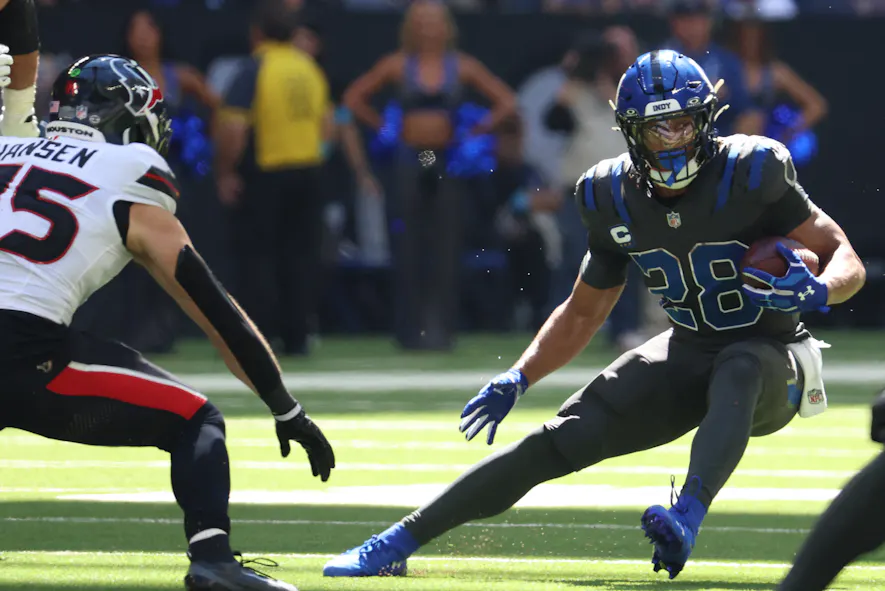
But if I told you I also had Rashaad Penny at #2 overall, J.K. Dobbins 4th, and Raheem Mostert 8th, you might raise an eyebrow. If I told you my Top 20 included Miles Sanders, Jaylen Warren, Khalil Herbert, Gus Edwards, Elijah Mitchell, Damien Harris, Matt Breida, and Bilal Powell... but not Christian McCaffrey or Saquon Barkley (they rank 23rd and 24th, respectively), well, things wouldn't be smelling so good anymore. By the time you find out that Le'Veon Bell, David Johnson, Najee Harris, Leonard Fournette, Frаnk Gore, Adrian Peterson, and Matt Forte all rank in the Bottom 25, well, I doubt you'd have much faith left in my rankings.
The baffling placements go on and on. Todd Gurley behind T.J. Yeldon? Yup. Kenneth Wаlker as the 2nd-best back named Kenneth (behind Kenny Gainwell)? Yup. Marshawn Lynch behind Wayne Gallman, Austin Ekeler behind Rico Dowdle, Alvin Kamara behind Rhamondre Stevenson? Yup, yup, and yup again. Whatever stat I'm using to produce these rankings, it certainly doesn't seem fit for purpose.
But that's exactly the list you see if you rank running backs by yards per carry. The guys toward the top tend to be better than the guys toward the bottom... but this tendency is fairly tenuous. For a statistic that so many take as an indicator of talent, it sure appears to be a poor indicator of talent.