
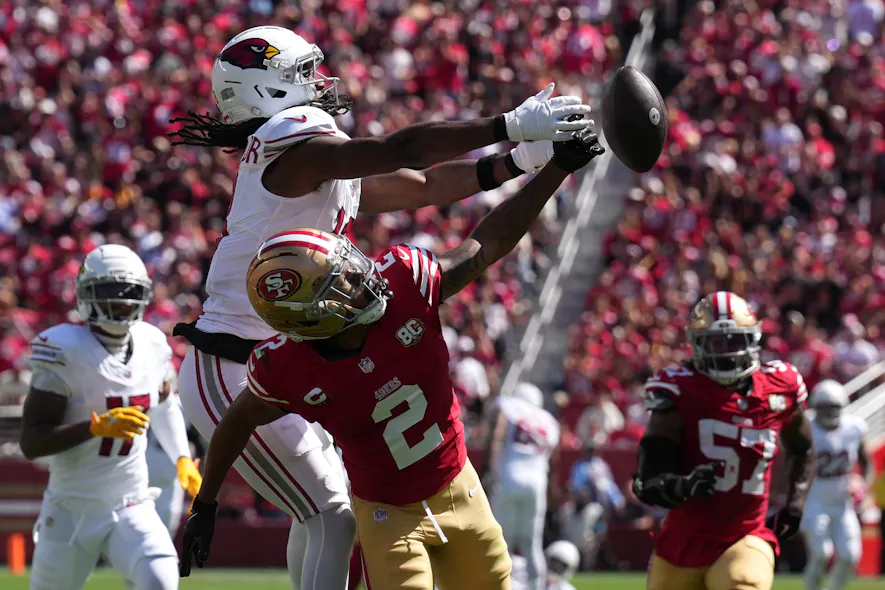
Welcome to Week 6 of the 2026 Footballguys Roundtable. Our intrepid panel of fantasy pundits discusses and debates four topics every week. We split the conversation into separate features.
This week's roundtable features these four topics:
- Surprising Fantasy WRs
- Malik Nabers' Outlook
- Marvin Harrison Jr. Trade
- Drop-Hold-Start: The RB Edition
Let's roll...
Matt Waldman: Marvin Harrison Jr. is now a Texan. Let's explore this trade's impact on the Texans' offense.
- As a team-building move, is this a good move for the Texans?
- What is Harrison's immediate fantasy value in 2026?
- Who stands to lose the most value in the Texans' passing game?
- Harrison has been working with an advanced jugs machine called a Seeker since his college career. It's what Arizona refused to pay for him. Harrison is known for his daily dedication to using it. The Seeker can be programmed for pass trajectory, velocity, placement, playbooks, and fire six targets in rapid succession. What's your best guess as to why he still drops specific types of targets regularly?
Thoughts?
Phil Alexander: No, it's not a good team-building move. Houston is 1-4 and just gave up a second-round pick for a player who doesn't solve an immediate problem, doesn't fill an obvious long-term need, and still hasn't proven he's an above-average NFL receiver more than two years into his career.
Recent history has been largely unkind to notable wide receivers traded during the season. The most likely outcome for Harrison's immediate value is fancy Xavier Hutchinson. Think 7-8 fantasy points per game in half-PPR scoring.
It should be Hutchinson, who rarely adds value to his targets, who stands to lose the most value. Given how long Houston has taken to give Jaylin Noel starter's snaps despite how well he's produced when given a chance, though, I worry it will be him.
As to why he still drops the ball after having a machine to work with, the data says it's because he's not required to separate from, or outrun, the JUGS machine.
Andy Hicks: Stroud likely had input into the trade or at least provided management with a character evaluation. While Harrison arrives as a valuable asset, his disappointing production over his first two-and-a-bit years means he will be on a short leash as he competes for a starting role. Still, I think it's a good move.
I would urge caution about Harrison's immediate value. To date, he has yet to justify his high draft pedigree. Struggling franchises frequently burn premium draft capital on wasted potential, but the Cardinals at least salvaged a strong return asset in the trade. While preseason expectations of WR3 production felt like his absolute ceiling for this year, a reunion with C.J. Stroud could allow Harrison to surprise us all.
To me, Nico Collins seems miscast as a WR1. His overachievement is a credit to his work ethic and reliability. Collins has also benefitted from injuries to a slew of young Texan receivers like Tank Dell and Jayden Higgins who were primed for breakouts. The other receivers don't have much to lose from any numbers Harrison puts up. Collins does. Harrison doesn't have the money in the trust bank like Collins does in Houston, but Stroud and Harrison have an immediate advantage to working strongly together straight away.
Pressure and a bunch of human beings against him is why the Seeker machine isn't helping Harrison. These tools may help his skill set, but they don't help him when it matters. Phil's succinct comment sums it up perfectly.
Jeff Blaylock: Despite his struggles in the desert, Harrison is an immediate upgrade to the committee Houston has used to replace Jayden Higgins, who suffered a season-ending knee injury in training camp. Harrison gives Houston a legitimate threat opposite Nico Collins.
DeMeco Ryans and offensive coordinator Nick Caley offer the fresh start Harrison needed after a coaching staff with no loyalty to him schemed him out of the Cardinals' offense. If nothing else, reuniting Harrison with his college quarterback should boost spirits.
To estimate his fantasy value, we have to understand how Harrison will be deployed. Arizona used Harrison mostly as an X receiver, and over a quarter of his routes were deeper, low-percentage opportunities. Because he's not the best at the catch point and doesn't beat defenders with speed, Arizona's scheme didn't set him up for success.
We must set aside the first four games this season because Harrison was simply running cardio down the sideline. His 18.3-yard average depth of target was the fourth-highest among receivers with at least 10 targets this season, and he was Jacoby Brissett's first-read option less than 10 percent of the time.
In Houston, he likely shifts to a Z/flanker role, which plays more to Harrison's strengths. He is best on slant, dig, curl, and comeback routes, not the deeper sideline routes.
Aligning Harrison as the Z keeps Nico Collins as the primary X receiver and Jaylin Noel (or Christian Kirk, if he's healthy) as the main slot receiver. Harrison would see shorter, higher-percentage targets, and more of them, than he did in Arizona. I don't expect him to suddenly emerge as a Comeback Player of the Year candidate, but a return to fantasy WR3-level production is well within his plausible range for 2026.
Kayshon Boutte and Xavier Hutchinson will be the odd men out once Harrison is fully integrated into the offense. Boutte is averaging 5.5 fantasy points per game, so there's little value to lose.
Hutchinson's production has been closer to eight fantasy points per game, so he falls out of the flex conversation. Dalton Schultz's value takes a slight hit, too, but he can't be trusted as a fantasy starter whenever Nico Collins is on the field. For dynasty purposes, the real value loser will be Jayden Higgins in 2027, assuming both he and Harrison are still on the team.
Pressure is my likely culprit for Harrison's drops, whether it comes from between his own ears or from a coaching staff that didn't have faith in him.