
What Dreams Are Made Of
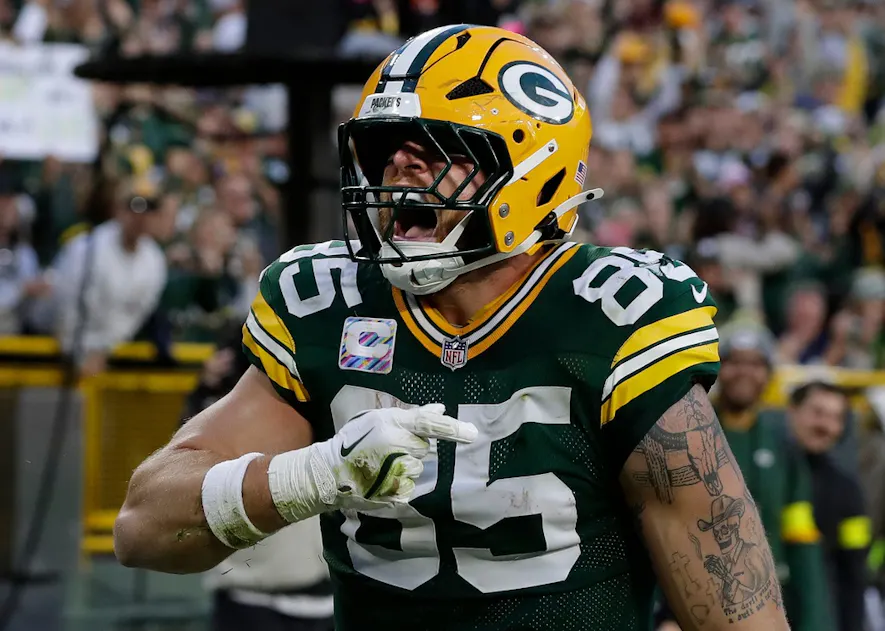
Since entering the league in 2023, Tucker Kraft has steadily climbed the fantasy tight end ranks. In 2024, he was inconsistent but flashed an elite ceiling, finishing as a top-5 tight end three times (including two TE1 overall performances).
Last season, it looked like the breakout finally happened for Kraft. Through Weeks 1-8 (pre-injury), he was the TE2 overall in PPR scoring, averaging more than 16 fantasy points per game and had emerged as Jordan Love’s most consistent receiving option. Then disaster struck in Week 9. Kraft suffered a season-ending knee injury - torn ACL. The breakout campaign came to a screeching halt.
Now, as we look ahead to this season, what once seemed like a slam-dunk TE selection suddenly comes with more questions. Kraft is returning from ACL Reconstruction (ACLR), and Green Bay’s receiving corps is healthier than it was a year ago. The return of Christian Watson, along with the Packers’ other pass-catching options, could chip away at Kraft’s target share.
Despite those concerns, Kraft is still being drafted in the late sixth to early seventh rounds in most redraft and bestball leagues. Whether that price properly accounts for the injury risk and the potential change in workload is worth a closer look.
2026 TE ADP (Last 30 Days)
| Pos Rank | Player | Underdog ADP | DraftKings ADP | Yahoo! ADP |
|---|---|---|---|---|
| 1 | Brock Bowers | 21 | 21 | 18 |
| 2 | Trey McBride | 27 | 23 | 23 |
| 3 | Colston Loveland | 47 | 40 | 36 |
| 4 | Tyler Warren | 64 | 61 | 48 |
| 5 | Tucker Kraft | 83 | 78 | 57 |
The Pre-Injury Vision
Kraft was flat-out dominant before his injury last season.
Through the first eight weeks of 2025, Kraft wasn't simply producing; he was emerging as one of fantasy football's biggest breakout stars. During that stretch, he ranked as the TE2 overall in PPR scoring, and the underlying metrics suggest his production was anything but a fluke.
Fantasy points aside, Kraft was among the league leaders at the tight end position during the first 8 weeks:
- Targets: 41 (9th among TEs)
- Receiving yards: 469 (3rd among TEs)
- 20+ yard receptions: 6 (T-3rd among TEs)
- 50+ yard receptions: 2 (1st among TEs)
- Receiving touchdowns: 6 (2nd among TEs)
An 8-week sample is substantial evidence for a player who had become a focal point of his offense, supporting a strong breakout rather than luck/variance. And if the statistics aren't convincing enough, the film certainly is.
YAC DEMON TUCKER KRAFT
— SleeperNFL (@SleeperNFL) October 27, 2025
pic.twitter.com/6dyyadQ4Hz
With Christian Watson sidelined, Kraft established himself as Green Bay's most dangerous receiving weapon. He led Packers pass catchers in nearly every major receiving category and finished just one target behind Romeo Doubs (42 to 41). More importantly, he looked like Jordan Love's most reliable and explosive option whenever the offense needed a play.
By the midway point of the season, there was little debate left — Tucker Kraft had officially arrived.
ACLR: Return to Play
The excitement surrounding Kraft's 2025 breakout, however, was short-lived. In Week 9 against the Carolina Panthers, he suffered a season-ending ACL tear. The good news is that all early reports out of Green Bay indicate he's on track to be ready for Week 1. Given the timing of both the injury and surgery, I believe a Week 1 return is not only realistic but likely, as he'll be roughly 10 months removed from surgery.
Advances in surgical techniques and rehabilitation have dramatically improved ACL reconstruction recovery over the past decade. NFL players are returning to the field sooner than ever, and many regain their previous level of play more quickly than in years past. That said, fantasy football tells a slightly different story. While the sample of NFL tight ends returning from ACL reconstruction is relatively small, the available evidence suggests fantasy production often declines early in the return-to-play process. This trend isn't unique to tight ends. It has been observed across all fantasy-relevant skill positions. In most cases, the decline appears to be driven more by reduced efficiency than reduced opportunity.
That distinction is critical when evaluating Tucker Kraft. If his workload remains intact but his efficiency takes even a modest step backward, what does that mean for his fantasy outlook? To answer that, we first need to understand which aspects of tight end play are most responsible for fantasy production.