
Welcome to the weekly Fantasy Notebook, the must-stop spot for keeping your finger on the pulse of Fantasy Nation. NFL news and developments drive fantasy values. The Notebook is here to keep you in the loop on all of it throughout the season -- and into the offseason.
Dealing With Disappointment
If you've been playing fantasy football for a while, you're very familiar with disappointment. Those new to the game will quickly learn about it.
Players falling short of expectations are as much a part of the game as your draft, the waiver wire, and checking your scores.
How you deal with it is where you can separate yourself from the field.
Hopium? Copium? Mopium?
We all wish our underperformers were faring better. We all accept the circumstances as part of the game. Sometimes we curse the fantasy gods and complain to those willing to listen to our lamentations.
But when it comes right down to it, we have to make a plan for these players. It's going to be different depending on the player involved, the draft capital expended to secure their services, and the options available to you.
To be clear: there is no right approach.
We're dealing with a sea of ever-shifting circumstances.
But there is a wrong approach.
Doing nothing is not going to get you past the issues. Work the problem. Grind the waiver wire. Look for trade opportunities and make offers when appropriate, even if it means selling low at times.
I'm going to look at six disappointing players, make an effort to understand the issues behind their poor showings, and try to assess the best steps going forward.
You might come to different conclusions as you process this information. That's fine. The important part is processing it and making a plan.
Because you're not going to wish it better.
No Joy in Loveland
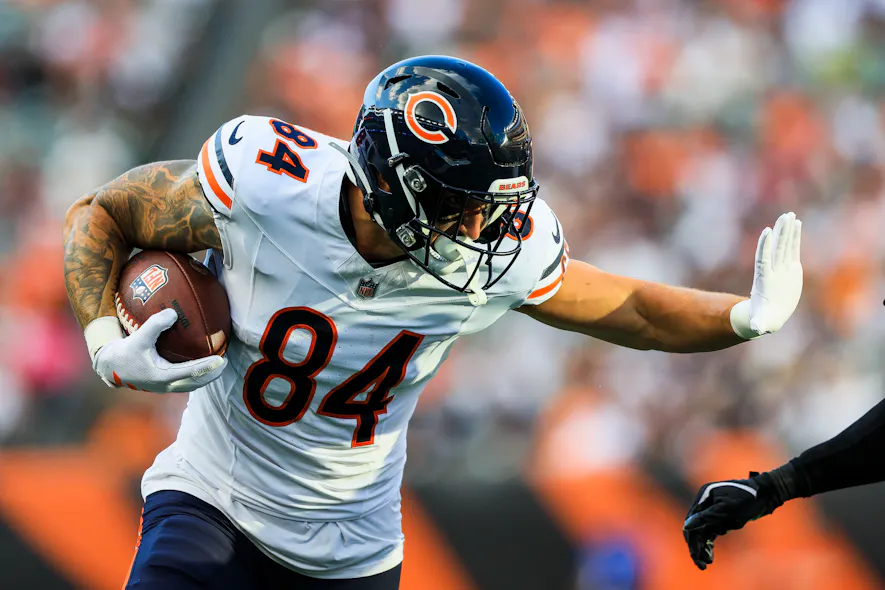
Loveland totaled 597 receiving yards over his final 10 games last season. He was a favorite target of Caleb Williams.
This summer, he was a favorite target for fantasy managers. Loveland was being drafted as TE3 with the 38th pick overall.
That's extraordinary capital for a tight end not named Brock Bowers or Trey McBride.
That's the Problem
Nobody expected Bowers- or McBride-level production. But Loveland is TE48 after three games with a 2.8-point-per-game average.
Even adding the 4-31-0 line he delivered against the Eagles on Monday night, we're looking at five receptions for 34 yards and no touchdowns through three games.
That's not what was expected from last year's No. 10 overall pick, who led the NFC North champs with 713 receiving yards and 58 receptions.
What Happened?
According to ESPN.com's Courtney Cronin, Loveland's disappearance is multifaceted.
Offensive coordinator Press Taylor and head coach Ben Johnson are adamant that Loveland is built into the game plan, often as the primary receiver. The ball has yet to find him.
Another reason behind Loveland's lack of production is the way defenses are playing him.
According to NFL Next Gen Stats, Loveland faced double coverage on 7 percent of his routes over the first two games, which was the highest rate in the NFL regardless of position with a minimum of 40 routes.
As a result, Loveland was averaging significantly less separation, down from 3.7 yards of separation on his targets in 2025 to 2.1.
Can He Turn It Around?
First, this isn't exactly uncharted territory for Loveland, who battled a slow start as a rookie. It wasn't until Week 8 that he reached the end zone, scoring two touchdowns against the Bengals on a day when he hauled in six catches for 118 yards.
So, the answer is yes. Better days could well be coming.
And based on that possibility -- and the draft capital expended to secure his services in drafts this year -- Loveland investors should not release or sell low on the talented tight end.
But for now, there's no reason for him to be in starting lineups.
If there are any quality tight ends on waivers, you should at least consider scooping one up to slot into your lineup while moving Loveland onto your bench.
Look for Darren Waller in Carolina (with a great matchup against the Lions this week), Jets rookie Kenyon Sadiq, Seattle's AJ Barner, or possible targets of opportunity like Tyler Higbee if Rams teammates Terrance Ferguson and Colby Parkinson can't go this weekend.
The Timeshare We Chose to Ignore
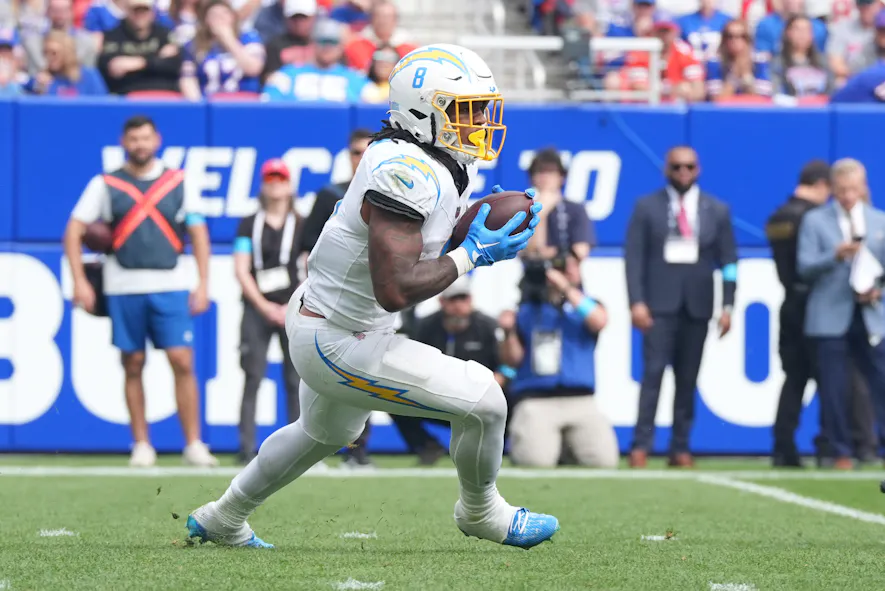
Chargers running back Omarion Hampton went into the season as RB9, drafted with the 15th pick overall.
The high-end production we were banking on hasn't materialized.
The second-year back currently sits at RB21 with an average of 11.8 points per game.
And even though incoming offensive coordinator Mike McDaniel told us in August he would use all of his backs and ride the hot hand, we didn't believe him.
We expected an every-down role. We aren't getting that.
The Split
The shared workload is the biggest issue. In Buffalo this past week, Hampton, Keaton Mitchell, and Kimani Vidal each ran fewer than 30 percent of the routes, and Hampton finished with 56 scoreless rushing yards.
Pro Football Focus' Nathan Jahnke noted this week that the Chargers opened the season with Hampton dominating early downs at a 74.3 percent snap rate. At the same time, Mitchell saw more passing-down work, holding Hampton to 58.2 percent of snaps overall in Week 1.
In Week 2, Kimani Vidal mixed in a bit more on passing downs, though Hampton's early-down rate stayed high.
Vidal took on an even bigger role in Week 3, pushing Hampton almost entirely off the field on passing downs. Mitchell, meanwhile, jumped to 38.6 percent of early-down snaps, up from just 23.7 percent over the first two weeks.
Mitchell's box score has been just as telling.
He's racked up nearly as many rushing yards as Hampton on roughly half the carries, and he's added a receiving touchdown. Through three games, he's outpacing Hampton in both yards per carry and yards after contact.
Hampton still holds the edge in first-down rate, but Mitchell breaks 5-plus-yard runs more often and more than doubles Hampton's rate on 10- and 15-yard gains.
As Late-Round Fantasy's JJ Zachariason put it, "Mitchell just seems to fit this McDaniel offense better than Hampton does, which isn't what Hampton drafters were hoping for when they selected him in August."
If Mitchell's touches keep climbing, the former Raven looks like a legitimate waiver add.
Where Does That Leave Hampton?
Even if we believe in Hampton's talent, the circumstances aren't great.
The Chargers are struggling. The offensive line has struggled beyond the absence of center Tyler Biadasz. It's fair to question the coaching, play-calling, and quarterbacking (more on that below). The receiving corps isn't playing at a high level.
All that compounds the workload problem.
And this week, the Chargers play the Seahawks, who allow the fifth-fewest fantasy points to opposing running backs.
As SI.com's Mark Morales-Smith put it, "Hampton is surrounded by incompetence, and you should consider benching him this week."
Of course, it's not that simple.
Your options will determine your ability to make that call. But at the very least, you should set realistic expectations. Hampton's Footballguys projection -- he's RB28 this week -- is a good starting point.
Players you might consider include Jaylen Warren, Aaron Jones Sr., Braelon Allen, or Bhayshul Tuten.