
We are proud to be among the first, if not the first, to publish full projections for the upcoming season, going live just days after the Super Bowl. Publishing detailed projections in early February comes with trade-offs, not the least of which is a near-total lack of clarity on how free agency, cap transactions, and the NFL draft will reshape rosters.
We've been updating our projections in near real time, including during the recent onslaught of free-agent transactions. This version will remain largely stable until we can layer in the April NFL draft, but stable projections don't mean settled debates.
We have a staff of sharp analysts with sharp takes of their own, so I thought it would be worthwhile to solicit their views on the key coin-toss situations that will shape each team's outlook in the coming months. These are important questions where reasonable, informed people can credibly land in very different places. I asked my colleagues to weigh in with one assumption: they were answering strictly through the lens of a standard 0.5-PPR redraft league.
Chicago Bears Coin-Toss Questions
- Is Williams' Inaccuracy a Warning Sign for His Fantasy Outlook?
- How Will Swift and Monangai Split Touches This Season?
- Should Loveland Be the Third TE Off the Board in Your Draft?
- Odunze or Burden: Who Should Be Picked First This Year?
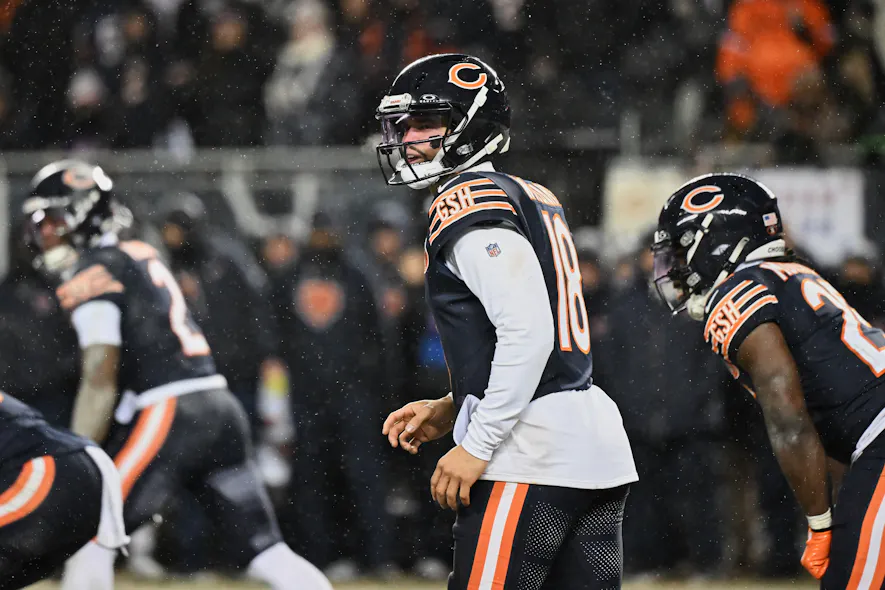
Caleb Williams completed 58.1% of his passes last year. For context, that's the lowest completion rate in the NFL over the last five seasons for a quarterback with at least 500 attempts in a season. Do you care? Do you expect material improvement in his accuracy this year? Or do you see this as a warning sign that he'll regress overall?
Sigmund Bloom: I care insomuch as Williams' inaccuracy/inefficiency is one of the main reasons to opt for another quarterback in his ADP range. I don't think he will regress overall, but I also don't think he is the kind of quarterback who will ever be better within structure than outside it. He's an overpriced matchup QB1.
Maurile Tremblay: I care about it moderately. Ben Johnson has set an explicit target of 65% for 2026. That's roughly 40 additional completions across 17 games, and the coaching staff has already identified 40 plays from 2025 film where a better throw would've produced a completion. Williams is often most impressive on the hardest throws while losing focus on the routine stuff. This pattern is encouraging because fixing the routine stuff should be doable. I expect material improvement in his accuracy, probably landing somewhere in the 62–65% range. I agree with Sigmund on the structural point. Williams' value is tied to his improvisational ability, and his fantasy production will always be a bit streaky, which does make him somewhat matchup-dependent.
Meng Song: I am not a film guy and instead refer to trusted sources like Footballguys' own Matt Waldman and other smart minds. However, across the entire fantasy and NFL content landscape, I have yet to find a single analyst who can consistently predict quarterback development. My own process is to trust that stable organizations and smart GMs and coaches achieve above-average success rates in developing quarterbacks. Chicago has long been a dysfunctional organization, which is why the Bears' targeting and successful hiring of Ben Johnson was a coup. Caleb Williams may very well regress in 2026, but I think the guardrails are in place for him to succeed and continue developing. Ben Johnson is currently a consensus top-five offensive mind in the league, and Chicago has a young, talented pass-catching corps consisting of Rome Odunze, Luther Burden III, and Colston Loveland. The biggest concern is the regression of offensive line play after left tackle Ozzy Trapilo ruptured his patellar tendon during the playoffs and following the surprise retirement of center Drew Dalman. In spite of these concerns, however, I would be comfortable drafting Williams in the top six or seven fantasy quarterbacks due to the strong surrounding cast overall, in addition to his mobility and propensity for adding fantasy production on the ground.
Andy Hicks: Statistics need to be taken into context. A second-year potential elite quarterback who throws a lot is going to miss. If we look at the bottom 10 for this metric, we see the names Patrick Mahomes II and Matthew Stafford — and Trevor Lawrence twice. There were numerous stories pre-season about how Ben Johnson was going to throw the entire complex playbook at Williams and make him sink or swim. He swam quite well, but with even normal development, he should get better. Stats are one thing; the eyeball test tells me Caleb Williams will be an elite NFL quarterback, sooner rather than later. If Williams is in this list after the 2026 season, let's reevaluate. For now, he deserves time to fix the flaws in his game. His positives are numerous.
Jeff Haseley: That 58.1% completion rate is definitely a bright yellow flag, if not a red one. However, the Bears went 11-6 last year and were 8-3 in games decided by six points or less. He was often hunting the big play rather than taking the checkdown, which I'm sure was a key factor in the lower completion percentage. I expect a jump in efficiency in his second year in Ben Johnson's system. For the most part, Johnson's system is built on simplicity and efficiency for quarterbacks, so I'm betting on improvement rather than total regression. If Williams can control his urge for the big play downfield, his completion numbers should increase.