
We are proud to be among the first, if not the first, to publish full projections for the upcoming season, going live just days after the Super Bowl. Publishing detailed projections in early February comes with trade-offs, not the least of which is a near-total lack of clarity on how free agency, cap transactions, and the NFL draft will reshape rosters.
We've been updating our projections in near real time, including during the recent onslaught of free-agent transactions. This version will remain largely stable until we can layer in the April NFL draft, but stable projections don't mean settled debates.
We have a staff of sharp analysts with sharp takes of their own, so I thought it would be worthwhile to solicit their views on the key coin-toss situations that will shape each team's outlook in the coming months. These are important questions where reasonable, informed people can credibly land in very different places. I asked my colleagues to weigh in with one assumption: they were answering strictly through the lens of a standard 0.5-PPR redraft league.
Chicago Bears Coin-Toss Questions
- Is Williams' Inaccuracy a Warning Sign for His Fantasy Outlook?
- How Will Swift and Monangai Split Touches This Season?
- Should Loveland Be the Third TE Off the Board in Your Draft?
- Odunze or Burden: Who Should Be Picked First This Year?
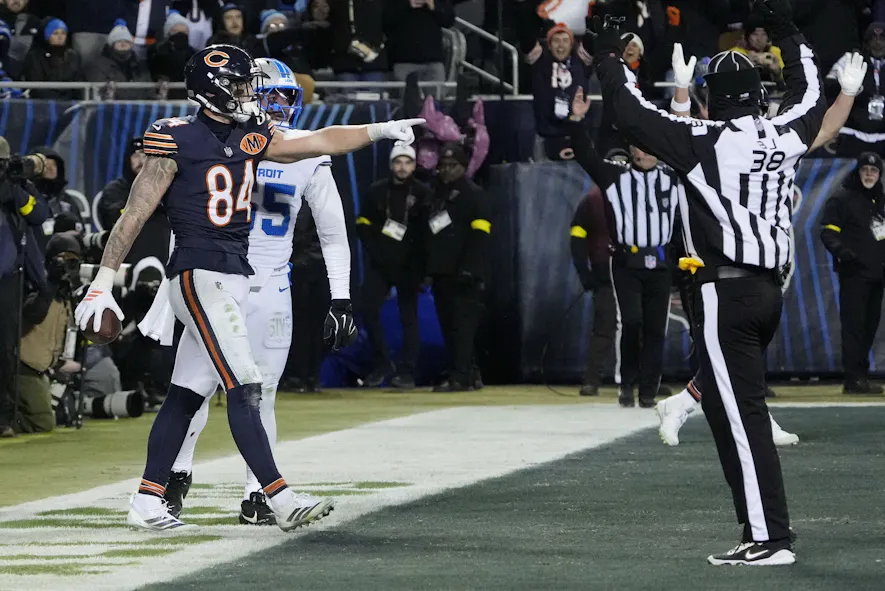
Colston Loveland is the 3rd tight end off the board in early ADP (behind Brock Bowers and Trey McBride). Are you on board with that? If not, where do you rank him?
Sigmund Bloom: Yes. His biggest impact came late in the season and the postseason, and being the No. 1 target in the pass offense is within his range of outcomes. He's going multiple rounds after McBride and Bowers, but his ceiling is closer to theirs than ADP suggests.
Maurile Tremblay: I'm on board with Loveland as TE3. Loveland's production as a 21-year-old rookie was impressive: 58 receptions, 713 yards, and 6 touchdowns in the regular season, followed by a postseason surge that included 12 catches for 193 yards. Loveland's role expanded as the season progressed, and his performance in the playoffs is evidence that Williams trusts him in the highest-leverage moments. The Bears led the league in two-tight-end packages in 2025, with Cole Kmet playing 70% of snaps in that role. But Loveland is the better receiving tight end, and I'd expect his target share to grow in year two.
Meng Song: I don't have an issue with Loveland's positional ADP as the No. 3 tight end given his ceiling, but I suspect his overall ADP may creep up too high for me to draft him. His offensive snap share and target volume increased in the second half of 2025, a trend that correlated with Rome Odunze's stress fracture, which limited the wide receiver's effectiveness. Loveland's jump in usage happened right around Week 9, which was when Odunze first popped up on the injury report. In Weeks 1 through 8, Loveland averaged just a 52% snap share and 3.0 targets per game. From Week 9 onward, those metrics jumped to a 72% snap share and 6.4 targets per game. I do think Loveland will maintain an impactful role in Year 2, but assuming Odunze is healthy, I would temper expectations a little bit.
Andy Hicks: I am beginning to dislike second-year tight ends who have a great rookie year. Brock Bowers, Sam LaPorta, and Kyle Pitts Sr. all dropped significantly in Year Two. Loveland also has Harold Fannin Jr. and Tyler Warren from the class of high-achieving rookie tight ends for company this year. Bowers and LaPorta were both impacted by injuries, and while they fell short of ADP expectations, they still delivered solid production. Loveland absolutely warrants a high ADP this year, but ranking him as the TE3 feels like a stretch — top six is more realistic. From Week 6 onward, he was the third-ranked fantasy tight end, but the gap between third and twelfth was razor-thin. Essentially, a touchdown and a handful of catches. Loveland does deserve upside consideration, but any of the top eight tight ends can have a case made for their inclusion in the top three. A smart drafter waits for one of these eight a few rounds later. Ranking Loveland inside the top eight is common sense. The top three with any certainty is a mistake.
Jeff Haseley: Absolutely not. Loveland finished TE12 last year, and while he was TE5 from Week 10 on, it's still too high for me to consider him as the third tight end off the board. If I am drafting Loveland this year, it's because he falls down the board and yields excellent value.