Many of us are still consuming fantasy content this week because of Trey McBride. The matchup nightmare we hoped we were drafting this summer had a massive Week 15. I'll get to how it looked shortly.
Welcome to the penultimate edition of Fantasy Dreams and Nightmares. I'll save the farewells, thank-yous, and the you-rule-for-readings for next week. There are more pressing matters to attend to. I hope that if you're still reading, you're still alive in your quest for hardware. It was a week of close calls. Nothing is more representative of the fickle nature of fantasy football quite like a playoff loss.
The beauty is there's nothing more exhilarating than a playoff win. Perspective is key in the wake of both results.
Isaiah Likely was one of the week's more consequential players. Firing him up made too much sense. Cincinnati was allowing tight ends to score 8.3 points over their season points-per-game average entering Week 15. That was the worst mark in the league by a significant margin. Likely played at least 50 percent of the snaps in every game after Week 4, and logged six targets in Weeks 13 and 14. He was a top-12 tight end in each of those games, including against the Bengals on Thanksgiving.
You know what really made this feel like a smash spot? A tight end facing Cincinnati's defense has finished in the top-10 at the position in each week since Week 4. The Bengals' 2,160 yards after the catch allowed entering Week 15 were the most by any defense and 291 more than the second-worst Commanders. 518 of those yards, or 23.9 percent of the total, were also deemed over expected. Perfect for maximizing Likely's ability after the catch.
So, now that I've established why he was my start of the week on Sunday Morning Live, we can acknowledge that I swung and missed harder than Giancarlo Stanton.
Likely broke managers who started him, and saved those facing him, by finishing without a single catch. He wasn't even targeted. Mark Andrews was only targeted three times. Lamar Jackson attempted 12 passes, the fewest in a game that he started and finished in his career. Baltimore's defense and Derrick Henry did the heavy lifting. It was a brutal time for a weird game.
The reason for the dissertation on the Likely dud is that those games should remind us that it's difficult to win fantasy championships. Even the layups can look like three-point airballs when the dust settles. All we can do is trust the process that got us here. If you're still playing, there's a reason why. Lean into that.
That'll do it for the intro, my friends. Let's get into the six storylines that defined Week 15.
Fantasy Dream: A Salute to Trey McBride
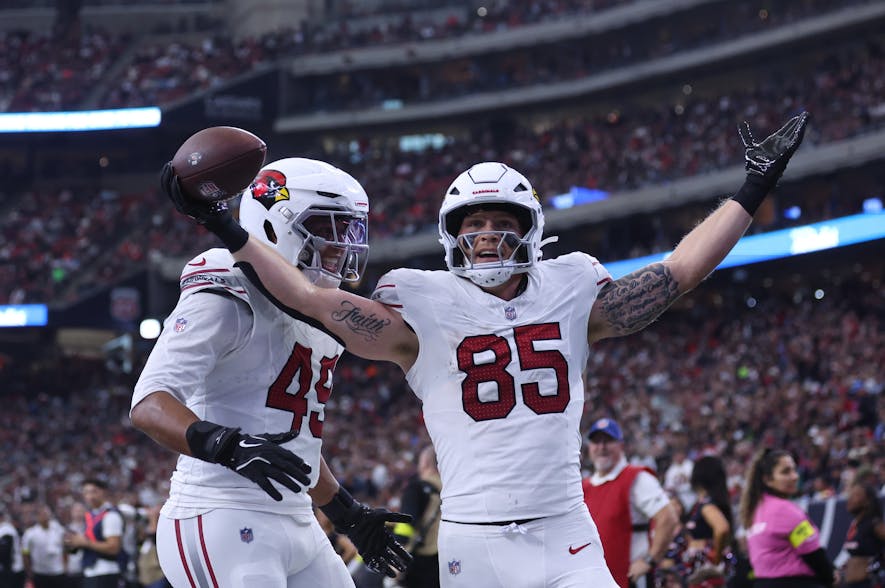
At the opposite end of the tight end spectrum in Week 15 was McBride. He laughed when we questioned his ceiling against the red-hot Texans defense. McBride, the guy who couldn't find the end zone, scored twice in Houston. He's up to 10 touchdowns, with three games to go. He scored six times in his first three career seasons combined.
I wonder what changed.
Trey McBride's 17-game pace with Jacoby Brissett at QB, and where it would rank among all TE seasons in NFL history:
— Underdog (@Underdog) December 15, 2025
185 targets (1st)
144 receptions (1st)
1504 yards (1st)
17 TDs (1st)
324.1 fantasy points (1st) pic.twitter.com/GuXHIOOc54
So much of the argument against drafting a tight end with a late-first or early second-round pick centers around value. Those who were in favor of selecting a premium tight end were focused on the positional advantage. In an effort to accurately depict McBride's value, I wanted to contextualize his metrics and fantasy production with where each would rank among wide receivers.
Trey McBride's Season Metrics with Where He'd Rank Among Wide Receivers
| Metric | Trey McBride | Rank Among Qualified WRs |
|---|---|---|
| Target Share | 25.5% | T-9th |
| Receptions Per Game | 7.5 | 3rd |
| Yards Per Route Run | 1.8 | T-24th |
| Expected Points Added/Target | +0.47 | 12th |
| Missed Tackles Forced | 21 | 2nd |
| Yards After Catch | 506 | 3rd |
| Half-PPR Fantasy Points Per Target | 1.6 | T-13 |
| Half-PPR Fantasy Points Per Game | 15.7 | WR5 |
The impact of the shift from Kyler Murray to Jacoby Brissett on McBride's outlook can't be overstated. From Weeks 1-5, McBride averaged 9.6 Half-PPR points per game. He scored one touchdown on 42 targets. A top-five tight end, sure. Whether or not he was worth the premium investment as a significant positional advantage was still a reasonable question.
From Weeks 6-15, McBride is averaging 19.1 points per game. He's caught nine touchdowns on 76 receptions. If he were solely eligible as a wide receiver, he'd be the WR2 over that span behind only Jaxson Smith-Njigba. The next closest receiver is George Pickens, with 14.9 points per game.
If the McBride team were to play the Bowers team in your league, McBride's 19.1 points per game would provide a five-point cushion over Bowers' 14.1 points per game average. For reference, that's the second-best per-game figure from Weeks 6-15. I think we can call that a positional advantage.
I don't want to ignore the benefit of the situation. I think it's fair to assume a competitive Cardinals team isn't asking its quarterback to throw 38.6 times per game. This offense ran at the 11th-highest rate in 2024. What we're seeing now is a slight departure from a preferred identity. Still, McBride is only 26 and will continue to be one of the few players at the position with the profile to be his team's offensive catalyst. You won't find me attempting to discount that.
Fantasy Nightmare: The Mack Hollins Infatuation
The feeling that Stefon Diggs could be a viable fantasy asset down the stretch was fun while it lasted. In this current iteration of New England's offense, Hollins rarely leaves the field.
After Diggs' run as the WR15 in Half-PPR points per game with 13.1 over Weeks 9-11, he's averaging 3.7 points per game over Weeks 12-15. That's 88th among receivers over the latter span.
Patriots Wide Receivers Over the Last Three Games
| Metrics | Mack Hollins | Stefon Diggs | DeMario Douglas | Kayshon Boutte |
|---|---|---|---|---|
| Snap Share | 79.9% | 48.3% | 23.5% | 76.6% |
| Target Share | 21.6% | 13% | 4.2% | 8.7% |
| Receptions/Game | 3.0 | 2.7 | 1.3 | 2.3 |
| Receiving Yards/Game | 31.3 | 24 | 23.3 | 26.7 |
| Yards/Route Run | 1.3 | 1.2 | 2.1 | 1 |
| Expected Points Added/Target | -0.10 | 0.21 | 1.54 | 1.43 |
| Air Yards/Target | 14.6 | 6.5 | 13.6 | 11.2 |
| Half-PPR Fantasy Points/Game | 4.6 | 3.7 | 3.6 | 5.8 |
The Patriots are throwing on 52.9 percent of their plays over the last three weeks. That's almost dead-on with their season average of 53.1 percent. Over Diggs' three-week run, the pass rate didn't spike. New England still threw on 54.1 percent of its plays. While it was a slight uptick, Diggs handled a 24 percent target share and two yards per route run. He handled volume with efficiency.
Based on New England's last three games, Boutte and Hollins are the only two full-time receivers the team employs. That hasn't equated to much in terms of fantasy utility.
The frustrating nature of this shift might have something to do with Diggs' usage in Week 11. In New England's win over the Jets on Thursday Night Football, Diggs played a season-high 71 percent of the offensive snaps and logged a 32.4 percent target share. He was, again, efficient with the volume, averaging 3.2 yards per route run. It was the fourth time in five games he posted a target share north of 20 percent. He hasn't logged more than five targets in a single game since then.
That makes Diggs difficult to trust, right after it seemed like we could.