
Welcome to Week 1 of the 2026 Footballguys Roundtable. Our intrepid panel of fantasy pundits discusses and debates four topics every week. We split the conversation into separate features.
This week's roundtable features these four topics:
- Bold Fantasy Predictions
- The Players They Wish They Drafted Less
- The Players They Wish They Drafted More
- Listening to the Little Voice
Let's roll...
Matt Waldman: Who are the players you wish you drafted more often than you did and why?
Maurile Tremblay: Two early-mid-round players I should have leaned on much harder are DeVonta Smith and Ken Walker III. The A.J. Brown trade to New England freed more than 120 targets, and Smith's only competition for those looks is a rookie in Makai Lemon who missed most of camp and a depth piece in Dontayvion Wicks. Meanwhile, Kansas City handed Walker a full three-down role, including the red-zone and screen work Seattle used to give Zach Charbonnet, in an offense shifting toward under-center power runs under Eric Bieniemy.
My biggest positional regret is tight end, where I mostly waited and then settled. I wish I'd taken more Sam LaPorta. Drew Petzing's Arizona offenses led the league in tight end target share and ran two- and three-tight-end sets extensively. Jared Goff's efficiency per dropback was much higher with LaPorta on the field than without him. I should have made him my tight end in every draft where I had not already taken Trey McBride. Even later, Isaiah Likely had a terrific training camp with the Giants, and Matt Nagy's offense is built around two-tight-end sets.
The late-round back I most regret passing on is Chris Rodriguez Jr. He should lead the Jaguars in rushing yards and get most of the goal-line carries in an offense that averaged 33.6 points per game during its closing run. (Runner-up is Kenny Gainwell, who could lead Tampa Bay in total touchdowns.)
Jeff Haseley: The three players I keep coming back to are Chase Brown, Colston Loveland, and David Montgomery.
I found myself passing on Brown in draft after draft, largely because I was too enamored with wide receivers at the end of the first and early second round. But looking back, I wish I had clicked his name more often. He possesses true high-touch, dual-threat potential in a potent Joe Burrow offense. The Bengals are content to let him dominate touches, and in PPR formats, a clear workhorse in an elite passing attack at a reasonable ADP is something you can never have enough of.
Loveland's price tag climbed into the 4th/5th-round range late in draft season, which felt steep for a second-year tight end. But watching Ben Johnson's offense in Chicago continue to evolve, it's clear Loveland is the real deal.
Once he fully unlocked his playing time late in his 2025 rookie season, he was delivering top-tier WR1-level weekly numbers at the tight end position. Pairing Caleb Williams with an athletic focal point in the middle of the field yields elite upside, and I probably should have bent my draft strategy to secure that edge.
I fell into the trap of fading Montgomery because of his move to Houston and the fear of a messy backfield committee. Yet, every year, people overlook just how reliable Montgomery is as a physical, volume-driven running back.
Montgomery consistently finds the end zone and brings a far higher workload floor in that Texans offense than his mid-round price tag reflected. He is the exact kind of RB2/Flex player you end up desperately wishing you had on your bench the moment early-season injuries hit.
Corey Spala: Rhamondre Stevenson, Jaylen Warren, and Jacory Croskey-Merrit are players I wish I had drafted more. Running backs in perceived ambiguous situations do not give me confidence when drafting them. I understand it is easy to play the hindsight game and note that I wish I had drafted them more.
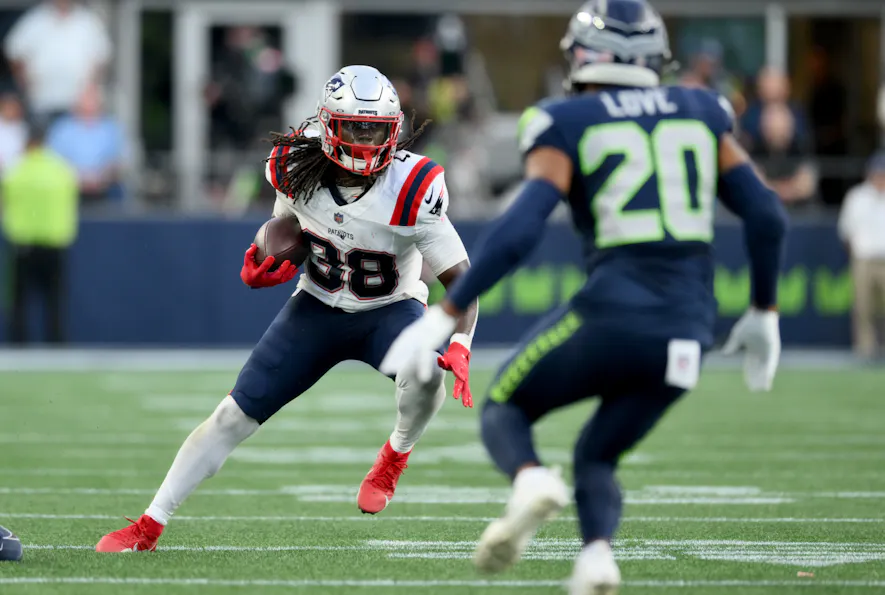
Personally, I should have noted Stevenson's usage in the playoffs, with New England accumulating 75 percent of the touches. TreVeyon Henderson will have a role, but it does not interfere with Stevenson’s.
Stevenson is more than capable of helping during pass-down situations; he has over 30 receptions over the last four seasons. There is an existing consistent role with the potential for a larger workload any given week.
Pittsburgh signed Rico Dowdle and drafted Eli Heidenreich. Warren has had a career complementary role and saw an uptick in usage following the departure of Najee Harris.
Dowdle's signing brings back the perceived uncertainty. Warren comfortably handled an increased workload while maintaining his receiving outlook. The departure of Kenny Gainwell should open more receiving opportunities, even if Warren loses carries to Dowdle.
Washington signed Rachaad White and drafted Kaytron Allen. I should not have overthought White’s low-guaranteed deal ($1.7M) and Allen’s sixth-round investment.
I am sure you are able to identify other players who may be in situations where you can overthink relative to Jahmyr Gibbs, Ja’Marr Chase, and other focal pieces of an offense. Those players are nearly guaranteed to finish atop their positions outside of injuries.
In season-long leagues, players with a role and a path to high-volume touches shouldn't get lost in the what-ifs. Your scoring settings will matter when determining which players to target.
A good baseline is the outlook for total touches, regardless of whether they come from the rushing or passing game. Having the ball in your hands is an ideal situation in season-long leagues, especially from the middle rounds.