
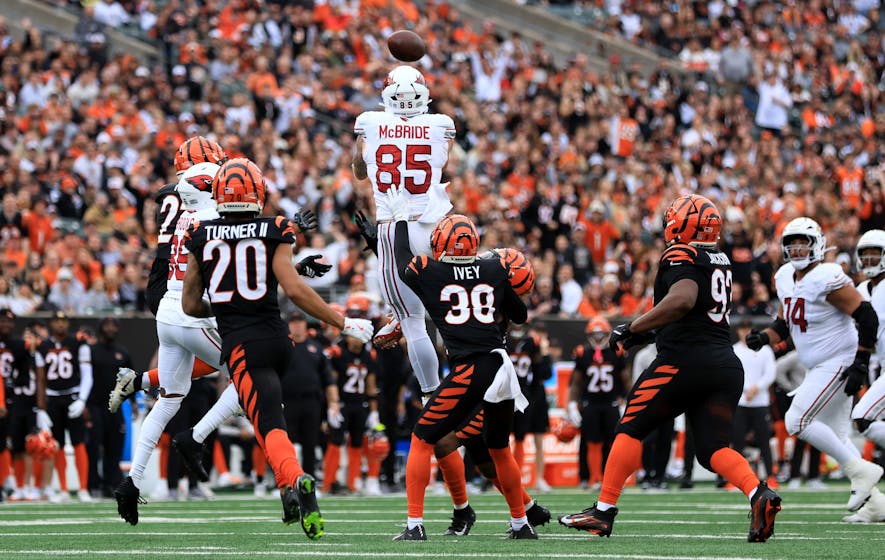
It's time to reflect on this season's fantasy football experience and figure out what (if anything) we learned that we can apply to improve our outcomes in the future. We'll break this down position by position. Today, the ever-disappointing world of fantasy tight ends.
Quick Links: Quarterbacks (1/27) | Running Backs (2/3) | Wide Receivers (2/4)
Lesson 1: Kyler Murray Was Holding Trey McBride Back
Nobody who watched Kyler Murray play for the first six years of his career would have said he was one of the NFL's best passers, but we never suspected that he was keeping Trey McBride from being the most valuable player in fantasy football. Jacoby Brissett - who was considered a journeyman stopgap backup coming into 2025 - vaulted McBride to the same scoring level in PPR leagues as Puka Nacua and Jaxon Smith-Njigba once the veteran quarterback took over in Week 6.
A terrible Cardinals team that created a lot of garbage-time defense helped the fantasy production, but the Cardinals seemed to realize the quarterback change was necessary, as the team put Murray on injured reserve only after he had missed a month with a foot injury.
How to use this lesson in 2026
Is McBride a value pick in the second round? That's his way-too-early ADP. Brissett is under contract with Arizona for 2026, but the team could draft or sign another quarterback. He probably won't reproduce his 2025 numbers, but if Brissett is back, McBride could still return the expected value of a second-round pick, so it's not crazy to take him there.
There's also a strong candidate to be the McBride of 2026 who you might wait a round to see if you can take instead.
Lesson 2: Last Season Was Tough at TE for Fantasy
It's easy to forget that McBride was averaging a paltry 12.5 PPR points per game through Week 5. Jake Ferguson and Tucker Kraft were jockeying to be TE1 in fantasy leagues before Brissett settled in. Kraft was in the middle of a breakout year before going down with a torn ACL in Week 9. Ferguson was a PPR volume and red zone monster in an improved Cowboys pass offense, but eventually fell out of favor as a target and became a fantasy liability during the playoffs. He still finished as TE7.
Unless you had McBride, your fantasy tight end spot was probably unstable week-to-week due to injury or unpredictable performance, which made his production even more valuable. Injuries (Bowers, Kittle, LaPorta, Kraft), age-based decline (Kelce, Andrews, Engram, Njoku), quarterback injury (Warren), the rookie curve (Loveland), and a poor offense (Hockenson) doomed the other 11 tight ends that went in the top 12 of fantasy drafts.
How to use this lesson in 2026
It's okay to punt tight end in your draft if you don't take McBride or Bowers early. It might even be the best strategy for the second year in a row, but with so many ascending 2025 rookies (Loveland, Warren, Harold Fannin Jr., Oronde Gadsden) at the position, there could be a breakout player or two in the mid rounds worth targeting.
Lesson 3: Avoid Tight Ends on the Back Nine of Their Career
There were five tight ends in the top 12 that were 29 or older: George Kittle (TE3), Travis Kelce (TE7), Mark Andrews (TE8), Evan Engram (TE9), and David Njoku (TE12)
Kittle produced at the level of the two tight ends going a round or more ahead of him, which made him seem like a screaming value. Ends up the hive mind was right to consider him a tier below. Kittle missed five games because of a Week 1 hamstring injury, then missed Week 17 with a hamstring injury, and finally went down with a torn Achilles in the Wild Card win over the Eagles.
He was still a better pick than Andrews, Engram, or Njoku, who all finished at TE25 or lower. All were on (or should have been on) the waiver wire during the fantasy playoffs, and for good reason.
Kelce was startable until Patrick Mahomes II went down, but he still did not eclipse the PPR points-per-game average he posted in 2024, when he was TE7 and widely considered a disappointment.
How to use this lesson in 2026
Kittle is the only tight end 29 or older who could go in the top 12 in 2029 drafts, but he's an easy fade coming off an Achilles tear. Dallas Goedert, Mark Andrews, and Hunter Henry could go in the TE13-18 range, which is a more palatable price to pay for a player in their golden years.