
Adam Harstad recently wrote a great article titled There Is an Offseason, making a strong case that the smartest move this time of year is often to do nothing at all. I agree. January is not the moment for firm conclusions or aggressive roster surgery. At best, we are making educated guesses about how free agency, the NFL Draft, and key organizational decisions will eventually shape dynasty values for 2026. There is no real downside to resisting the urge to immediately start tinkering, especially before we have actual information to react to.
That reality raises an obvious question for a monthly dynasty trade value article published in January. If we are not supposed to be acting with conviction yet, what exactly should we be doing? My answer is that this part of the offseason is less about answers and more about framing the right questions. This is the time to zoom out and think about the major inflection points that will matter most over the next several months. Which players carry the most outcome variance? Which roles, depth charts, and contract situations could meaningfully swing player values the most once real news arrives? And where are the fault lines in dynasty valuations that will ultimately determine whether your 2026 offseason trading is successful or not?
You should not have a long list of conclusions right now. We have the entire offseason to process the 2025 season, absorb new information, and let prices settle after free agency and the draft. What you should have is a mental checklist of the biggest questions you want answers to. This month's Dynasty Trade Value Chart article is written with that mindset. It reflects how I'm currently thinking about the landscape, some early attempts to quantify uncertainty, and a few initial leans on where I may eventually place my chips once it actually makes sense to start pushing them into the middle.
Tools and Full Values
As always, my most recent dynasty trade values, which can be adjusted to your specific format, are available in the Dynasty Trade Value Chart tool. Full listings of player values are always available there. The positional value tables below only include the most valuable players at each position.
Quarterback
| Rank | Player | Team | Value | SF Value |
|---|---|---|---|---|
| 1 | Josh Allen | BUF | 22 | 55 |
| 2 | Drake Maye | NE | 21 | 54 |
| 3 | Lamar Jackson | BAL | 17 | 45 |
| 4 | Joe Burrow | CIN | 17 | 45 |
| 5 | Jayden Daniels | WAS | 15 | 43 |
| 6 | Justin Herbert | LAC | 15 | 42 |
| 7 | Jalen Hurts | PHI | 12 | 40 |
| 8 | Patrick Mahomes II | KC | 11 | 40 |
| 9 | Caleb Williams | CHI | 11 | 40 |
| 10 | Jaxson Dart | NYG | 9 | 35 |
| 11 | Brock Purdy | SF | 8 | 35 |
| 12 | Trevor Lawrence | JAX | 7 | 33 |
| 13 | Bo Nix | DEN | 7 | 32 |
| 14 | C.J. Stroud | HOU | 7 | 31 |
| 15 | Dak Prescott | DAL | 7 | 29 |
| 16 | Jordan Love | GB | 7 | 29 |
| 17 | Cameron Ward | TEN | 6 | 28 |
| 18 | Sam Darnold | SEA | 6 | 27 |
| 19 | Baker Mayfield | TB | 6 | 26 |
| 20 | Jared Goff | DET | 5 | 25 |
| 21 | Tyler Shough | NO | 5 | 24 |
| 22 | Bryce Young | CAR | 4 | 22 |
| 23 | Daniel Jones | IND | 3 | 17 |
| 24 | Matthew Stafford | LAR | 3 | 14 |
| 25 | Michael Penix Jr. | ATL | 3 | 13 |
| 26 | J.J. McCarthy | MIN | 3 | 13 |
| 27 | Kyler Murray | ARI | 3 | 11 |
| 28 | Shedeur Sanders | CLE | 2 | 9 |
| 29 | Malik Willis | GB | 2 | 9 |
| 30 | Mac Jones | SF | 2 | 8 |
| 31 | Jacoby Brissett | ARI | 2 | 7 |
| 32 | Tua Tagovailoa | MIA | 1 | 6 |
| 33 | Geno Smith | LV | 1 | 5 |
| 34 | Aaron Rodgers | PIT | 1 | 4 |
| 35 | Anthony Richardson Sr. | IND | 1 | 4 |
| 36 | Marcus Mariota | WAS | 1 | 4 |
| 37 | Kirk Cousins | ATL | 1 | 4 |
| 38 | Quinn Ewers | MIA | 1 | 4 |
| 39 | Jalen Milroe | SEA | 1 | 4 |
QB Musical Chairs: Open Seats
Every offseason, the biggest storyline revolves around player movement at the most impactful position in sports: quarterback. The 2026 offseason will be no different, although there appear to be fewer marquee names potentially on the move than we have seen in recent years. There may also be less intrigue at the top of the NFL Draft. While several underclassmen still have decisions to make, the early expectation is that the class features just two surefire rookie starters, and we have an unusually strong sense of where both will land.
If things play out as expected, Fernando Mendoza would go first overall to Las Vegas, with Dante Moore following as the second pick to the Jets. I would not bet my life savings on that exact outcome, but it is a reasonable working assumption for now. If those two seats are filled, we are left with a game of quarterback musical chairs centered around the following seven teams whose 2026 quarterback situations remain very much in flux.
Pittsburgh
Does Aaron Rodgers come back for another season? Tyler Loop's missed field goal that allowed the Steelers to sneak into the playoffs may have bought Rodgers another year if he wants it. If he retires or the organization decides to go in a different direction, this becomes the league's most wide-open starting job.
Miami
All indications are that the Dolphins are ready to move on from Tua Tagovailoa, and Quinn Ewers does not appear to be a long-term answer. Miami could be one of the most aggressive teams in the league when it comes to upgrading the quarterback position for 2026. Tagovailoa's market, should he hit free agency, will be one of the more fascinating situations to monitor.
Arizona
The firing of Jonathan Gannon opens several possible paths. The Cardinals could hire a coach who wants to give Kyler Murray another run in 2026. They could decide they liked what they saw from the passing offense with Jacoby Brissett and lean into the veteran option. They could keep both and allow a competition. However it plays out, this feels like one of the defining decision points of the 2026 offseason. Murray's trade market, if he becomes available, would be especially interesting.
Cleveland
The Browns had to watch the top two draft picks go to quarterback-needy teams, which is frustrating for a franchise that has been searching for stability at the position for decades. The silver lining is that it increases the odds that Shedeur Sanders gets another season to prove himself. Deshaun Watson's contract remains guaranteed, Dillon Gabriel is also in the building, and none of the options are particularly inspiring. The most sensible path may be to continue building the roster, give Sanders another year to audition, and position the team to pursue a true difference-maker in 2027 if needed.
Atlanta
Michael Penix Jr. struggled as a first-year starter, and how secure his hold on the 2026 job is will be determined by a new coaching staff. Kirk Cousins would be an expensive backup, but he is also a valuable insurance policy. That combination makes this one of the trickier quarterback rooms for a new staff to evaluate.
Minnesota
J.J. McCarthy showed real improvement late in the 2025 season, although much of it came against some of the league's weakest pass defenses. I lean toward him getting another year as the presumptive starter. Still, the Vikings, at minimum, need a much stronger Plan B. McCarthy's injury history and uneven early-season play make it imperative that a legitimate starting-caliber veteran is in the building.
Indianapolis
The Colts appeared to have solved their quarterback issues with Daniel Jones' strong early-season play, but a midseason Achilles tear complicates everything. His recovery timeline clouds his Week 1 availability for 2026 and makes contract negotiations more difficult. The most likely outcome is that Indianapolis works out a longer-term deal and continues to view Jones as the eventual answer.
QB Musical Chairs: Potential Seat Fillers
Several of the teams above may already have their eventual starter in-house. It is entirely possible that Kyler Murray, Tua Tagovailoa, or Kirk Cousins ends up filling one of these open or semi-open seats. Geno Smith could also be available with the Raiders expected to turn things over to a rookie. However, the two most intriguing potential solutions are current backups on playoff teams.
For my money, Malik Willis is the most underrated dynasty asset at quarterback. He was outstanding filling in for Jordan Love in Green Bay, is an unrestricted free agent, and would be my top target if I were running a quarterback-needy franchise. Willis has always had elite athleticism and arm strength, and he appears to have made real progress as a passer.
The other name worth monitoring is Mac Jones. Unlike Willis, Jones is under contract through 2026 on a very team-friendly deal with the 49ers, which gives him real value to San Francisco and likely makes him costly in a trade. That said, he has been excellent when asked to start for extended stretches over the past two seasons. He fits the profile of the type of quarterback a team like Minnesota would want in-house to compete with McCarthy. If Rodgers retires, it would not be surprising to see Pittsburgh explore whether a Day 2 pick is enough to pry Jones loose.
Tyler Shough: Small Sample, Big Questions
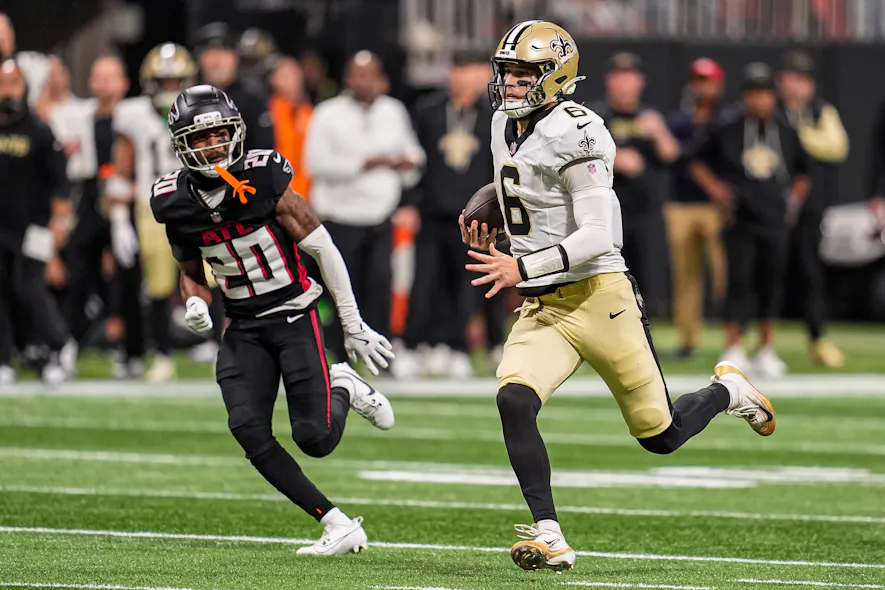
Valuing Tyler Shough right now is uncomfortable, and that is probably a good thing. We are talking about less than half a season as a starter, which is always a dangerous foundation for confident dynasty conclusions. Small samples lie all the time, especially at quarterback. That said, what we saw from Shough was impressive enough that we cannot simply hand-wave it away or park him in the "wait-and-see" bucket with the rest of the unknowns.
Over the final five games of the season, Shough led a patchwork group of skill players to a 4–1 record while averaging 263 passing yards and 27 rushing yards per game. He threw only five passing touchdowns over that stretch, but he added three more on the ground, and the overall efficiency of the offense was notable. The setup is quietly appealing for fantasy purposes: a fast-paced offense, a dome, and warm-weather divisional opponents that minimize late-season weather concerns. There are also some young, developing pieces along the offensive line, and the supporting cast should improve rather than regress.
The age factor is what complicates everything. Shough is an outlier in terms of his age when he entered the league, which narrows the margin of error in his dynasty valuation. At the same time, the idea that he should improve with more experience still applies, even if the runway is shorter than it would be for a typical young starter. So, where does he fit relative to his peers in his division? In my value rankings, Shough currently sits ahead of Michael Penix Jr. and Bryce Young, but still behind Baker Mayfield. The broader market has it flipped, with Young generally valued above Shough, and that disconnect is one of the more interesting dynasty debates to track this offseason. Even in a limited sample, I think Shough has shown more consistent NFL-caliber traits and more flashes of high-end play than Young has across three seasons. That does not mean the case is closed. Young is still two years younger, and Shough's age makes his profile more fragile if things stall. But if you are weighing what we have actually seen on an NFL field, rather than what we once hoped to see, I believe Shough should be valued slightly higher. I am not quite ready to push him past Mayfield, but the gap there is narrower than it appears. As with any early take, this is subject to change after deeper analysis.
Running Back
Continue reading this content with a ELITE subscription.
An ELITE subscription is required to access content for Dynasty leagues. If this league is not a Dynasty league, you can edit your leagues here.