
Week 1 of the 2026 NFL season has come and gone, and it's on to Week 2. It's important to take note of different storylines and situations, but it's also important not to overreact to these early occurrences. Let's dig deep and try to decipher some clarity as we look back at Week 1 and look ahead to Week 2.
Chasing points is real, and it's a slippery slope. We've all done it. Player X has a huge week on your bench, so you do what any self-respecting fantasy enthusiast would do. You start him next week, and he delivers a total disappointment. Now you've lost out on the first week of success, and you followed it up with a dud in the second week. What do you do in the third week? We've all been there. Every single one of us. That's the downside of chasing points. The upside, of course, is racking up points each week. How can you predict who will have a successful outcome and who won't? It's tricky, but there are signs, triggers, and factors. Keep reading...
Don't worry too much about Week 1 failures.
Some teams take time to right the ship, figure out their blocking schemes, find the right mix of personnel, navigate coaching adjustments, or get a key player back healthy. Take a look at last year, for example...
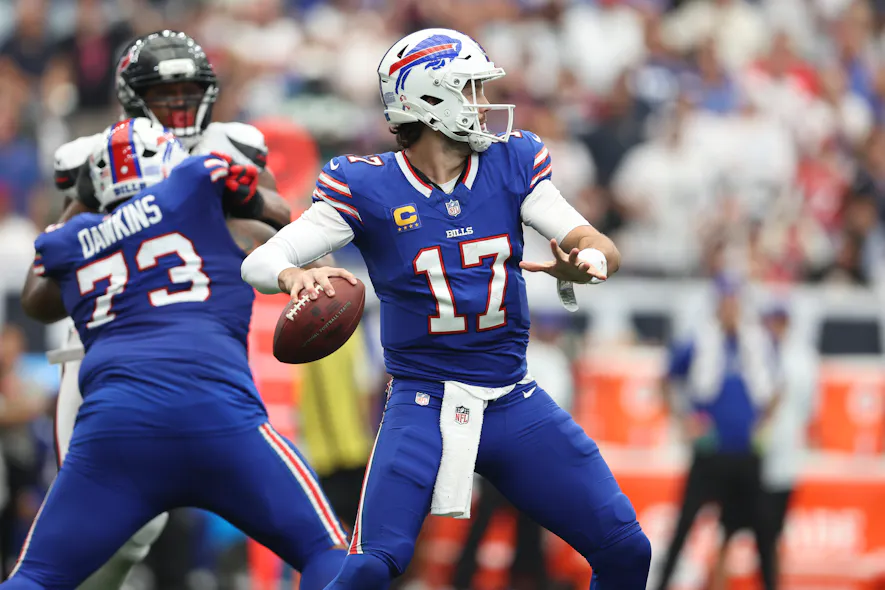
- Josh Allen and the Bills were completely stymied in Houston last year before turning around their offensive narrative; this opening week, Allen dropped 334 passing yards and four total touchdowns on that same Houston defense.
- Amon-Ra St. Brown managed just 13 yards in a previous season opener before dropping 115 receptions, 1,263 yards, and 12 touchdowns on the year.
- Chase Brown had just 11 rushing yards on three carries in his initial Week 1 action before exploding for nearly 1,000 rushing yards and 11 total touchdowns.
- Drake London started a past campaign with two catches for 15 yards and ended up with a 100-reception, 1,271-yard season.
- Jaxon Smith-Njigba hauled in only two passes in his career Week 1 debut before going on to notch 100 catches.
In reality, Week 1 is one of 18 weeks of the NFL regular season. It stands out because it's the first game, and we're all watching with bated breath to get clarity across the league. Some performances signal what's to come, but others are an anomaly. It's a small sample size, but we think we can predict the future from one week. How do you know the difference?
There are more wide receivers on the field than players at any other position. This means more receivers have a chance to rank high, but more receivers also have a chance to rank lower. Don't overreact, especially when it comes to pass catchers.
Here is a list of ten factors you should consider to understand a player's fantasy value when looking ahead to the rest of the season:
1. Observe snap counts and snap percentages. How often were they on the field? Footballguys displays offense and defense snap count numbers every week.
2. Examine the depth chart around them. Is there a clear opening for this player to thrive moving forward?
3. What are coaches saying about their players? AI tools can help surface local beat notes quickly. Try asking this question: What did Kyle Shanahan say about Deebo Samuel Sr. after his 2026 Week 1 performance? Do the same for other coaches and players. AI can be a fickle beast, but it's getting much better, and quotes from coaches are usually spot on and easy to find this way.
4. Did an injury open the door for more involvement? Check the Footballguys Injury Articles for full recovery breakdowns.
5. Was a particular matchup the main reason for their success or failure? Was Cleveland's defense that bad or was Jacksonville's offense that good? Why did Josh Allen have success vs. Houston's stout defense? Houston's front seven was strong, but they repeatedly played single coverage on the outside, and Allen took advantage with a 43-yard touchdown strike to DJ Moore and a 46-yard defensive pass interference call. He also exploited zone voids in the middle of the field, allowing Dalton Kincaid to find open seams. Houston will likely make some changes, but kudos to Allen and staff for finding what worked.
6. Did their points come in garbage time? Will this be a commonality with their team's script? Rookie Denzel Boston hauled in a beautiful 46-yard fourth-quarter touchdown pass from Deshaun Watson and finished with 2 receptions for 59 yards and Cleveland's only touchdown of the game. You could argue Carolina spent the entire fourth quarter racking up yards after losing a 31-31 score, which quickly became 52-31 and eventually 59-38. A good percentage of Bryce Young's 361 yards came when the game was out of hand. The same can be said for Jonathan Taylor. A significant portion of Taylor's volume and his second goal-line score arrived in the second half while Baltimore played conservative defense up by three scores. While New Orleans eventually mounted a real comeback to push Detroit into overtime, their volume was dictated by garbage-time theatrics after falling behind 21–0 early.
7. Did their production come from one or two big plays? Zay Flowers had a 75-yard touchdown catch-and-run and also had another 40+ yard reception in double coverage. He left in the second quarter with a hamstring injury and could've had a huge week if he'd stayed in the game. Denzel Boston (previously mentioned) had one big play, the 46-yard touchdown in the fourth quarter. Adonai Mitchell (NYJ) had three receptions for 60 yards on three targets with one big 38-yard play.
8. How many red-zone targets did they have? Check team red-zone summaries.
9. What was their target share % compared to the rest of the team? Some notable target share numbers:
The Good
- Bijan Robinson (RB, ATL) - 52.6%
An incredibly high number, especially for a running back. This was mainly indicative of Cooper Rush's hesitancy to throw downfield. - Jaxon Smith-Njigba (WR, SEA) - 45.8%
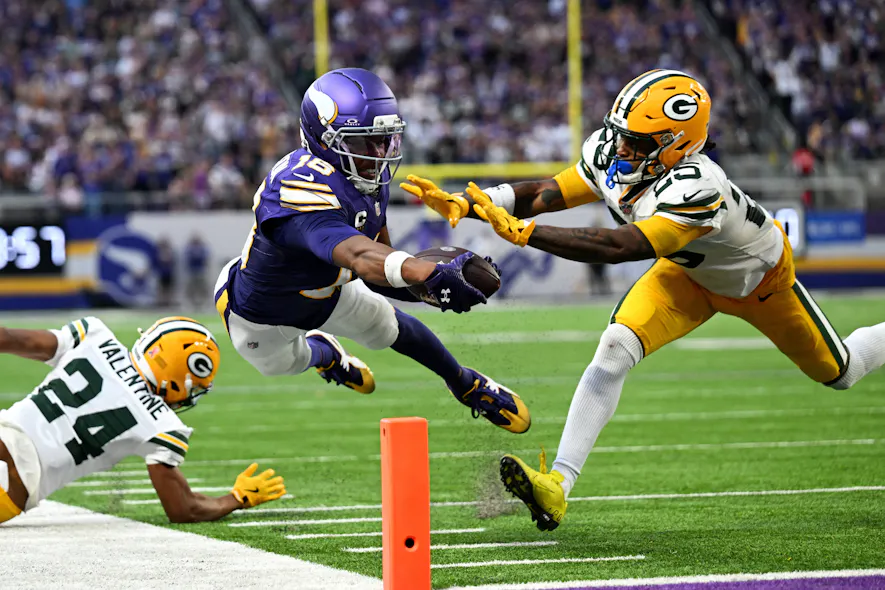
He picked up where he left off - still the most dominant player on the team. - Justin Jefferson (WR, MIN) - 39.1%
Minnesota clearly wants Jefferson to be the most targeted receiver, and so far, he's showing why. - Amon-Ra St. Brown (WR, DET) - 35.9%
Detroit's top receiver by far. - Trey McBride (TE, ARI) - 35.1%
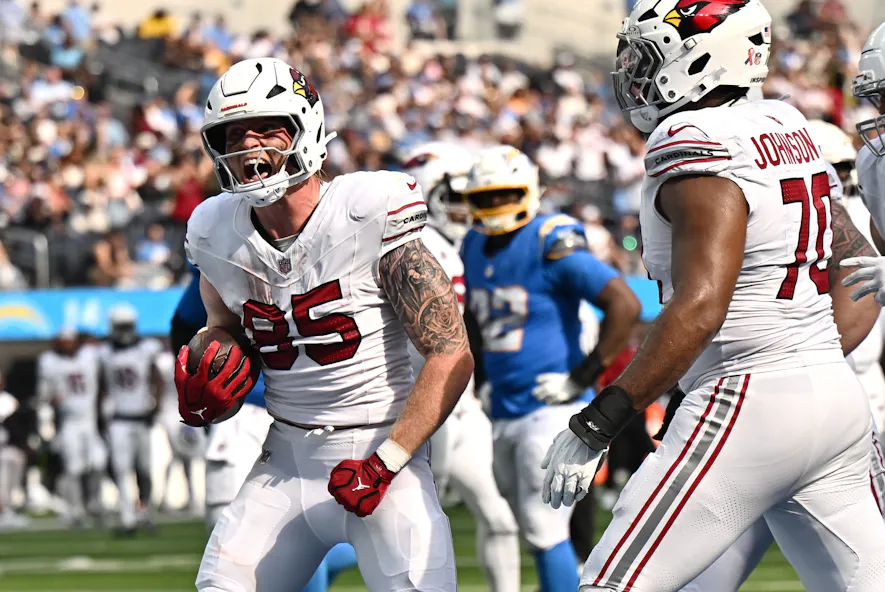
9 receptions on 13 targets for 95 yards shows that McBride is the focal point of the passing game. This is good to know with a new coach and regime. - Kalif Raymond (WR, CHI) - 34.6%
This was a surprise, but he knows Ben Johnson's offense from his Detroit days. With Rome Odunze nursing a calf injury, Raymond produced when called upon, and the offense shined vs Carolina. - Puka Nacua (WR, LAR) - 33.3%
Typical numbers from Nacua, Matthew Stafford's top target. - Malik Nabers (WR, NYG) - 31.0%
His confidence in his knee is going to grow with each play and success he has. - Stefon Diggs (WR, WAS) - 31.0%
Nine targets led the team, but he only had 4 receptions for 55 yards. He did score, though. - Isaiah Likely (TE, NYG) - 30.8%
In his Giants debut, Likely immediately became Jaxson Dart's top safety valve. He had 8 targets (catching all 8 for 78 yards and 2 touchdowns), taking over the middle of the field while Malik Nabers drew bracket coverage. This is something the Giants may exploit all season as long as Nabers is active. - Matthew Golden (WR, GB) - 30.0%
Christian Watson had the glory (two scores), but Golden led the team with 12 targets. His time is coming. - Parker Washington (WR, JAC) - 28.5%
He looks to be the Jaguars' top receiving threat, but six targets to lead the team isn't that strong of an argument. - Jalen Coker (WR, CAR) - 28.1%
While Chicago blew the game open late, Coker established himself as Bryce Young’s preferred downfield option, turning 9 targets into 8 receptions, 138 yards, and 2 touchdowns. Tetairoa McMillan also came on later in the game, but Young kept turning to Coker throughout the entire game. - Caleb Douglas (WR, MIA) - 25.0%
The rookie receiver stepped straight into a starting role on the outside and had a quarter of Miami's pass attempts, turning 7 targets into 5 catches for 94 yards.
The Bad
- Ja'Marr Chase (WR, CIN) - 11.7%
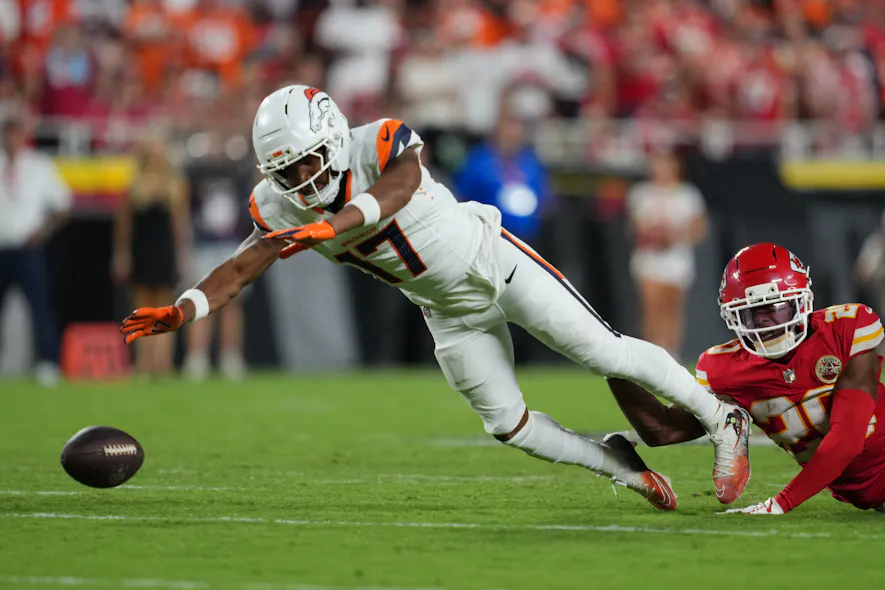
Tampa Bay double-bracketed Chase all game, holding him to just 4 targets and 2 catches for 12 yards. He'll bounce back, but other teams may try this method. - Jaylen Waddle (WR, DEN) - 11.1%
No Broncos player had more than four receptions in a horrible week for offense against Kansas City. Pat Bryant, Evan Engram, Courtland Sutton, and RJ Harvey had more targets than Waddle this week. Expect a bounce back and chalk this up as a Week 1 anomaly. - Colston Loveland (TE, CHI)
In a week where Chicago scored 59 points, Loveland was held without a reception. He ran 35 routes and was targeted only twice. The Bears offense is projected to be one of the league's better offenses. Don't look too deep into this. - Michael Pittman Jr (WR, PIT) - 8.1%
He caught all three of his targets for 58 yards, but DK Metcalf's 10 targets far outweighed him, despite only catching four of those for 40 yards. Pittman also ran 39 routes but had only those three targets. - Marvin Harrison Jr. (WR, ARI) - 8.1%
He caught one pass for 33 yards on three targets and ran 34 routes. - Rashee Rice (WR, KC) - 8.0%
He had two receptions on two targets for 19 yards, including a touchdown, but this week it was all about Ken Walker III running the ball and exploiting a surprisingly weak Denver run defense. No Chiefs player had more than three receptions.
10. Was their fantasy production touchdown-dependent, or were they consistent throughout the game? The following players all scored a touchdown with 4 targets or less. Elic Ayomanor (TEN), Jack Bech (LV), Denzel Boston (CLE), Josh Cameron (JAC), Cole Kmet (CHI), Jakobi Meyers (JAC), Joshua Palmer (BUF), Eli Raridon (NE), Rashee Rice (KC), Demarcus Robinson (SF), Brenton Strange (JAC), Jahdae Walker (CHI), Dontayvion Wicks (PHI), Antonio Williams (WAS)