
The key to Week 2 FanDuel GPP success is accounting for what happened in Week 1 without veering too far into the trap of “chasing points.” We have to aggressively update our offseason assumptions about team quality and usage only where warranted.
Injuries will also play a big role in deciding who to play on this slate. Nico Collins, Zay Flowers, Brock Bowers, and Chig Okonkwo are out, three teams will start a backup quarterback (Cooper Rush in Atlanta, Carson Wentz in Minnesota, and Drew Lock in Seattle), and Ladd McConkey and Chris Olave carry questionable tags into Sunday. McConkey seems like he could legitimately go either way. For now, I am projecting him as in, which makes it tough to play Quentin Johnston or Tre' Harris, but both would be very solid options if McConkey is confirmed out sometime in the next 24 hours (this article was completed Saturday morning).
Every number in this article comes from my own weekly projections, which are built on a simulation of every game on the slate run ten thousand times. The simulation also solves the best possible FanDuel lineup in each of those ten thousand worlds, and how often a player lands in that best lineup is his optimal percentage. For tournaments, the key is comparing that number to our percent rostered projections, which Devin Knotts assembles each week. When the field is on a player far more often than he shows up in the optimal lineups, he is over-owned relative to what the numbers say, and when the reverse is true, he is a leverage play.
At each position, I will show you which players are expected to be the most popular (the chalk), with the ones I think are worth going heavy on at that elevated ownership marked as good chalk, and then a list of other targets who are flying a little further under the radar and whom my process likes more than the field does.
Slate Overview
Before diving into the individual plays, let's get a big-picture view of the slate. The table below shows each team's implied total and how it compares to my season projection for that offense, along with two numbers that frame everything that follows. The first is how often that team's players show up in the optimal lineups across the ten thousand simulations, and the second is how often we project them to show up on the field's rosters. When a team's players fill more of the optimal lineups than the field is projected to roster them, our competition is probably overlooking that offense, and when the reverse is true, the field is probably overplaying it. That gap is the quickest way to see where to be over the field this week and where to be under it.
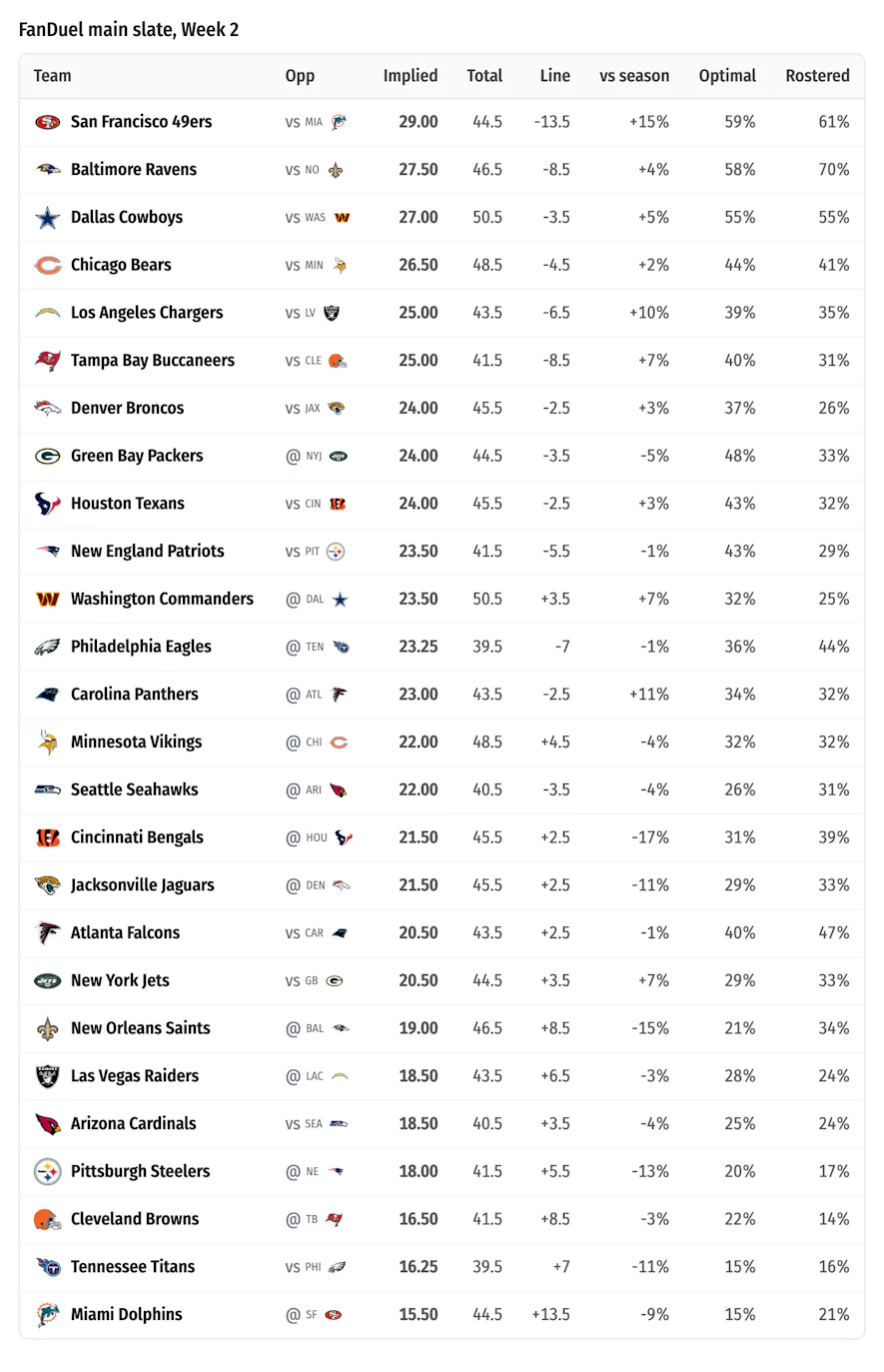
This is a 13-game main slate with no byes, so there are more viable players than at almost any other point in the season, but only six teams carry an implied total of 25 or more, and those six offenses will decide most tournaments.
San Francisco 49ers, 29.0
The 49ers are 13.5-point home favorites against Miami with the highest implied total on the board. The field has noticed. San Francisco players fill about 61 percent of the field's projected roster spots against 58 percent of the optimal lineups, so this is a spot where the simulation and the field mostly agree on the offense and disagree on how to buy it. Christian McCaffrey lands in the optimal lineups at almost exactly his 21 percent projected ownership, Brock Purdy is over-rostered at 11.5 percent for a quarterback who shows up in 7.5 percent of the best lineups, and Mike Evans and the 49ers defense are the two pieces the field is projected to be underweight on. The obvious risk in a game with a 13.5-point spread is that the starters sit for the fourth quarter, and that shows up in the simulation as a fat left tail for McCaffrey and Purdy rather than a lower projection. Those risk factors are more of an issue in cash games. In GPPs, we care more about the high end of the distribution, and those numbers look very good for the top 49ers weapons. I am especially interested in Evans as a contrarian play who may go overlooked because his salary is tough to fit in.
Baltimore Ravens, 27.5
Baltimore is the offense the field is most heavily invested in, and after Friday it is even heavier than the table shows. Ravens players fill about 70 percent of the field's projected roster spots against 58 percent of the optimal lineups. Derrick Henry at 29 percent rostered is the second-most popular player on the slate after Bijan Robinson, Lamar Jackson is the co-most popular quarterback, and the Baltimore defense is the third-most popular unit. The one Raven the simulation wants more of than the field does is Mark Andrews, and with Flowers and Ja'Kobi Lane both out, he is the piece of this offense I want to be over the field on. It is worth noting that, despite his obvious rushing upside, Lamar Jackson usually hits his fantasy ceiling not when he is extra productive with his legs but when he throws for four or more touchdowns. I’d avoid playing him “naked” and try to add a bargain stacking option in GPPs this week.
Dallas Cowboys, 27.0, and Washington Commanders, 23.5
Dallas at home against Washington carries the highest total on the slate at 50.5, and the two offenses are treated very differently by the field. The Cowboys are priced fairly, with their players filling about 55 percent of both the optimal lineups and the field's rosters. Dak Prescott is the quarterback the simulation likes most, landing in 10.5 percent of the optimal lineups against 8 percent rostered, George Pickens is under-rostered at just under 10 percent, and CeeDee Lamb and Javonte Williams are each a couple of points over. Washington is the side the field is lighter on, with a 6-point gap in our favor built on Jayden Daniels, Terry McLaurin, and Jacory Croskey-Merritt.
Chicago Bears, 26.5
Chicago's implied total against a good Minnesota defense is the number that jumps off the page for the second straight week, and the field is a touch under the simulation on the Bears as a whole. Caleb Williams is priced exactly right at about 6 percent, and Luther Burden III and Colston Loveland are both fairly popular for their price. That being said, I do think the narrative angle favors Loveland. Teams make a concerted effort to get the ball to key players who were underutilized the week before, and I think Ben Johnson and Caleb Williams will make sure Loveland gets his in Week 2.
Green Bay Packers, 24.0
Green Bay is where the field is furthest from the simulation in our favor. Packers players fill about 48 percent of the optimal lineups against 33 percent of the field's projected rosters, a 14-point gap that is the widest on the slate. Tucker Kraft accounts for most of it at 12 percent optimal against under 5 percent rostered, but Jordan Love, Matthew Golden, and Christian Watson all show up more often in the best lineups than the field will play them. I modeled this game as if the Packers are going to be faster-paced and more pass-heavy than most other projectors expect. This is a spot where I want to be aggressive in adjusting assumptions about teams after Week 1, and I believe this offense without Josh Jacobs looks much different from the Green Bay offense we’ve seen in 2024 and 2025.
New England Patriots, 23.5
The Patriots are the other offense the field is badly under on, at 43 percent of the optimal lineups against 29 percent of the field's rosters. A.J. Brown is on injured reserve, which concentrates the passing game on Romeo Doubs and Hunter Henry, and Drake Maye is the single biggest leverage play at quarterback at 8 percent optimal against 3 percent rostered. This is a spot where I think the field may be over-indexing on what happened in Week 1 in a primetime game everyone watched. This may be a very good offense that simply ran into a buzzsaw of a defense in one of the toughest stadiums to play in last week. This is a clear bounce-back spot.
Tampa Bay Buccaneers, 25.0
Tampa Bay at home against Cleveland is in a great spot, and the field is 9 points light on the Buccaneers as a whole. Emeka Egbuka is in nearly 10 percent of the optimal lineups against 5 percent rostered, and the Tampa Bay defense against a Cleveland offense with a 16.5 implied total is the most common defense in the optimal lineups at 8 percent, while the field is on it under 4 percent. One key player to keep an eye on Sunday in the hours leading up to kickoff is Sean Tucker. If he is inactive, you have to feel confident in Bucky Irving getting the goal-line work, which significantly increases his chances of having a ceiling game in what looks like it could be a fantastic game script.
Los Angeles Chargers, 25.0
The Chargers are 10 percent above their season number at home against Las Vegas, and the field is slightly under them. Justin Herbert is good chalk at 5.6 percent rostered, and Omarion Hampton shows up in 11 percent of the optimal lineups against 8 percent rostered. The complication is McConkey, who practiced on a limited basis Friday after sitting out Wednesday and Thursday and is questionable with a rib injury. I have him at 55 percent to play with reduced usage if he does, which is why he lands in only 6 percent of the optimal lineups against nearly 12 percent projected rostered. Week 1 was a disaster for this offense, and I am unsure whether that was a preview of what is to come or a game we eventually look back on as a weird outlier.
Quarterbacks
Continue reading this content with a ELITE subscription.
An ELITE subscription is required to access content for DFS leagues. If this league is not a DFS league, you can edit your leagues here.